
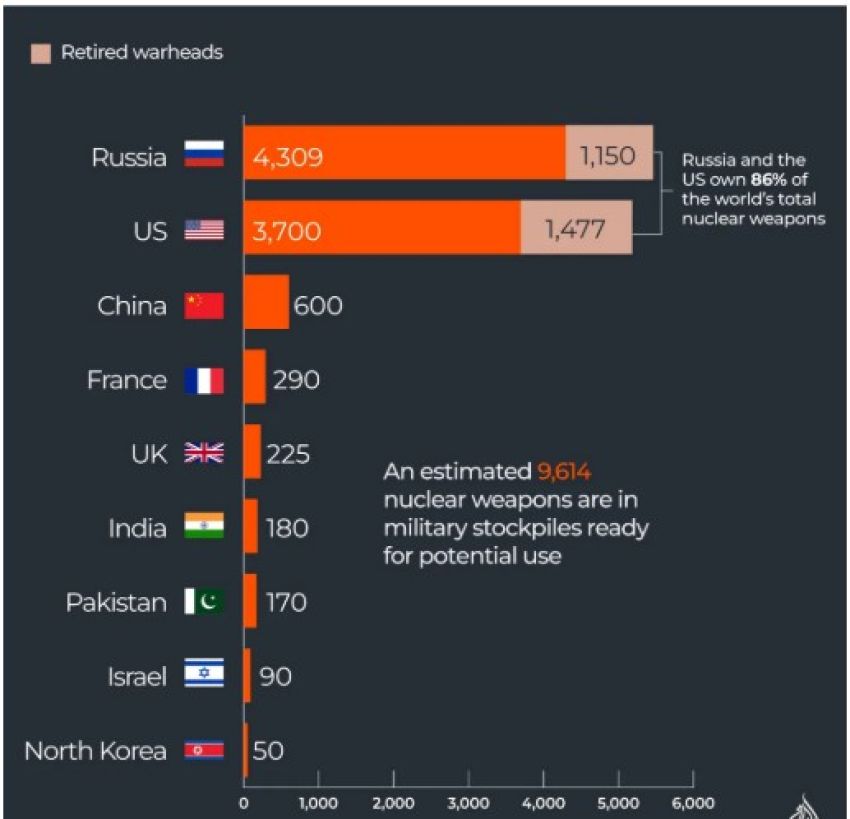
Nuclear weapons have made the world safe for hypocrisy and unsafe in every other respect. Linking the states that are permitted to have nuclear weapons and those that do not is the Treaty on the Non-Proliferation of Nuclear Weapons (NPT).
For decades, the nuclear club has dangled an unfulfilled promise to eventually disarm their arsenals by encouraging non-nuclear weapons states to pursue peaceful uses of the atom.
With preference given over to developing ever more ingenious and idiotic ways of incinerating humans and animal life, it is little wonder that some countries have sought admission to the club via the backdoor, thereby avoiding the NPT.
North Korea is the unabashed example, alongside Israel, which remains coy about its possession of nuclear weapons. Meanwhile, Iran has been lectured and bombed into compliance for its own nuclear ambitions.
United States President Donald Trump has instructed his Department of War to resume nuclear testing.
Trump declared that “Because of other countries testing programs, I have instructed the Department of War to start testing our Nuclear Weapons on an equal basis. That process will begin immediately.”
Strictly speaking, North Korea remains the black sheep of an otherwise unprincipled flock to consistently test nuclear weapons since the late 1990s, while 187 states have added signatures to the Comprehensive Test Ban Treaty.
Trump also asserted, unreliably, that the US had a nuclear weapons inventory larger than that of any other state, something, he said, was “accomplished” through “a complete update and renovation of existing weapons” during his first term.
The announcement caused controversy. “For both technical and political reasons,” said Heather Williams, director of the Project on Nuclear Issues and a senior fellow in the Defense and Security Department at the Center for Strategic and International Studies, “the United States is unlikely to return to nuclear explosive testing any time soon”.
She did concede that Trump’s post pointed “to increasing nuclear competition between the United States, Russia, and China”. Whatever the bluster, and however many bipartisan calls to do so, the current administration had been “slow to seriously invest in this nuclear competition”.
This is telling. Williams did not seek to criticise the resumption of a type of testing — the explosive, high-yield variety — but rather chide Trump for not taking a serious interest in joining the great game of nuclear modernisation with other powers.
“Nuclear testing is not the best step forward in that competition, but it should raise alarm within the administration about the state of the United States’ nuclear enterprise and the urgency of investing in nuclear modernization,” Williams said.
And there you have it.
Rebeccah Heinrichs, of the Hudson Institute, took the same approach. Trump might have meant, she wrote in the Wall Street Journal, “conducting flight tests of delivery systems”. Maybe he was referring to explosive yield-producing tests. And those Russians and Chinese were not behaving in terms of keeping their nuclear arsenals inert.
Heinrichs, a nuclear hawk, is unequivocal about what the administration should do. “Whatever Mr. Trump means by ‘testing,’ the US should work urgently to improve and adapt its nuclear deterrent. To do this, Mr. Trump should let the last arms-control treaty between the US and Russia — the New Strategic Arms Reduction Treaty, or New Start — expire in February.”
Other commentators expressed their concern. Tilman Ruff, affiliated with the International Physicians for the Prevention of Nuclear War, said in the Conversation: “If Trump is referring to the resumption of explosive nuclear testing, this would be an extremely unfortunate, regrettable step by the United States.
“It would almost inevitably be followed by tit-for-tat reciprocal announcements by other nuclear-armed states, particularly Russia and China, and cement an accelerating arms race that puts us all in great jeopardy.”
Ruff points out the obvious dangers of such a resumption: The risks of global radioactive fallout; the risk, even if the tests were conducted underground, of “the possible release and venting of radioactive materials, as well as the potential leakage into groundwater.”
Others appealed to facts. “Nothing [in the announcement] is correct,” said Tom Nichols from the Atlantic. “Trump did not create a larger stockpile by ‘updating’ in his first term. No nation except North Korea has tested nuclear weapons since the 1990s.”
At the New York Times, WJ Hennigan took some relish in pointing out that the province of nuclear testing lay, not with the Pentagon, but the energy department. But then came the jitters. “The president’s ambiguity is worrisome not only because America’s public can’t know what he means, but because America’s adversaries don’t.”
The problem goes deeper than that. Hennigan admits that the breaking of the moratorium on nuclear testing is always lurking around the corner. The US, for instance, is constructing the means of conducting “subcritical nuclear tests, or underground experiments that test nuclear components of a war head but stops short of creating a nuclear chain reaction, and therefore, a full weapons test”.
Even if Trump’s announcement was to be taken seriously — and there is much to suggest that it was one of his moments of loose thinking — the dangers of any resumption of full testing will only marginally endanger the planet more than matters stand.
The nuclear club, with its Armageddon fanciers and Doomsday flirters, is determined to keep the world in permanent danger. An arms race is already taking place, however euphemised it might be.
[Binoy Kampmark lectures at RMIT University.]