Rio Tinto has said it is not prepared to keep Australia’s largest aluminium smelter operating at Tomago, allegedly due to the high cost of energy.
The smelter, north of Muloobinba/Newcastle, employs more than 1000 people whose labour produces almost 40% of the national annual aluminium output. It is also the largest single user of electricity, which accounts for more than 40% of its current operating costs.
Rio Tinto said on October 28 that energy prices — for coal-fired and renewable energy — were its “central challenge”. It said it could not see a way of being “commercially viable” — in other words, it could not see a way of making enough of a profit beyond 2028, when its 18-year contract with AGL (initially signed with the then state-owned Macquarie Generation) expires.
The shock announcement came three months after Norwegian oil industry-backed company Equinor said it would no longer develop the 5-gigawatt Hunter offshore wind farm, despite its popularity and the backing of unions, Hunter Jobs Alliance, Rising Tide and Rio Tinto.
The Liberals, Pauline Hanson’s One Nation and the Murdoch media had campaigned against the wind project, as part of their broader war on climate action.
Equinor’s decision would have influenced Rio Tinto, but the giant corporation is also probably fishing for federal — that is, public — subsidies to stay open.
Opponents of the Hunter offshore wind project are, hypocritically, blaming renewables and net zero for the smelter’s looming closure.
Wind blows more strongly and consistently at sea, so despite being more expensive to build, offshore wind farms produce far more power than onshore equivalents.
Some offshore wind farms produce at full output 60% of the time, which makes their electricity output comparable to a coal-fired power station.
China is the world leader in offshore wind. It is also leading in the manufacture and installation of conventional onshore wind farms, as well as solar panels and electric vehicles.
It would make sense for NSW and federal Labor to demand Rio Tinto open its books, so that the public can see what it means by being “commercially viable”.
Given the need for these jobs and the product, the federal government should compulsorily acquire Tomago and build the Hunter offshore wind park. This would save jobs and ensure that the huge amounts of energy used by the smelter come from sustainable sources.
Labor could instruct the NSW-owned Snowy Hydro authority to run the project in the same way that former Coalition Prime Minister Scott Morrison instructed the agency to build the Kurri Kurri gas power plant. But it is unlikely to intervene to keep the smelter and its offshore wind engine replacement alive.
This is a symptom of a bigger problem facing the climate movement. With energy companies in private hands, the transition to renewables has been slowed down to suit their profits-first agenda. Also, private companies tend to rip off workers’ pay and conditions simply because they can.
This is why trade unionists and community organisations mobilised to support the Hunter offshore wind farm, which would have provided employment and skills training for workers exiting the coal industry.
According to the Hunter Jobs Alliance, the value of Australia’s fossil fuel exports could fall by nearly 50% by 2030. Other analysis suggests a 70–97% drop in coal demand by 2035.
Labor can be pushed to intervene and repower Tomago if enough unionists and community organisations demand it. We know from experience that the dying coal industry will not simply say goodbye — it wants to reap every last dollar in export income, and its friends in parliament are happy to oblige.
The only serious way of tackling climate change is if energy is placed back into public hands, so that the sustainable energy transition can start in earnest, not in the piecemeal way it has for the past 20 years.
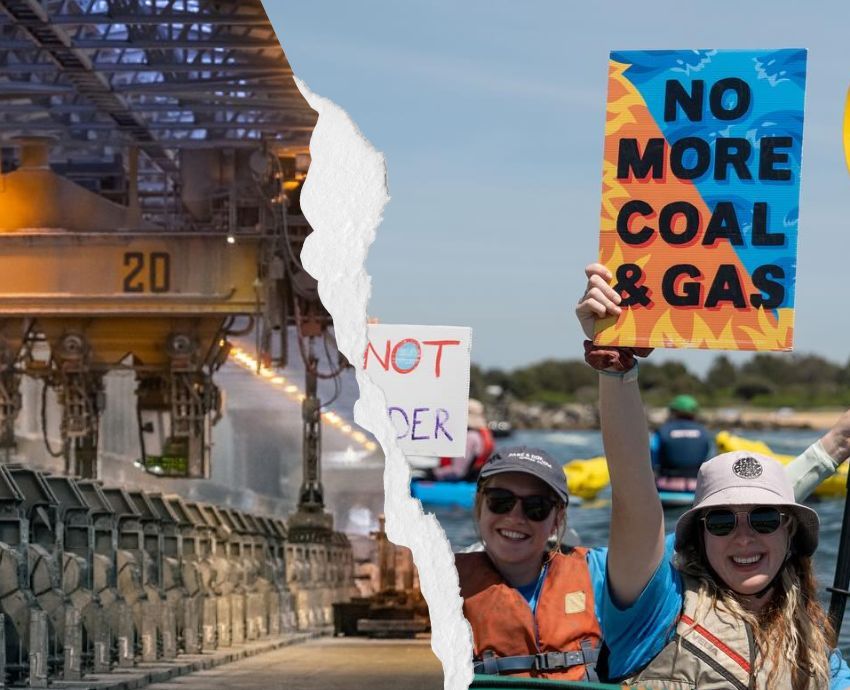
However, the only way the state will step in is if unions, communities and climate organisations force it to. That’s why everyone should join Rising Tide’s mass blockade of the world’s biggest coal port in Muloobinba at the end of the month.
Green Left has supported and promoted this mass climate protest since the early 2000s, and we are proud to be supporting this year’s protest-ival. Look for us on the beach and in the water. And if you agree with the need for new politics that puts people and the planet before profits, become a supporter.
[Zane Alcorn is a long-term climate and Socialist Alliance activist.]