A Rose Loupt Oot
Edited by David Betteridge
Smokestack Books 2011
£8.95, 64 pages
www.smokestack-books.co.uk
Last year marked the 40th anniversary of the work-in Upper Clyde Shipbuilders (UCS) in 1971, a campaign by Scottish workers that resulted in the reversal of the Conservative government’s decision to close down a number of shipyards on the River Clyde in Glasgow.
A Rose Loupt Oot is a collection of poems, songs and artwork marking the anniversary.
-
-
"This is a bittersweet victory for nurses and midwives after an unprecedented industrial marathon with the Baillieu Government to protect patient care and secure a fair pay rise.” — Lisa Fitzpatrick, State Secretary, Australian Nursing Federation (Victoria). The Australian Nursing Federation (ANF) of Victoria has had a good win. At a time when the employers are on the march, the Victorian ANF ran a campaign that involved two periods of industrial action, including bed closures, elective surgery cancellations and four hour rolling stoppages twice a day. -
Mental health workers voted to escalate industrial action in two weeks unless Ted Baillieu's Coalition government begins to seriously negotiate with their union. The Health and Community Services Union (HACSU) covers psychiatric nurses, social workers, occupational therapists, psychologists and support staff. The Australian Nursing Federation covers some mental health nurses as well. -
About 120 unionists and supporters rallied outside the New Zealand Consulate in Sydney on March 19 in solidarity with 292 Auckland wharfies who were sacked for being members of the Maritime Union of New Zealand. The rally was organised by the Maritime Union of Australia (MUA). It called on the NZ government to pressure the Auckland Council, which owns Auckland port, to immediately reinstate the workers. -
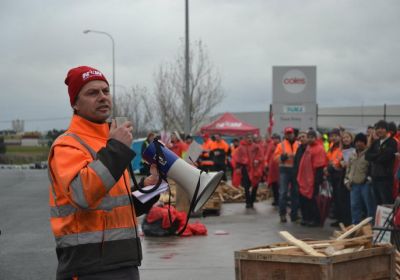
After three weeks of action, warehouse workers at the Sigma pharmaceutical Melbourne plant returned to work on March 21. Workers fended off attempts by the company to abolish afternoon and night shift loadings. They also won a 4% pay rise. The workers, members of the National Union of Workers at the Rowville plant in Melbourne’s south-eastern suburbs, had rarely been on strike.
-
The New South Wales Liberal government said on March 11 that it planned to force schools to bear the responsibility for its latest funding cuts. The government did not consult the NSW Teachers Federation (NSWTF) before releasing the “Local Schools, Local Decisions” and “Empowering Local Schools” initiatives, which it claimed would deliver “autonomy” to local public schools. In reality, the move is a smokescreen that forces public school principals to implement the government cuts of $250 million a year. -
One of my first jobs as a junior reporter was to meet flights bringing famous people to Australia. Growing up in a country far from everywhere (except, as my father would say, "where you come from"), I was led to believe that Australia's honour was at risk unless a well-known person from Over There said something flattering about us, preferably the moment they arrived at Sydney airport. -
Women workers in the United States are attacking low pay and bias from many angles, assailing wage laws that exclude them, suing over outright discrimination and trying to organise unions. And they’ve been confronting the disrespect that accompanies smaller paychecks. The pay gap between men and women in the US actually shrank in 2011. Women now average 82.2% of men’s earnings ― but the numbers don’t indicate progress because all workers lost buying power. -
Community workers were granted long-awaited pay rises in a historic decision by Fair Work Australia on February 1. Before this decision, the 16 previous equal pay cases tried to improve pay for sectors that employ mostly women, such as the community services sector. Every case failed. The Australian Services Union waged a determined and ultimately successful campaign. This decision will give wage rises from 23-45% to youth support, disability, refuge, family support and social workers, and also clerical and administrative staff. -
Victorian nurses crowded into Festival Hall in Melbourne on March 16 to hear their nine months of struggle had reached a successful outcome. After what the ABC said was Victoria’s longest running industrial dispute, nurses have won 14-21% pay increases and kept their nurse-to-patient ratios in return for minor productivity offsets. Australian Nursing Federation (ANF) secretary Lisa Fitzpatrick said: “This is a bittersweet victory for nurses and midwives after an unprecedented industrial marathon with the Baillieu government to protect patient care and secure a fair pay rise." -
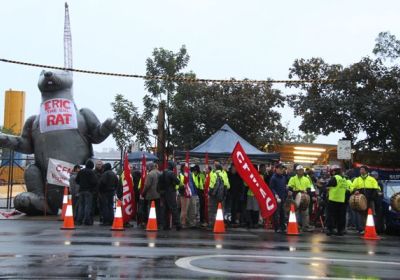
Another company is following in the footsteps of Qantas by locking out its workers from March 5 to 14. Sigma, a company that distributes pharmacy products to wholesale and retail customers, locked out 150 workers in an attempt to intimidate them into ceasing all industrial action. The workers are members of the National Union of Workers. The workers walked off the job for 48 hours on February 23 after Sigma management told them that it would cut night-time shift loadings. Workers at both the company’s sites at Rowville in Melbourne and Shepparton walked off.
-
The Occupy Wall Street movement, which began in New York in September last year and rapidly spread to hundreds of cities and towns across the United States, continues organising against the greed and exploitation of the “1%”. Occupy activists are mobilising against home evictions, supporting workers fighting for their rights and taking action against corporate exploitation and environmental destruction.