In a divestment valued at 256 million euros, the Norwegian government pension fund has blacklisted Australian company Incitec Pivot and the US/Canadian company Potash last year due to their phosphate imports from occupied Western Sahara.
-
-
More than 1000 students protested against the closure of the Jaffna University on December 2, TamilNet said. The university was reopened that day after several weeks of closure. All universities in Sri Lanka had been closed during the Commonwealth Heads of Government Meeting to prevent them being used as organising centres for protests. But in the case of Jaffna University, situated in the predominantly Tamil north of the island, the closure was prolonged to prevent students from marking Heroes Day on November 27.
-
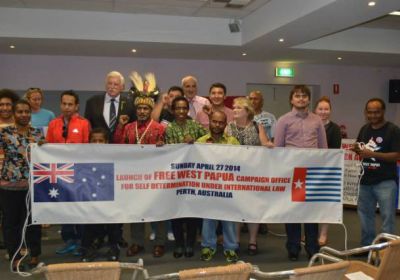
Hundreds of people have been arrested and some killed as Indonesian authorities crack down on events commemorating the declaration of West Papua's independence. On December 1, West Papuans mark the first raising of the Morning Star flag, a symbol of West Papuan independence. On that day in 1961, the flag was raised by the New Guinea Council, the parliament in the then-Dutch colony. Soon after the ceremony, Indonesia invaded West Papua, claiming it was part of its campaign to liberate the Dutch colonies of the East Indies. -
Filep Karma is a 54-year-old West Papuan independence activist and long-term political prisoner. He is in jail for his non-violent political activities in the struggle for West Papuan self-determination. In 2004, Karma organised a Morning Star flag-raising ceremony to celebrate the anniversary of the Papuan declaration of independence from Dutch rule in 1961. -
Young Palestinian prisoner Hassan Abdul-Halim Turabi, who suffered from leukemia, died at the Afula Israeli Hospital aged 22 on the November 5. Turabi was killed by deliberate Israeli medical neglect, after being denied essential treatment. The number of Palestinian prisoners who have died in Israeli jails since 1967 now sits at 205. Turabi was taken prisoner more than 10 months ago. Due to his ill health, Israel said it would release him but did not. When he first started experiencing pain, he asked for medical treatment in the prison clinic and was given painkillers. -
The International Criminal Court (ICC) was established at The Hague in 2002 to investigate and prosecute individuals alleged to have committed war crimes, crimes against humanity and the crime of genocide.
-
The UN General Assembly has voted for the 22nd consecutive year to reject the US embargo, with 188 nations opposed the embargo and three abstentions. Only the US and Israel voted in favour of the continuation of the embargo, which has been in place since 1960. The UN resolution is non-binding. On October 29, Cuba's foreign minister Bruno Rodriguez described the embargo as “extraordinary” and “barbaric”.
-
Anyone in Spain with the slightest understanding of human rights’ law knew that the Grand Chamber (full bench) of the European Court of Human Rights was bound to reject the appeal of the Spanish government over the case of convicted Basque Homeland and Freedom (ETA) prisoner Ines del Rio. For decades, ETA waged an armed struggle for independence for the Basque Country from the Spanish state. In 2011, it declared a “permanent ceasefire”, ending its armed campaign. -
I was introduced to Gazan hip-hop act Revolution Makers when I saw them perform a rare live hip-hop performance in Gaza City during PalFest in May.
-
Few people from the 20th century can really claim to have changed history. One of them was General Vo Nguyen Giap, who led the Vietnamese people to defeat the French and American empires. Giap died on October 4, aged 102. Mainly remembered as a military leader, Giap was also one of Vietnam’s most significant political leaders. He was a revolutionary intellectual, an environmentalist and a campaigner for progressive change within Vietnam. -
The Israeli authorities must drop all charges against a Palestinian human rights lawyer now released on bail, Amnesty International said. A military judge at Ofer Military Court ordered the release of Anas Barghouti on bail because confessions from other detainees submitted as evidence failed to prove he is a security threat. The accusations against him relate to alleged activities from over a year ago.
-
A recent report details genocide against the indigenous people of West Papua carried out by the Indonesian government, which has occupied the territory since the 1960s. The report, “A slow-motion genocide: Indonesian rule in West Papua”, was written by Dr Jim Elmslie and Dr Camellia Webb-Gannon, both visiting scholars at the Centre for Peace and Conflict Studies at Sydney University. It was published in the Griffith Journal of Law and Human Dignity.