
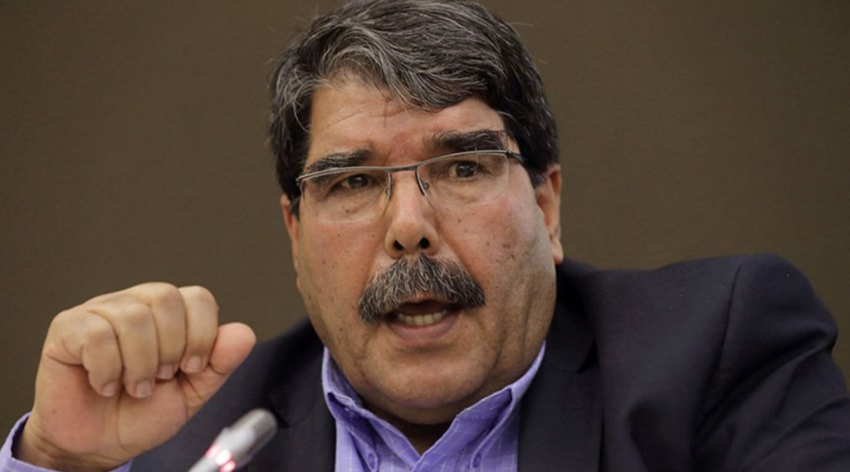
Salih Muslim, one of the key leaders of the Rojava revolution in northeast Syria died on March 11 in Erbil, in the Kurdistan autonomous region in Iraq, where he was being treated for kidney failure.
Muslim, 75, was a founding member of the Democratic Union Party (PYD), a former co-chair and a member of its presidential council at the time of his death.
As one veteran internationalist fighter in the battle for Kobane said, “Salih Muslim gave everything for the people”.
When his son Şervan fell in 2013 defending Girê Spî from Daesh/Islamic State, Şervan’s mother, Ayşe Efendi, did not cry when she saw her son’s body. “My children are no better than the children of the people, after all, when I sent my children to war, I expected such things to happen, that’s why I don’t cry,” she said.
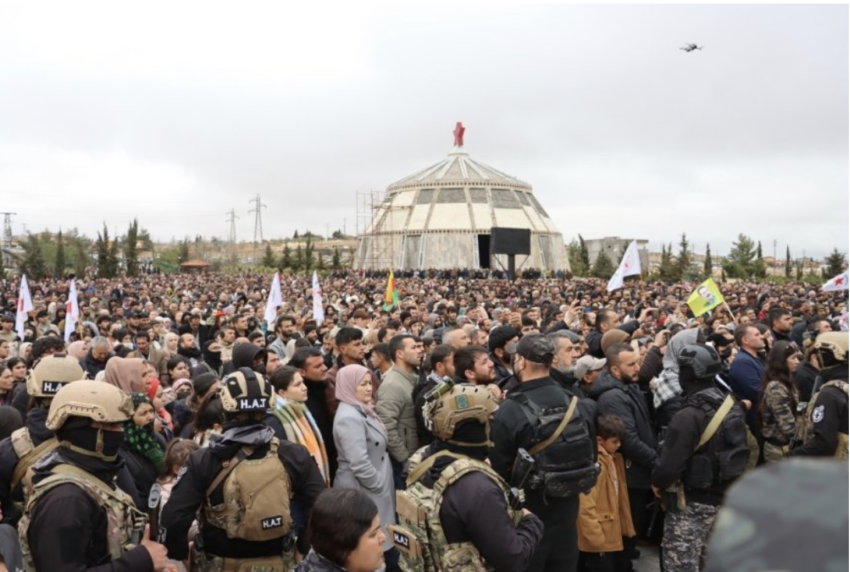
Thousands turned out for Muslim’s funeral in Kobane, where he was born.
Imprisoned Kurdish leader Abdullah Öcalan sent a message of condolence, hailing Muslim as a “cornerstone of Rojava” and “an unextinguished star of both our struggle and our peace”.
“Salih Muslim is part of the political history of Rojava,” Mazloum Abdi, commander-in-chief of the Syrian Democratic Forces (SDF), said at the funeral.
“He fought against the Baath regime and continued his political engagement even under the most difficult conditions. He consistently worked for the unity of Kurdish forces and at the same time carried out significant diplomatic efforts.
“As a leading member of the PYD, he was part of the political movement in Rojava and was also active within the Syrian opposition.
“He is a witness to the political history of Rojava and today a martyr of the Kurdish freedom struggle.”
Green Left interviewed Muslim several times over the past few years. His answers were always frank and humble.
He remained confident in the power of the Rojava revolution, even as it entered a new and difficult phase of the struggle for a democratic Syrian integration, in the wake of brutal attacks on the Democratic Autonomous Administration of North and East Syria by the United States- and Israel-backed Hay'at Tahrir al-Sham regime in Damascus.
The SDF chose to retreat from most of the territory it had liberated from Daesh terror to the Kurdish majority areas on the northern border of Syria — to avoid further bloodshed — and signed a ceasefire agreement with the HTS regime.
While most of the international media predicted that this was the end of the Rojava revolution, the SDF has persisted in implementing the negotiated settlement to preserve key gains of the Rojava revolution.
“Our Rojava will be protected by our own forces. Our schools and education will be in Kurdish,” Muslim told me in our last exchange on February 13.
“Our security will be from our people. The border gates and airport and natural resources will be shared with Damascus. The governance will be by Kurds.”
Millions of Kurds and their allies hope his confidence in the Rojava revolution is rewarded by history.