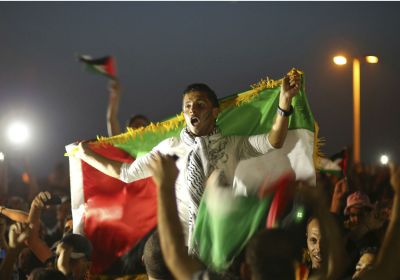
Gaza's Ark, a Palestinian-built protest boat which was preparing to run Israel's naval blockade of the territory, was badly damaged in an explosion on April 29 that organisers blamed on Israel, Alarabiya.net said that day.
-
-
Imagine trying to win public approval for the following scenario: detonate a hydrogen bomb in a remote region of the Pacific that has little contact with the outside world, in meteorological conditions guaranteed to spread radioactive contamination for hundreds of miles, then refuse to evacuate those affected for days finally taking the affected communities to research facilities for extensive and intrusive testing. -
Members of the Irish community and supporters of Irish freedom gathered at the Irish Martyr's memorial Waverley Cemetery in Sydney on April 20 to commemorate the 98th anniversary of the 1916 Easter Rising.
-
-
A new investigation by the Associated Press into a project of the United States government-funded US Agency for International Development (USAID) project to create a Twitter-style social media network in Cuba has received a lot of attention. -
The violent anti-government protests that shook Venezuela in February have again thrust the issue of the pace of change into the broader debate over socialist transformation. Radical Chavistas, reflecting the zeal of the movement’s rank and file, call for a deepening of the “revolutionary process”. Moderate Chavistas favour concessions to avoid an escalation of the violence. -
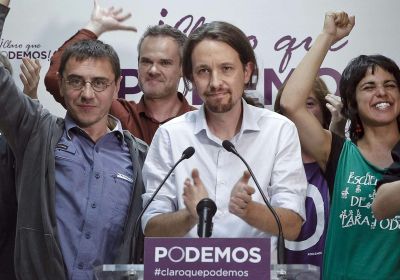
The Spanish congress met in Madrid on April 8 to hear a petition from the parliament of Catalonia: that the power to hold a non-binding referendum on its political future be granted to Catalonia under Section 150 of the Spanish constitution. -
The Venezuelan people have marked the 12th anniversary of the right-wing military coup on April 11, 2002, that briefly ousted former President Hugo Chavez. In an historically unprecedented event, the coup was overturned within 48 hours by a mass uprising of the people and soldiers loyal to the Bolivarian revolution. This year’s anniversary occurs in the context of one of the most intense right-wing destabilisation campaigns since the dramatic days of 2002. -
The United Nations Human Rights Council adopted a US-sponsored resolution on “Promoting reconciliation, accountability and human rights in Sri Lanka” on March 27. But the resolution makes no mention of the plight of the Tamil people. The word “Tamil” does not appear once. The resolution expresses “serious concern at the continuing reports of violations of human rights in Sri Lanka, including sexual and gender-based violence, enforced disappearances, extrajudicial killings, torture and violations of the rights to freedom of expression, association and peaceful assembly”. -
Via Campesina is a global organisation of peasants and one of the largest and most significant international social movements. The statement below in solidarity with Venezuela’s revolution and peasants was released by its International Coordinating Commission of Via Campesina International, which met in Managua, Nicaragua on March 29. *** -
Shuhada Street was the major thoroughfare, and bustling, principle commercial centre, in the Palestinian town of Hebron in the south of the Israeli occupied West Bank. Today, the street is all but deserted, an empty place of boarded-up houses and shuttered shops. On February 25, 1994, a Zionist settler from Kiryat Arba, Baruch Goldstein, shot dead 29 Palestinian civilians and injured 125 more during morning prayers in Hebron's Ibrahimi Mosque. -
The United Nations general assembly voted on March 27 ― with 100 votes for, 11 against and 58 abstentions ― to not recognise the results of the March 16 referendum in Crimea. In the poll, most voted for the territory to leave Ukraine and join Russia. The resolution was put by Ukraine and sponsored by the United States, the European Union and other Western powers, including Australia.