
 More than 1 million people took part in a pro-independence march in Barcelona on September 11, Catalonia's national day.
A year has passed since the British establishment won the September referendum on Scottish independence with a final campaign week of blackmail, dirty tricks and multi-party sworn promises yet to be kept.
More than 1 million people took part in a pro-independence march in Barcelona on September 11, Catalonia's national day.
A year has passed since the British establishment won the September referendum on Scottish independence with a final campaign week of blackmail, dirty tricks and multi-party sworn promises yet to be kept.
-
More than 1 million people took part in a pro-independence march in Barcelona on September 11, Catalonia's national day.
A year has passed since the British establishment won the September referendum on Scottish independence with a final campaign week of blackmail, dirty tricks and multi-party sworn promises yet to be kept.
-
 Vanished: The Mysterious Disappearance Of Mustafa Ouda By Ahmed Masoud Rimal Press, 2015 US$20, 205 pages, pb There is an act of violence in Ahmed Masoud’s Vanished: The Mysterious Disappearance Of Mustafa Ouda that reverberates throughout the novel. An act done in a perfunctory way, described in a short sentence that compels the reader to sit up, if not choke.
 -
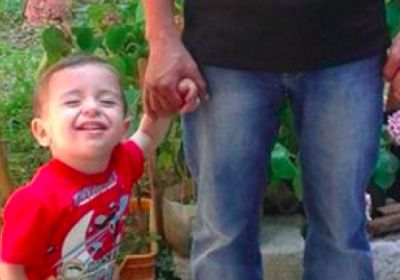 Sometimes the fate of a child is written 100 years before they are born. Some will view this as a reductionist approach or fatalistic, but here we are not talking of a divine fate, we are talking of historical forces, politics, power, hegemony, economic exploitation and colonialism.
 -
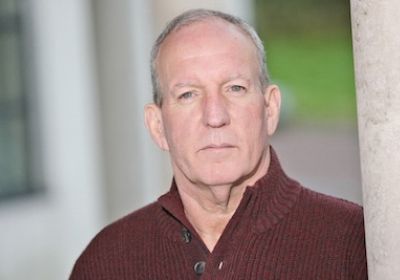 An unusually grave political crisis rocking the power-sharing agreement in Northern Ireland was worsened by the arrest of three top republicans on September 9, Irish Republican News said that day. Those arrested included Bobby Storey, the chairperson of Sinn Fein in the six counties in Ireland's north still claimed by Britain.
 -
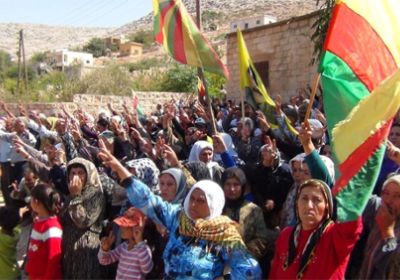 Rojava, the Kurdish-majority liberated zone in northern Syria, is the location of a unique experiment in grassroots, participatory democracy. It is undergoing a profound social revolution that emphasises social and economic equality, ecology, religious tolerance, ethnic inclusion, collectivity combined with individual freedom and, most obviously, feminism.
 -
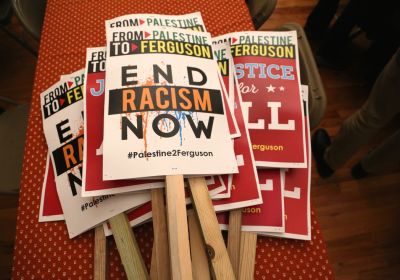 The statement below was released by Palestinian BDS National Committee on August 25. * * *
 -
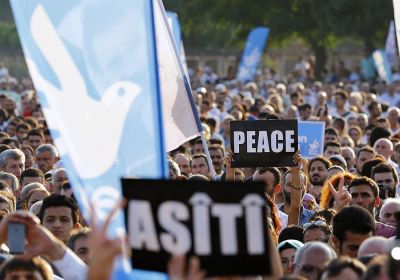 A broad campaign by the left-wing Kurdish-led People's Democratic Party (HDP) won a breakthrough 13.12% and denied President Recep Tayyip Erdogan's Justice and Development Party (AKP) a majority in parliament in the June 7 elections. The HDP's success combined with the ongoing example of the progressive Kurdish-led Rojavan revolution across the border in northern Syria has prompted Erdogan's regime to push a strategy of war and conflict against Turkey's long-oppressed Kurdish population.
 -
 Palestinians in Susiya demonstrate in May against Israel’s plans to destroy the village. Photo: Sarah Levy/Electronic Intifada.
The Palestinian village of Susiya is at imminent risk of demolition. On May 5, Israel’s High Court of Justice refused to grant an interim order to freeze the demolition until the outcome of an appeal brought by villagers to prove the village’s legitimacy.
Palestinians in Susiya demonstrate in May against Israel’s plans to destroy the village. Photo: Sarah Levy/Electronic Intifada.
The Palestinian village of Susiya is at imminent risk of demolition. On May 5, Israel’s High Court of Justice refused to grant an interim order to freeze the demolition until the outcome of an appeal brought by villagers to prove the village’s legitimacy.
-
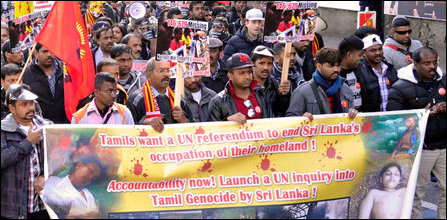 Tamils protest in Geneva to demand a UN investigation into Sri Lankan war crimes. Photo via Tamilnet.
-
 Israeli bulldozers uproot olive trees on Palestinian lands to make way for a separation wall in Beit Jala.
Palestinian farmers have called for international solidarity against ongoing Israeli destruction of their olive groves and livelihoods.
Israeli bulldozers uproot olive trees on Palestinian lands to make way for a separation wall in Beit Jala.
Palestinian farmers have called for international solidarity against ongoing Israeli destruction of their olive groves and livelihoods.
-
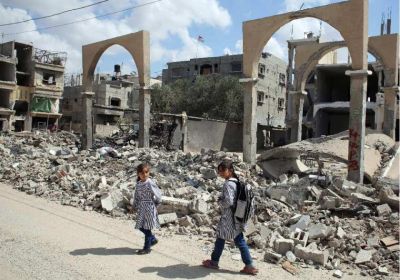
The recent introduction of controversial laws by Israel, including 20-year jail sentences for stone throwers and the authorisation of force-feeding Palestinian prisoners on hunger strike, would worsen an “already-precarious human rights situation”, the United Nations warned on August 19.
-
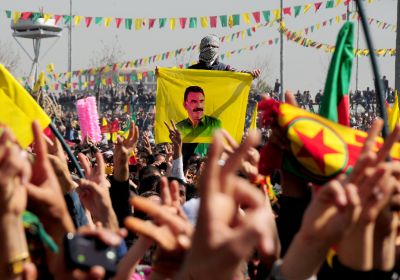 Since Turkish President Recep Tayyip Erdogan's new wave of attacks on North Kurdistan within the Turkish state in the wake of Turkey's June election, people of all ages have joined the effort to defend and govern themselves in the area. Since the 1990s, the Turkish state has used tactics of denial, assimilation and annihilation in the North Kurdistan. Although the promises of peace that the Erdogan's Justice and Development Party (AKP) made when it first came to power awakened hope for many, 13 years later the promises remain unfulfilled.