-
The circus is over. The suits have left Paris after the November 30-December 12 UN climate talks (COP21). There have been millions of words written about the text. But one fact stands out. All the governments of the world have agreed to increase global greenhouse gas emissions every year between now and 2030. Why? Because all the countries have agreed to accept the promises of all the other countries. -
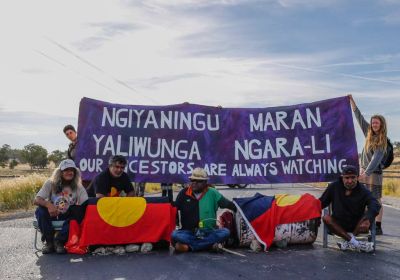
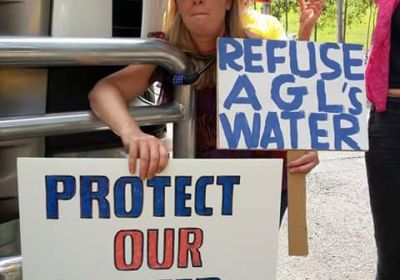
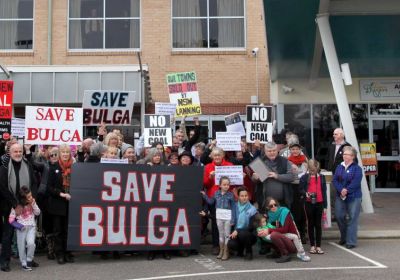
The battle to save land and water in north-west NSW's Liverpool Plains, from coal and coal seam gas continues to be fought by Aboriginal communities, farmers, local councils and environmentalists.
-
Up to 100 people gathered in Wollongong on December 5 to witness the New South Wales government's costly operation to move 25 tonnes of highly radioactive nuclear waste through Port Kembla to the Lucas Heights facility in southern Sydney. After a welcome to country by a prominent traditional land owner and elder, we were addressed by representatives from the Maritime Union of Australia, the South Coast Labour Council and Beyond Nuclear initiative. Overnight and into the early morning, Greenpeace activists on flotillas witnessed the incoming shipment on their flotillas. -
The poorest half of the world suffering the worst impacts of climate change is responsible for just 10% of global carbon emissions, while the richest 10% spew out half of all emissions, says a new report released by Oxfam on December 2. TeleSUR English said that day that the findings of Oxfam's Extreme Carbon Inequality highlight the need for world leaders to heed the calls of social movements and pay attention to the vastly unequal contributions to climate change to craft a deal based on global climate justice. -
Bolivian President Evo Morales has blamed capitalism for environmental destruction during his speech at the opening plenary at the United Nations COP21 climate summit in Paris, France, TeleSUR English said on November 30. Morales called capitalism “the formula that has destroyed our species” and delivered a manifesto to save Mother Earth and life. -
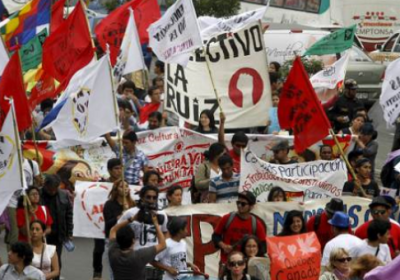
Even with protests banned in Paris ahead of the United Nation's COP21 climate talks, about 2300 climate protests sent a global message to leaders at the talks. Hundreds of thousands of people joined climate change protests, marches and other events around the world on November 29 to send a message to leaders on the eve of COP21 that the world is waiting for climate change action. The 2300 climate actions included 175 countries. -
The campaign against the Perth Freight Link freeway continues to gather momentum with more than 3000 people participating in its contingent at the Fremantle Festival Parade on November 1 and a similar number converging on the Beeliar Wetlands on November 22. The Rethink Perth Freight Link Alliance has now linked 32 organisations opposed to the freeway and in support of alternative transport solutions, including better public transport, more freight on rail and the building of a second container port in Cockburn Sound. -
More than 2000 People's Climate Marches were held over the weekend of November 27 to 29. In Australia more than 140,000 people took to the streets to show they care, passionately, about climate change. They are also angry at government inaction, as illustrated by the many homemade placards and props. These marches were the biggest national anti-government mobilisations for many years. The Melbourne march — a huge 60,000 people — was the biggest street march there since the anti-Work Choices protests of 2005. -
One side event at the COP21 United Nations climate change conference in Paris was the launch of the Fossil-Fuel Subsidy Reform Communique. Almost 40 countries signed onto the statement, which pledges to eliminate subsidies to the fossil fuel industry. The communique said: “The International Energy Agency (IEA) highlights fossil fuel subsidy reform as a key component of a set of energy measures to combat climate change and estimates that even a partial phase-out of fossil-fuel subsidies would generate 12% of the total abatement needed by 2020 to keep the door open to the 2°C target.”
-
The dam took just half-an-hour to entomb half the village of Bento Rodrigues in 18 metres of iron-ore tailings, reddish mud and water slurry.
A “mountain tsunami” is how firefighters in Mariana, in Minas Gerais in south-eastern Brazil, described the bursting of mining company Samarco Santarem’s iron-ore tailings dam on November 5.
Marcos de Eufrasio, a 38-year-old stonemason who was cutting rock on that sunny afternoon, said that, from nowhere, he heard a “mighty roar”.
-
This year the Earth's climate scored the global warming trifecta: it passed the milestone of 1°C of warming since pre-industrial times; it is set to be the hottest year on record; and it will be the first year in which the concentration of carbon dioxide in the atmosphere is over 400 parts per million (ppm) on average due to the continued burning of fossil fuels. This is uncharted territory for the Earth. It came as world leaders met in Paris for Climate talks on how to keep warming below 2°C. -
On November 22, the Australian Greens launched their updated renewable energy plan Renew Australia. The plan improves on their 2013 Clean Energy Roadmap, which was light on detail, merely calling for the Renewable Energy Target (RET) to be raised to 90% by 2030, more funding for the commercialisation of renewable energy technology and improved coordination and planning of the electricity grid.