-
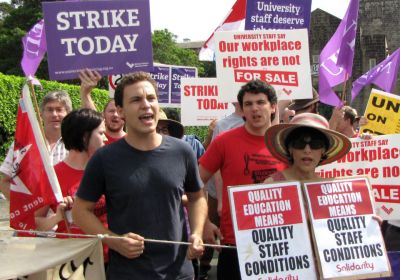
Shares in Qantas were traded at $1.25 on February 21, the highest price since October last year. Anyone with more than a passing interest in the stock exchange would know that the company has been in deep trouble for some years. In October 2011, it stranded thousands of its passengers after it grounded its entire worldwide fleet during a union dispute. When rumours began circulating throughout the media after its half-yearly report meeting that Qantas was preparing to shed thousands of jobs at, its share price began to rise. Sacking workers is a profitable sign for speculators.
-
Venezuelan President Nicolas Maduro announced his country was severing all diplomatic and economic ties with Panama after its government sought the intervention of the Organization of American States (OAS) into Venezuela’s domestic affairs. The move came as the US House of Representatives approved a motion calling on countries in the region to stand in solidarity with protesters currently seeking to topple Maduro. Maduro saidright-wing Panamanian president Ricardo Martinelli has been “actively working against Venezuela”.
-
Venezuela has commemorated the one year anniversary of the death of former president Hugo Chavez with rallies across the country. Supporters of the late socialist president turned out in hundreds of thousands for official commemoration services.
-
Below, Australia Venezuela Solidarity Network activist Federico Fuentes, provides answers to common questions about recent events in Venezuela. Key facts are referenced, largely from media outlets that could not be identified as pro-government.
-
A fresh protest by fans in Australia's A-League football (soccer) competition against restrictions on their rights took place at Parramatta Stadium on March 2 in a match between the Western Sydney Wanderers and the Newcastle Jets. The Red and Black Bloc (RBB), the “active support” group for the Wanderers sat still in their seats for the entire match in a 90-minute long “silent protest”.
-
With few exceptions, most international media coverage of the recent protests in Venezuela gives little sense of the response from the popular social movements who support the government of President Nicolas Maduro but operate independently from it. As researchers who have carried out long-term fieldwork in the urban barrios (poor neighbourhoods) of Caracas, we felt compelled to translate and publish the statement of one of these barrio groups. -
A new report by eight international trade unions and non-government organisations details the brutal government repression Cambodian garment workers were subjected to. It said the workers' demand to raise the minimum wage were reasonable.
-
Almost a year has passed since the death of Hugo Chávez on March 5, 2013. Arguably this has been the most difficult one for the Bolivarian Revolution. Many people, both on the left and the right expressed doubt that there could be Chavismo without Chávez. Perhaps a year is still too short of a period to assess the situation after Chávez’s passing. Yet, the dynamic developments over the past twelve months call for some preliminary remarks. -
Venezuelan car workers have slammed multinational car manufacturers for cutting back production in the country. The country's largest trade union federation has called for the industry to be nationalised. Accusing multinational car companies of being “imperialist”, the National Workers' Union (UNT) has called on the government to place car factories under worker control. The UNT said: “It's clear that building socialism relies on the working class, indeed the workers' control of the factories.”
-
After failing to violently crush mass protests in Kiev’s Independence Square, which have been raging since November 21, the regime of Viktor Yanukovich collapsed on February 22. The protests began in opposition to Yanukovich’s decision to back out of a Free Trade Agreement and Association Agreement with the European Union. But in the face of police brutality, the protests evolved into a general expression of anti-regime discontent. The movement was initially known as Euromaidan (“Eurosquare”) but later just Maidan, reflecting this evolution. -
Four days of talks in Singapore for the proposed TransPacific Partnership (TPP) ended inconclusively on February 25. It is clear big disagreements still exist between the negotiating countries.
-
Terry Barnes, a former adviser to Prime Minister Tony Abbott, is credited with coming up with the bright idea of introducing a $6 payment when people visit their GP.
Economy
Economy