Oh this is such fun. And every few hours it gets better, but always with an announcement there’s “still worse to come”, leaving us struggling to imagine what they might have done that’s worse.
Presumably by tomorrow it will turn out they planted a bug in Heather Mills’s false leg and hacked into Stephen Hawking’s voicebox.
The only thing that tarnishes it slightly is now everyone hates Murdoch. It’s like when you follow an obscure band and they become famous.
-
-
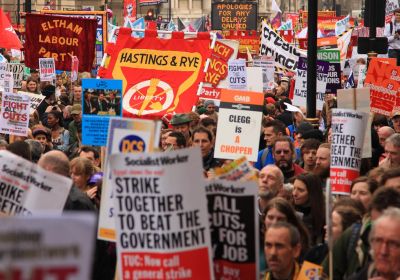
Britain’s public sector unions are set to unleash a wave of strikes starting on June 30 in response to the Conservative-Liberal Democrat coalition government’s attack on workers’ pensions. Unions have called a national day of action for June 30. Nearly 1 million public sector workers will strike for 24 hours. -
How is the government getting away with this idea that a public-sector pension is a “luxury”? Is it something that suave bachelors show off, saying: “Once I’ve taken you for a spin in my Aston Martin, how about I show you the mid-range forecast for my teacher’s pension over a bottle of Veuve Cliquot.” A pension is a necessity, so you might as well say we simply can’t go on enjoying the luxury of a sewerage system, given that the amount of waste we’re flushing is 35% higher than in 1996, so from 2015 we’ve got to throw it out the window otherwise we’ll end up like Greece.
-
With Italy being the latest European country to reject nuclear power in a June 12-13 referendum, a coalition of anti-nuclear groups in Britain has announced plans to hold a mass non-violent blockade of Hinkley Point nuclear power station on October 3. The plant, near Bridgwater in Somerset, is expected to be the site of the first new nuclear power station. Hundreds of campaigners are expected to take part in Gandhi-style civil disobedience, risking arrest by blockading the access road to the site in protest over the threat posed by nuclear power.
-
The British government continues to license millions of pounds in arms to the Sri Lankan regime despite suggestions that they may have been used in war crimes, the Campaign Against Arms Trade (CAAT) said on June 15. New evidence of alleged atrocities committed by the Sri Lankan state in 2009 in its purge of a stronghold of the Liberation Tigers of Tamil Eelam (LTTE) in 2009 emerged this week in a Channel 4 documentary screened in Britain on June 14. For more than two decades, until its defeat in 2009, the LTTE fought for an independent Tamil state in Sri Lanka's north-east.
-
Isn't this excellent news? The International Monetary Fund (IMF) say the British government's strategy for sorting us out is going to work. Every time they've been asked to comment on a country's economy they've insisted it must cut wages, restrict the unions and privatise everything. So the government must have been really nervous as to whether they'd approve of the strategy of cutting wages, restricting unions and privatising everything. It must have felt like waiting for your A-level results. -
Delegates from Community, a trade union representing workers in iron and steel, clothing, textiles, footwear and betting industries, delivered a crushing blow on June 7. They opposed the union executive's attempt to force through a resolution aimed at undermining the Trade Union Congress's policy of boycotting Israeli goods produced in illegal settlements. At the union's biennial conference in Southport, members accused the leaders of seeking a “retrospective mandate” to support Trade Unions Linking Israel and Palestine (Tulip), which they labelled “an apologist” for Israeli war crimes.
-
Springtime: The New Student Rebellions Edited by Claire Solomon and Tania Palmieri Verso 2011 283 pages, paperback, £9.99 In years to come, when people look back at 2010-11 and try to identify the moment the fightback against the British Conservative-Liberal Democrat coalition really got under way, many will select the huge March 26 TUC-sponsored demonstration in London. Magnificent and inspiring as March 26 was, however, November 10, 2010 has perhaps a greater claim to be recorded as the moment the fightback began in earnest.
-
The response of the British Conservative-Liberal Democrat coalition government to the economic crisis, which has been to implement billions of pounds worth of public spending cuts, is intensifying the effects of the crisis on the British people. Austerity measures are worsening mass unemployment. Chief British and European economist at forecasting company IHS Global Insight Howard Archer has predicted unemployment will reach 2.67 million people by the end of 2011.
-
What are some examples of highly offensive words that must be censored from radio? For British state broadcaster BBC, they are not all of the four-letter variety. The BBC appears to find not just the phrase “Free Palestine” but even the geographical entity of the Gaza Strip itself unutterable on a cultural show. A controversy has broken out over the BBC's anti-Palestinian bias after its digital radio channel BBC 1xtra, which largely plays hip hop, grime and other “urban music” genres, censored on air references to Palestine. -
Voting across Britain on May 5 resulted in a rejection of changes to the electoral system, but election results in Scotland may herald the end of Britain as we know it. The referendum on introducing an “Alternative Vote” voting system (much like the preferential voting system in Australia) to replace the current “First Past The Post” system was decisively defeated. With a turnout of only 42%, 67.87% voted against the change.
-
Good politicians are few and far between, but British health secretary Andrew Lansley is among the worst. In 2008, he was forced to apologise after saying recessions brought "good things" such as people being able to spend more time with their families.