
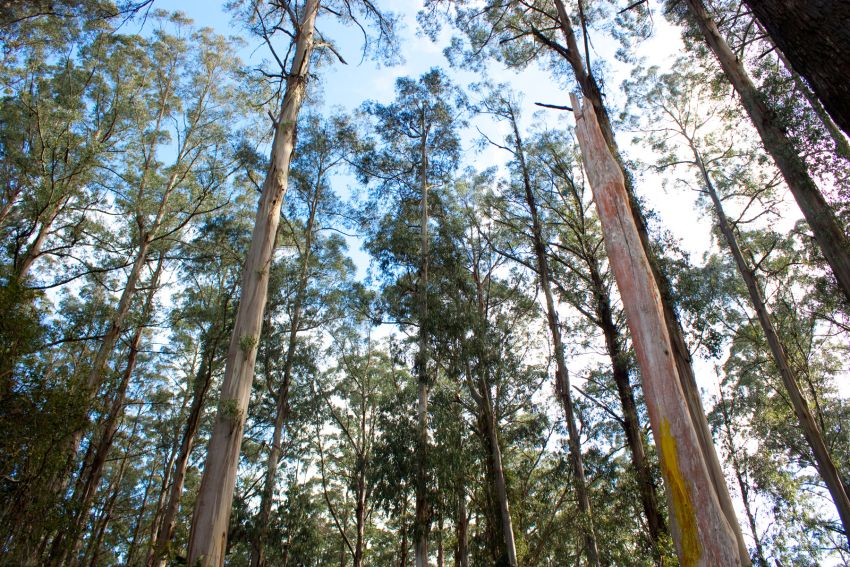
Australia is losing its forests at such a dangerous rate, it is the only “developed” country on the list of global deforestation hotspots.
Deforestation fundamentally reduces biodiversity, damages ecosystems, destroys habitat and increases harmful greenhouse gas emissions.
Native forests are vital for water security — the quantity and quality of water — due to their role in filtration, reducing erosion, producing rainfall and maintaining healthy water flows.
Forests act as carbon sinks, drawing in significant amounts of carbon dioxide and mitigating climate change. Therefore, the fight to protect and expand forests is inseparable from the struggle to avoid the worst impacts of climate change.
For First Nations people, forests are sites of deep cultural, historical and physical significance, and provide food and medicines. Since European colonisers arrived, First Nations people have resisted the destruction of their land, aiming to safeguard it for future generations.
Globally, forests under First Nations peoples’ stewardship, in countries such as Brazil, are being deforested at much lower rates than those without such protection. Crucially too, First Nations communities have regenerated previously deforested areas.
Governments at all levels have failed to protect native forests, instead enacting policies allowing their destruction. Australia ranks first in the world for mammal extinctions and second for biodiversity loss.
Last year’s changes to the Environment Protection and Biodiversity Conservation Act 1999 closed some loopholes, such as those exempting native forest logging from federal environmental laws and allowing “high-risk” land clearing.
However, the reforms are mostly designed to suit mining and agribusiness corporations’ interests; they allow governments to barely consider the impact of climate change when assessing projects.
Queensland has nearly 40% of the country’s remaining native forests — the biggest area of native forest of any state or territory. However, just 8% is protected and even that remains under threat from corporate interests.
The Queensland Country government’s 2022–23 Statewide Landcover and Trees Study found that 332,015 hectares of woody vegetation — an area bigger than the Australian Capital Territory — were cleared in just 12 months.
Queensland’s Liberal National Party (LNP) government released its Future Timber Plan 2050, last August. It reveals it plans to expand native forest logging based on incorrect claims that it is needed for the state’s housing industry. The plan was drawn up with representatives from the timber, housing and agribusiness sectors. Environmental groups and First Nations people were not consulted.
Most Queenslanders disagree with the LNP’s push to expand native forest logging. A survey, released last month, found that 56% support an end to logging in publicly owned native forests.
When asked about priorities for publicly owned native forests, 80% ranked environmental protection and recreation as most important, while just 20% said timber production.
Following decades of campaigning, the NSW Labor government finally announced last September that a Great Koala National Park would be created and that there would be an immediate logging moratorium within its boundaries.
However, following talks with the NSW Forestry Corporation, the NSW National Parks and Wildlife Service released an updated map of the park’s boundaries last month, in which previously protected areas had been reclassified as “state forest”.
Ashley Love, an environmental campaigner on the mid-north coast, told the Sydney Morning Herald that the government is letting Forestry Corp claim important koala habitat as “plantations”, excluding it from the promised park.
“It’s eating great big holes within the Great Koala National Park … including koala hubs and areas of high koala habitat value and areas of connectivity and important boundary areas to the [park] that are all left out,” Love said.
The current boundaries do not protect the biggest coastal koala population in NSW, found in Pine Creek, Orara East and Tuckers Nob state forests, because Forestry Corp designated them as “plantation”.
The government has excluded environmental groups from discussion around the park, Love said, while allowing Forestry Corp to continue logging within ecologically important forests not contained in the park.
The NSW government’s $20 million koala survey, released late last year, was found to hugely overinflate koala populations. It also included flawed data which indicated that cleared paddocks had higher densities of koalas than prime habitat within the Great Koala National Park.
This makes the protection of remaining koala populations, and the forests they live in, even more critical.
Labor’s decision to push ahead with Santos’ Narrabri coal seam gas project — despite almost-universal opposition from Gomeroi Traditional Owners, scientists, environmental groups and the people of NSW — also shows its lack of commitment to forest protection and the climate.
The 1000 hectares of land clearing for 850 coal seam gas wells, scattered over 950 square kilometres in northwest NSW, threatens at least two-thirds of the Pilliga Forest, the biggest temperate woodland in eastern Australia and biodiversity hotspot.
The forest is at the centre of Gomeroi Country, which has sustained local communities for thousands of years and contains many sacred cultural and burial sites. The project also represents a huge risk to the Great Artesian Basin, one of the world’s biggest underground water reserves.
Lutruwita/Tasmania is home to some of the world’s oldest, tallest and biodiverse native forests, but also accounts for 40% of all native forest logging volume in Australia.
Native forest logging is Lutruwita’s highest-emitting sector, producing two-and-a-half times more emissions than the state’s entire transport sector. The industry destroys ancient forests to mostly woodchips and fuel, and only survives due to state and federal subsidies.
Lutruwita has been the site of heroic campaigns to defend native forests from being destroyed. They include the successful protests to stop the Franklin River being damned in 1982–1983, the defeat of Gunns’ proposal for a huge pulp mill in the Tamar Valley in the mid-2000s to last year’s protests stopping the destruction of old-growth forests in Waykaywirinu/Central Highlands.
Now, environmental activists are gearing up for the March for Forests, being held across the country on March 22, to call for an end to native forest logging and forest mining.