
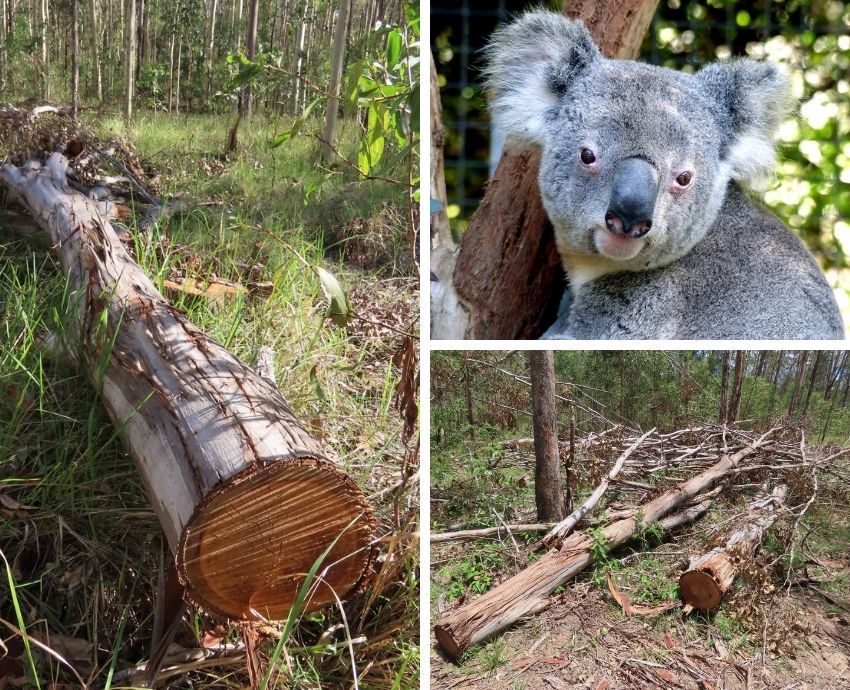
The New South Wales government’s three-year koala survey, released on December 11, estimated that there are about 274,000 koalas left in the state.
Koala populations have rapidly declined in recent years, due to habitat destruction and fragmentation from logging and bushfires, climate impacts, disease and vehicle strikes.
The state-owned NSW Forestry Corporation has intensified logging in recent years, destroying thousands of hectares of koala habitat and repeatedly breaching the weak environmental laws.
North East Forest Alliance spokesperson Dailan Pugh said now the government has finished its survey that identified key koala habitat, it must stop logging in those areas and ensure they are protected.
Forestry Corporation just finished logging in Braemar State Forest, Pugh said, “despite the abundant evidence that it supported an exceptional population of koalas”.
“We have pleaded with [NSW environment minister] Penny Sharpe on numerous occasions, and even resorted to taking the Forestry Corporation to court in a failed attempt to protect it,” Pugh said.
“The new koala model once again identifies Braemar as having amongst the highest occupancy and density of koalas, though the government already knew this, but didn’t care.
“It is not just Braemar, the NSW government is currently actively logging forests that the new model identifies as having very high densities of Koalas in Gilgurry, Ewingar, Kalateenee and Kerewong State Forests, and has numerous additional areas scheduled for logging in the near future.”
The decimated koala population from the 2019 bushfires was slowly recovering until the NSW government allowed most of its preferred feed trees to be logged, Pugh said.
After decades of grassroots campaigns, the NSW government finally announced the creation of the Great Koala National Park (GKNP) — a 475,000-hectare area incorporating 176,000 hectares of state forests with existing reserves — and an immediate logging moratorium within its boundaries in September.
However, vast swaths of prime koala habitat and areas of important connectivity are not included in the GKNP.
Pugh pointed out that the estimated 12,000 koalas in the GKNP represent just 4% of the total population in NSW. “[The government] needs to do a lot more if they are serious about reducing the threats to koalas’ continued survival, including by protecting all medium to high density koala habitat on state forests.”
“Creating the Richmond River Koala Park would be a logical first step,” Pugh said.