

Environment and water minister Murray Watt’s transactional behavior was on full display in the last parliamentary sitting week.
That Watts is prepared to “do a deal” with the climate-denying Coalition, or the Greens, to change the Environment Protection and Biodiversity Conservation Act 1999 (EPBC Act), shows how inadequate Labor’s changes are.
And why the rush, when a Senate committee into the Environment Protection Reform Bill 2025 and six related bills is still due to report next March?
Submissions from the coal lobby and the Environment Centre Northern Territory (ECNT) provide some answers.
Overall, Coal Australia (CA) agrees with Watt’s measures, with some additional tweaks. It argues in its submission that the world is entering a phase where a “record consumption of coal” will underpin economics, jobs and the industrial base “like never before”.
CA said this means “Australia is uniquely positioned”, given coal is its second-largest export earner and Australia is the fifth-largest exporter of coal in the world.
It agrees with quicker approvals for coal exports, but wants less scrutiny. Among other things, it wants “ambiguous definitions” of “unacceptable risks” and “accountability” in the Environmental Protection Authority (EPA) removed. It supports giving the minister in charge more power to “direct” the new EPA — the opposite of an independent statutory body.
It blithely skirts around the elephant in the room — that dangerous climate change is being driven by human-induced fossil fuel emissions.
The Climate Council of Australia submission said Labor’s suggested reforms would prevent the disclosure of direct emissions being factored into approval decisions. Further, it said it would allow fossil fuel project approvals (there are 42 in the pipeline) to be fast-tracked, unchecked, even if their domestic emissions put Australia’s climate targets at risk.
Overall, it said Labor had failed to address existing loopholes, which allow land clearing and native logging to continue.
The ECNT submission said it had “serious concerns” that Labor’s bills “considerably weaken protections for nature, climate and communities in the Northern Territory, and across Australia”.
The ECNT is well placed to understand the impact of fossil fuels. The NT is the site of several large-scale polluting projects, including the NT government-approved Beetaloo Basin fracking project, its associated Middle Arm petrochemical hub in Darwin Harbour and the Barossa Gas Project, which could generate 1.2 billion tonnes of emissions and raise Australia’s carbon emissions by 20%.
NT is home to globally significant, still largely intact, tropical savannahs, as well as some of the largest freeflowing rivers in the world.
It is also home to one of the most intact marine environments and the largest mangrove forest in the country. These irreplaceable landscapes face unprecedented threats from climate change, the ECNT said, with “large tracts of northern Australia predicted to be incompatible with human life at the projected 2.7 degrees of warming (see map).
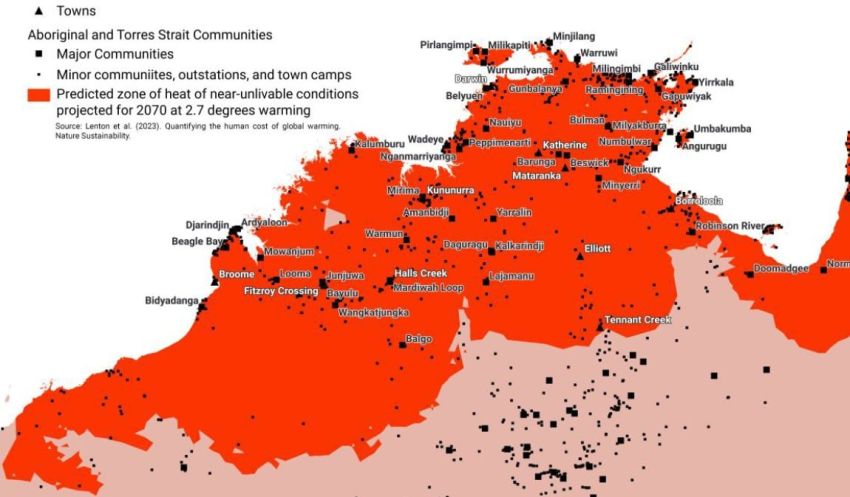
It said “biodiversity is in rapid decline”, with three key ecosystems meeting the technical definition of collapsing ecosystems — savannah, arid zone and the Gulf of Carpentaria mangrove ecosystems. It said the NT government’s pursuit of large-scale industrial developments “could industrialise and transform our landscapes irreversibly”.
It said land-clearing approvals, the biggest threat to biodiversity, have risen by close to 400% of 2017 levels.
The cotton, mining and fracking industries have been allocated so much water that, together with proposed dams for floodplain harvesting, the iconic free-flowing Roper and Daly river systems are at risk. But no standalone water licence or water allocation plan has “ever been referred for assessment under the EPBC Act”, the ECNT said.
Similarly, it said no NT fracking proposal had ever been referred for assessment under the EPBC Act, including under the 2023 expanded water trigger provisions, which consider significant impacts on water resources.
The ECNT argues the powers being given to the minister should be limited, as well as powers that are devolved to the states and territories, such as the water trigger.
It said the proposal to fast-track, or “streamline”, major projects must only be sparingly used and that provisions to allow the minister to exempt the offshore energy regulator from having to obtain approval under the EPBC Act must be struck out.
Subject to these issues being addressed, the ECNT said it would support: giving the new EPA approval powers; expanding the “water trigger” to cover any development’s significant impacts on water resources; closing deforestation loopholes; inserting a requirement to consider the climate impacts of proposals; inserting a requirement to assess broad-scale land clearing, which is the greatest threat to biodiversity in Australia; and removing the Restoration Contribution Fund, which it described as a “pay to destroy” offsets fund.
The ECNT called for the EPBC Act laws to remove “unfettered” ministerial discretion in decision-making, as recommended by the 2020 Samuel Review.
It wants to remove or limit the devolution of powers to state and territory governments; limit the fast-track process for new developments; and remove the special provisions afforded for the offshore gas and oil industry, which it said could wind back First Nations consultation rights and environmental protections.
It said the current amendments give the minister the “power to declare that a wide range of offshore gas activities do not require approval under the EPBC Act, as long as the Minister is satisfied of certain matters”. It said the clause amounts to an “effective exemption of the offshore oil and gas industry from the EPBC Act”.
Labor tried to make similar amendments in law last year, but withdrew in the face of strong opposition by environmental and First Nations groups.
The ECNT urged Labor to take input from First Nations people seriously, noting their responsibility, under native title and land rights laws, for approximately 98% of the NT. Four NT Land Councils are calling for significant amendments, including expanding the water trigger, protections and pathways for Indigenous participation in decision-making, including requirements to consider the views and expertise of Traditional Owners.
The Land Councils called for outcomes “consistent with Australia’s international commitments to reduce emissions and minimising the impacts of climate change on Indigenous people”.