
How will Spain’s new labour "reform" — announced on February 10 by employment and social security minister Fátima Báñez and already in force as a royal decree before adoption by parliament—affect Spain’s workers and unemployed?
First, imagine the essence of 30 years of Australian anti-worker and anti-union law — from Hawke’s Accord through Keating’s enterprise bargaining and Howard’s Workplace Relations Act to Work Choices and the Fair Work Act — but all rolled into one bill.
-
-

Lisbon's vast Palace Square became People's Square on February 12. More than 300,000 workers, young people, unemployed and pensioners from across Portugal marched to voice their rejection of cutbacks inflicted by Prime Minister Pedro Passos Coelho's government. It was the country's biggest demonstration in 30 years. Photo slide shows of the mass march can be seen here and here
-
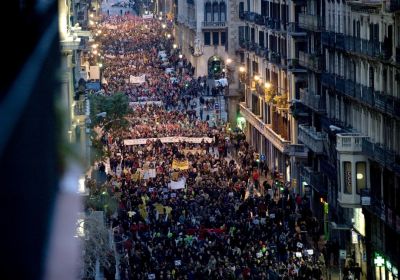 A vast icy pool of Siberian air, the coldest in 50 years, settled over all Europe in late January. At least 150 people without shelter were killed. Yet the suffering from this extreme cold snap will be nothing compared with that of the economic ice age now threatening to entomb Europe’s most vulnerable economies. Over the past fortnight southern Europe’s growth prospects have become increasingly wintry:
 -
 As you read these words, disaster may be about to strike in the galloping crisis of the European financial system and the euro. Or it may not — yet. On November 30, the imminent threat of a banking system implosion stirred the European Central Bank (ECB), the US Federal Reserve, Bank of England and central banks of Japan, Canada and Switzerland, into taking the minimum action needed to prevent a “Lehman Brothers event” collapsing the European financial system.
 -
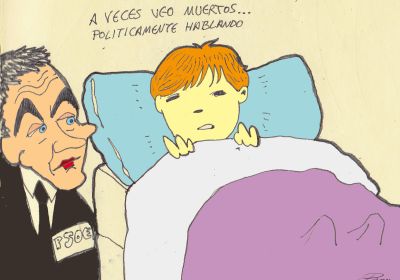 The November 20 Spanish election went as the polls had forecast: the Spanish Socialist Workers Party (PSOE) government was massacred, with its lowest vote in 34 years. The right-wing Popular Party got a 186-seat absolute majority in the 350-seat parliament and left and left-nationalist forces emerged stronger, led by the United Left (IU) and Amaiur, the Basque left-nationalist coalition.
 -
 Late on October 23, the culminating vote of the program congress of the German Left Party (Die Linke) came in Erfurt’s cavernous Congress Centre: 503 delegates raised their voting cards to support the document as finally amended by the congress, with only four against and 12 abstentions. Die Linke has operated since 2007 on the basis of the “programmatic key points” that created Die Linke from the fusion of the Party of Democratic Socialism (PDS) and the Electoral Alternative for Labour and Social Justice (WASG).
 -
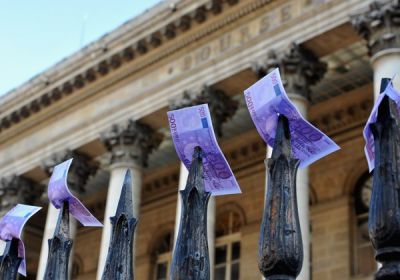 World financial markets are increasingly staking billions on a bet that the eurozone is on its last legs. This bet on a euro break-up is looking more and more realistic, particularly because it becomes increasingly self-fulfilling as austerity programs bite and economic growth slows across Europe. A very vicious circle is at work. Because of the rising wariness of financial institutions, in recent weeks the price of Italian and Spanish 10-year bonds has fallen. Their yield rose above 7% (bond prices and yields move in opposite directions).
 -
 The overwhelming success of the October 15 “United for Global Change” demonstrations (which took place in more than 1000 cities and towns in about 90 countries) is having powerful positive feedback on the indignados (15-M) movement in Spain.
 -
 At a Madrid media conference called by the 15-M movement to announce Spanish actions for the October 15 global day of occupations, the media showed little interest in the international solidarity plans of the world’s founding indignado movement. The journos wanted to talk about one thing: what would be 15-M’s attitude to the November 20 Spanish general elections? Abstention? Spoiling the ballot? A vote against the parties of “the political class”? A vote for parties closest to 15-M’s positions? And, if so, which parties?
 -
 What stance should the European left take towards the euro and its galloping crisis? This issue, which began as a theoretical discussion among radical economists in late 2009, has increasingly acquired practical political urgency: left parties are being challenged to define their position in the face of rising popular resentment at governments forking out billions in taxpayer euros to bail-out banks and indebted “Club Med” countries.
 -
 Speaking in Rome on September 15, Lorenzo Bini Smaghi, Italian executive board member of the European Central Bank (ECB), said of the design of the euro: “The assumption was made ― largely theoretical ― that there would be no crises.” Oh, indeed. And now with Europe and the world showing every sign of dipping into a recession that will further stress Euope's common currency, what is to be done?
 -
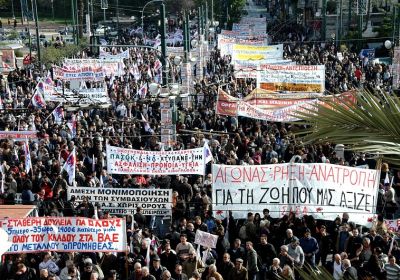 “Bloody Greeks — corrupt and lazy, born cheaters who think the world owes them a living. Why should the hard-working taxpayers of the euro zone core economies like Germany have to fund billion-euro rescue packages for those scoundrels?” That’s the vicious tone of Germany’s tabloids and conservative politicians towards Greece’s galloping public debt crisis and the Greek people’s protests against the austerity programs. The austerity has been imposed on them by the European Union, European Central Bank and International Monetary Fund (the “troika”) as the price of bail-out funding.