
What the polls had predicted would be an easy victory for the Social Democrats in Denmark's September 15 election turned out to be much closer.
The last poll before the vote showed the Social Democrat leader Helle Thorning-Schmidt ahead of her Liberal opponent Lars Løkke Rasmussen by 52.3% to 47.5% as preferred prime minister.
-
-
 In Spain the signs are unmistakable: a “hot autumn” of political and social conflict is brewing in the run-up to the November 20 general election. Polling night will reveal how much the growing social resistance, brought onto the streets since May largely by the 15-M movement of “indignants”, has shaken up the political scene. As things stand, the most likely result is a repeat of the wipe-out suffered by the governing Spanish Socialist Workers Party (PSOE) at the May elections for local council and regional governments (known as “autonomous communities”).
 -
 Ireland’s seven-month-old United Left Alliance (ULA) is the “new kid on the block” of European anti-capitalist parties. Launched in November last year, it won five TDs (members of the Irish parliament, the Dail) in February elections, despite its name not appearing on the ballot paper. To date the ULA has also won 20 positions in local councils and one seat in the European parliament. In the Dail, the ULA TDs have already had successes, such as stopping the abolition of the Joint Labour Committees that set wages and conditions in some industries.
 -
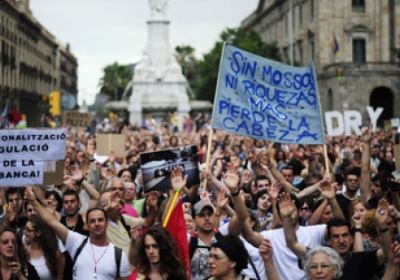
Huge demonstrations of the anti-austerity M-15 movement in 97 Spanish cities and towns brought at least 250,000 people onto the streets on June 19.
-
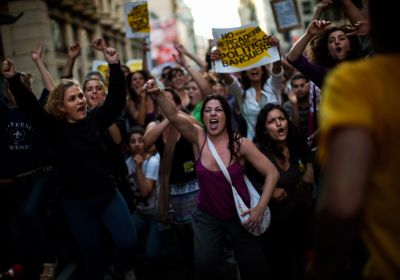 Pity the stressful life of police ministers in Spain and its autonomous communities (states). For weeks, the central plazas of big cities and towns across Spain have been the site of the camps of the “outraged” (los indiganados) of the M-15 movement — so-called after the large May 15 national protests that sparked the movement. The movement, which opposes the savage austerity imposed on ordinary people to pay for the crisis and the undemocratic nature of the political system, is now spreading into the suburbs of the larger cities and out into smaller regional towns.
 -
The June 5 national elections in Portugal produced a sharp lurch to the right. The two main conservative parties, the Social Democratic Party (PSD) and the Democratic and Social Centre-People's Party (CDS-PP) won 50.4% of votes and 57.1% of seats in the single-chamber parliament. (The results for the four seats determined by overseas Portuguese voters will be announced on June 15.) Compared to the 2009 poll, the PSD vote rose from 29.1% to 38.6%, and CDS-PP from 10.5% to 11.7%.
-
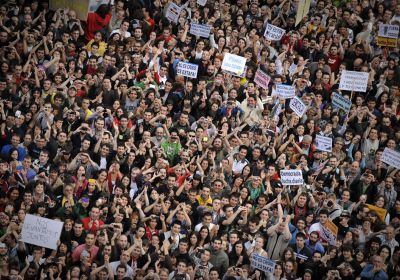
In late April, the progressive Spanish daily Publico asked why there was so little resistance to the economic crisis, despite the country’s 5 million jobless and rising misery.
-
 In Spain’s local elections on May 22, a tsunami of popular rage against the Spanish Socialist Workers Party (PSOE) government of Jose Luis Rodriguez Zapatero spread across this country of five million jobless. The punishment came amid widespread suffering caused by the economic crisis, worsened by the austerity imposed by Zapatero's government to pay for the billions of euros spent bailing out big banks. PSOE bastions since the fall of the Franco dictatorship were swept away.
 -
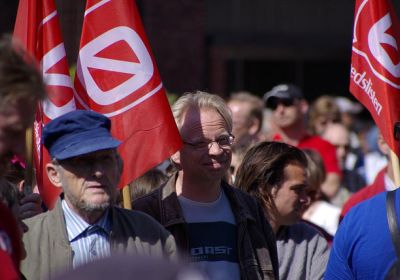 The debate over the Western military intervention into Libya that has swept sections of the world’s left since it began in March were concentrated into one passionate session at the annual congress of Denmark’s Red-Green Alliance (RGA), held in Copenhagen over May 20-22. The 300 congress delegates, representing 5900 members, were asked by a majority of the RGA’s National Board to endorse the March 18 vote of its four MPs in support of the “no-fly zone” imposed on Libya by NATO powers including Denmark ― acting in the name of United Nations resolution 1973.
 -
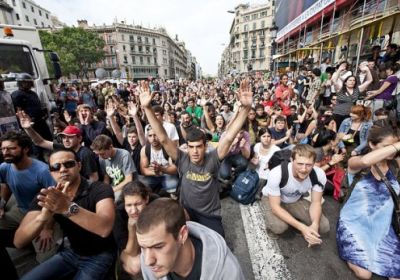
The central plazas of dozens of cities and towns across Spain bear an uncanny resemblance to Tahrir Square in Cairo. They have been taken over by thousands of demonstrators demanding a "new system".
-
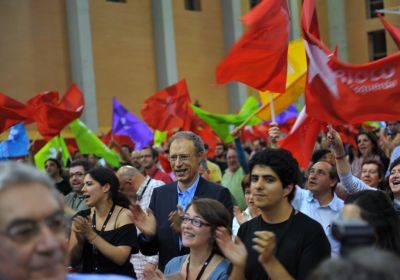 When the 548 delegates to the Seventh National Convention of Portugal’s Left Bloc came together in a vast sports hall in Lisbon onver May 7-8, they had two big questions to answer. The first was what alternative should they propose at the June 5 Portuguese elections to the €78 billion (about $103 billion) “rescue package” negotiated between the European Union, European Central Bank and International Monetary Fund (the “troika”) and the Socialist Party (PS) government of prime minister Jose Socrates?
 -
 Unions NSW presented the "Better Services for a Better State" campaign in the Sutherland Shire at the Sutherland District Trade Union Club ("Tradies") on November 19. There was only a small crowd but there was fruitful discussion on the issues confronting the campaign. In his opening presentation, Maritime Union of Australia Sydney branch secretary Paul McAleer explained how the battle to keep Sydney Ferries public had been won. McAleer said the MUA, and other unions representing workers on the ferries, had focused on building the broadest possible alliance against the sell-off.