
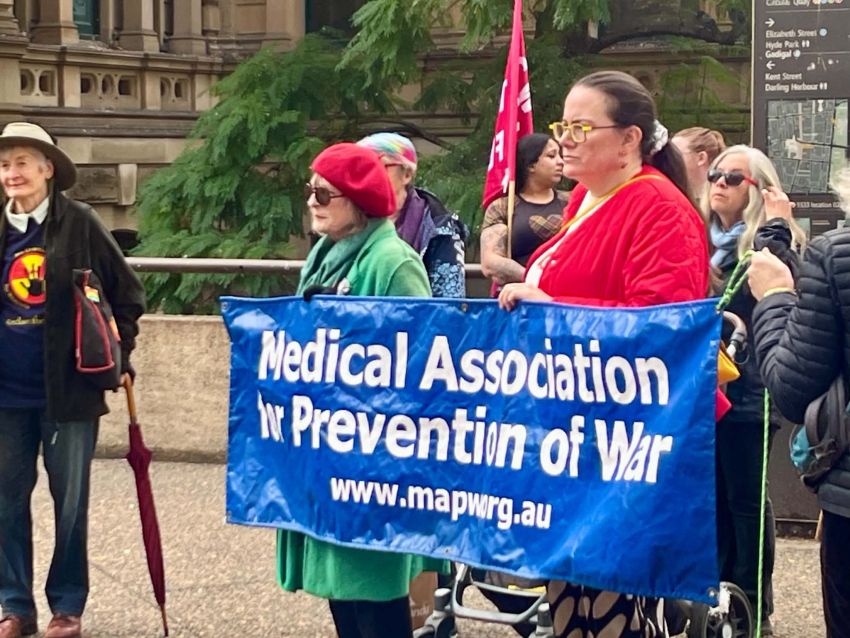
Dr Ruth Mitchell, a 2017 Nobel Peace Prize winner, doctor and neurosurgeon, delivered the following speech to the Hiroshima Day protest on Gadigal Country/Sydney on August 1.
• • •
It’s an honour to be here on unceded sovereign Gadigal land and I want to begin by acknowledging that this always was and always will be Aboriginal land.
Eighty one years ago this month, a uranium bomb was detonated by the United States over the city Hiroshima, on August 6, 1945. It flattened and burned around 70% of the city and, by the end of that year, at least 140,000 people had died.
Three days later a larger plutonium bomb exploded over Nagasaki, killing 74,000 people by the end of that year. Ground temperatures in Nagasaki reached 4000°C and radioactive rain poured down.
The survivors of the bombings of Hiroshima and Nagasaki, known as the Hibakusha, lived with massively increased rates of cancer and chronic diseases, some being passed to the next generations.
As a doctor and neurosurgeon, I am often called upon to treat severely injured people and, apart from the fact that this awful poisonous incineration was entirely preventable, I find it unspeakable that in Hiroshima and Nagasaki, no meaningful humanitarian response was possible.
In Hiroshima, 90% of doctors and nurses were killed or injured; 42 of 45 hospitals were rendered non-functional; and 70% of victims had combined injuries including, in most cases, severe burns.
All the dedicated burn beds around the world would be insufficient to care for the survivors of a single nuclear bomb on any city.
It takes around 10 seconds for the fireball from a nuclear explosion to reach its maximum size, but the effects last for decades and span across generations.
When people ask for a nuclear weapons expert, they often think of a nuclear physicist, an Openheimer, perhaps.
But I want you realise that the Hibakusha from Japan, and nuclear survivors everywhere, are the nuclear weapons experts we actually need to hear form.
I want to pay tribute to the tireless efforts by Hibakusha to rid the world of nuclear weapons to this very day; their stories are stories of hope and determination that must not be lost. Survivors of the atomic bombings of Hiroshima and Nagasaki are living witnesses to the horror of nuclear war and when we talk about nuclear weapons, we must talk about the real, unacceptable effects they have on human beings.
Last year, I was fortunate to visit both Hiroshima and Nagasaki, to pay my respects those whose lives were taken and to listen to the Hibakusha. What surprised me, one night as I walked through Hiroshima’s peace park, was to find a small group of people, including some second and third generation Hibakusha, protesting the destruction of Gaza.
The sight of these good people of Hiroshima standing in solidarity with the people of Palestine moved me to tears. A city that has endured so much has found room in their hearts for those currently being targeted and destroyed. We are all connected, and when one city suffers, we are diminished.
Closer to home, we must also grapple with the enormous and terrible legacy of British nuclear testing on unceded sovereign Aboriginal land at Maralinga and Emu Fields in the South Australian desert, and on the Montebello Islands. From 1952-1957, there were 12 major nuclear detonations in Australia in these three locations.
The impact of these tests on First Nations people, military personnel, community members and on the environment continue to be felt. The responses for the affected communities and survivors has been wholly inadequate. There is a terrible responsibility in the hands of those who have performed these “tests” and we call for accountability.
In Australia, it appears we have a gap between taking seriously the way in which First Nations folks and others have suffered as a result of nuclear testing and our nuclear posture as nation.
We have facilities at Northwest Cape, near Exmouth in Western Australia and Pine Gap, near Alice springs, which support the US in early warning, communications and targeting operations, which are essential for nuclear war planning.
Under AUKUS, US Virginia-class attack submarines will start arriving at HMAS Stirling near Perth from 2027. Will these be armed with nuclear weapons?
When I was a medical student, the Medical Association for the Prevention of Nuclear War and the International Physicians for the Prevention of Nuclear War gave birth to a new campaign, and in 2007, the International Campaign to Abolish Nuclear Weapons, or ICAN, was launched.
Ten years later, we were the main civil society partner in negotiations for a treaty for the prohibition of nuclear weapons. This United Nations treaty now has 100 signatories and 75 state parties.
But despite support from the Red Cross, the Australian Medical Association, trade unions, more than 60 religious organisations, the majority of surveyed Australians and hundreds of parliamentarians, to our great shame, Australia has not yet joined the treaty.
Recently, ICAN was joined by a delegation from the Pacific to mark the 80th anniversary of the first US nuclear detonations on, in and above the Marshall islands, as well as other nuclear tests in the Pacific.
To this day, parts of the Marshall Islands are still 10 times more radioactive than Chernobyl or Fukushima. The nuclear tests here in Australia, throughout the Pacific, and elsewhere have disproportionately affected Indigenous people and are the part of the nuclear racism we must grapple with.
The invitation from our Pacific neighbours is to join them in signing and ratifying the Treaty for the Prohibition of Nuclear Weapons. They have provided the moral leadership, even in the face of denial and exclusion of their lived experiences and their expertise.
We are living at a time when the risk of nuclear accidents and the use of nuclear weapons are at all-time highs.
Targeting of nuclear facilities, the threat of use of nuclear weapons, and the renewal of nuclear arsenals are worrying enough, without considerations of the ways in AI systems are already being integrated into nuclear weapons command and control.
The marriage of AI and conventional weapons’ systems, particularly in Gaza, has been utterly catastrophic.
There can be no way forward for the human race in the ongoing presence of nuclear weapons: either we get rid of nuclear weapons, or they will get rid of us.
Please join me in urging the Australian government to show some leadership, get on the right side of history and join the treaty for the prohibition of nuclear weapons.