
In this interview with Indymedia Argentina, Claudio Katz assesses the newfound prominence of socialist MP Myriam Bregman, from the Workers’ Left Front — Unity (FIT-U), in Argentine politics, and outlines some of the debates on the left.
Katz also examines Argentina’s political situation, its economic crisis and President Javier Milei’s declining support. Read the full translation at links.org.au.
* * *
Is Argentina’s political landscape changing?
Yes. Milei’s discrediting is very obvious, even among sectors that propelled him to power. His low approval rating, various expressions of disapproval with his administration and the early election campaigning all indicate this.
The causes are obvious: two years of a dramatic fall in consumption and a brutal transfer of income to the wealthiest has caused widespread discontent. Daily life has been dramatically disrupted. A simple trip to work is now a nightmare, with reduced services and fares rising 12 times faster than wages.
The healthcare system’s collapse is even more severe. Price hikes of 400% have pushed 740,000 people out of private healthcare and into already overcrowded public hospitals. Many pensioners are going without medicines to pay for food.
Inequality is shameful. As fuel exports rise, so do domestic energy costs. Each new record harvest comes with more empty tables in homes, while school canteens run short on food supplies.
But this has not caused his economic model to collapse…
In reality, it is creaking and the shock absorbers are wearing out.
One-hundred-and-forty-thousand jobs losses were offset by 100,000 new informal gig economy jobs. No economy can function with 930 businesses closing each month and disposable income collapsing.
Milei’s only solution to the crisis he has created is yet more austerity cuts. With tax revenue plummeting in a stagnating economy, Milei has imposed further cuts to sustain the fiction of a fiscal surplus and avoid a debt default.
He has created a vicious circle of economic contraction and poverty, with no way out in sight.
The ruling class still backs him though…
That is true, but the establishment is waiting for his term to finish in a respectable manner before continuing with “Mileism” without Milei.
They are already sounding out potential replacements. Some are even considering a de facto replacement, should the president fall before then. In that scenario, they would keep the government afloat with the support of state governors and the Peronist right.
But Milei is uncontrollable and refuses to give up. He seeks to survive with Trump’s blessing.
But, as always happens in Argentina, the streets will have the final say on the political course…
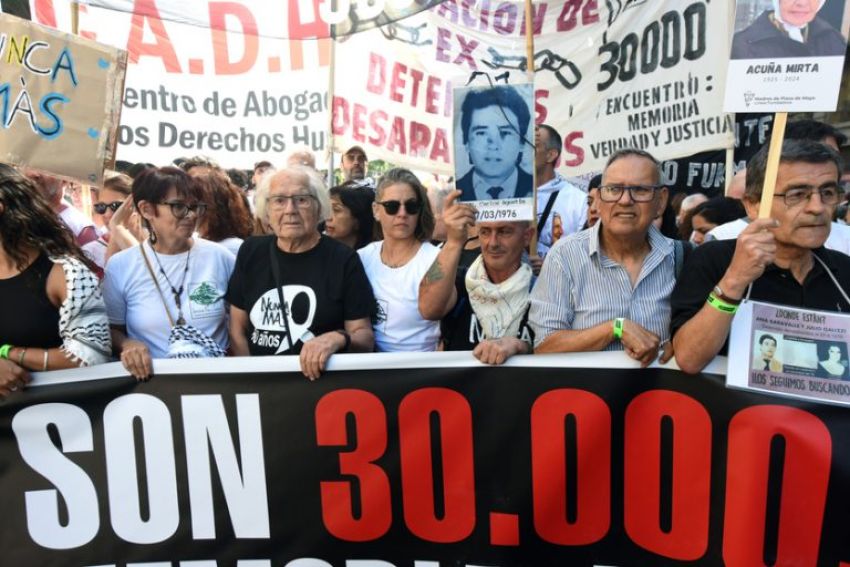
Exactly. The March 24 demonstrations [commemorating the 1976 military coup] exceeded all expectations. An estimated more than 1 million people attended, including a broad mix of generations, refuting claims that young people are shifting right.
There have been significant mobilisations, but they lack the scale and militancy needed to defeat Milei. There is not yet the prospect of a repeat of the 2001 rebellion [that toppled several presidents] or the 2017 electoral victory against [Mauricio] Macri.
Another significant shift is the sudden rise of Myriam Bregman…
Yes. Her rise in the polls is significant, as she has a very high net positive image, which is boosting her voting intentions.
Many analysts say Bregman’s appeal has expanded beyond the traditional left-wing or progressive electorate. They believe that the angry anti-establishment voters that supported Milei might soon channel their discontent via the left.
There are plenty of reasons to launch a major campaign in support of Bregman’s presidential candidacy. All the left agrees we need to shore up this prominence in the coming months.
There have been debates on the strategic significance of this campaign. What is your view?
There is discussion on the need for Bregman to shift her discourse to show a genuine intent to become president. Such a positive tone requires an affirmative message, highlighting how the left can govern.
This approach distinguishes between government and power, and calls on the people to take hold of both. The challenge lies in working out a strategy to achieve this objective.
Some participants in the debate have taken a negative view. They believe the FIT-U should not seek to govern, as it has no viable policy to achieve that goal.
Such pessimism simply repeats the right’s tired arguments against the left and fails to recognise potential shifts in the battle for power.
Is this pessimism being reconsidered?
We will have to see. The traditional Trotskyist view sees the struggle for government and power as two simultaneous processes, occurring in close succession.
This is the 1917 Bolshevik model: revolution, soviets, the storming of the Winter Palace and the immediate launch of a socialist process. Calls to deepen the struggle, with hopes that popular power will emerge from below, are premised on repeating this.
Some documents reformulate this possibility, presenting Bregman’s candidacy as a link in the chain. They propose a positive campaign, presenting her winning the presidency as closely tied to a revolutionary upsurge. This is the reason for proposing “Committees to fight for a workers’ government, with Bregman as president”.
The obvious objection is this view is unrealistic. But this sensible criticism can lead to the wrong conclusion of abandoning any effective campaign for the presidency.
Some documents reject running such a campaign, instead arguing that the focus should be simply on recruitment while reaffirming the idea that elections are merely a platform to spread socialist ideas.
More moderate versions of this position argue that now is not the time to win government, because the social support needed to implement a revolutionary program does not exist in the current climate. They say the left should instead prioritise the immediate building of a party to address this weakness.
I disagree with these positions, which I think help perpetuate the left’s political marginalisation.
What is your position?
Basically, fight to win the elections and form government as a means to initiate a struggle for power.
A victory at the ballot box that is grounded in popular mobilisation and grassroots organisations would allow us to start the struggle to seize economic, judicial, military and media power.
This is a clear, forceful strategy and, above all, one understood by the majority of the population. It avoids abstract debates about whether the conditions exist to advance the socialist project, because it situates that objective within an unpredictable course of events.
The left may soon be in a position where it can and must govern with a strategy for power. But the most realistic approach is to assess contexts, taking into account the recent history of our country and region.
Which is?
In Argentina, the 2001 uprising. This was a revolt involving assemblies, picket lines and widespread grassroots organisations.
This in turn led to an electoral process and the subsequent Kirchnerist cycle [of centre-left administrations headed by Néstor Kirchner (2003–07) and Cristina Fernández de Kirchner (2007–15)].
It seems to me the left had no strategy then to intervene in elections. We should not repeat that mistake.
In contrast, Evo Morales became president in Bolivia and [Hugo] Chávez was elected in Venezuela. Their paths were similar to Salvador Allende in Chile.
This path was greatly debated throughout the 20th century in terms of assessing the concrete meaning of a workers’ government. In my view, this path aligns, converges or complements — but is in no way counterposed to — the revolutionary dynamics in Russia, China, Vietnam or Cuba.
But the obvious objection would be that those attempts failed to combine the electoral path with revolutionary development…
That is not a valid objection, in my opinion. With that abstract yardstick, every left political process failed. All of them faced limits, setbacks and frustrations at some point.
If Bregman can consolidate her prominence on the political stage, these shortcomings will be overcome, especially if the left sets more ambitious goals in line with the position it could potentially occupy.
This is not just a question of electing more MPs, but winning elections at the district, municipality or provincial level in 2027, and from there launching a campaign to win government at the national level and contest for power.
Achieving these goals requires alliances and coalitions that go beyond just the left.
If the FIT-U significantly expanded its electoral base, it would have to clarify its positions on a potential run-off between a progressive centre-left and right-wing presidential candidate.
This is not an immediate issue, as Bregman’s positive presidential campaign supposes that she will make it into that second round. But it is essential to develop a position for what typically happens in second round run-offs in Latin America.
In that scenario, we cannot hesitate in calling for a vote against the right.
[First published in Spanish at Indymedia Argentina.]