
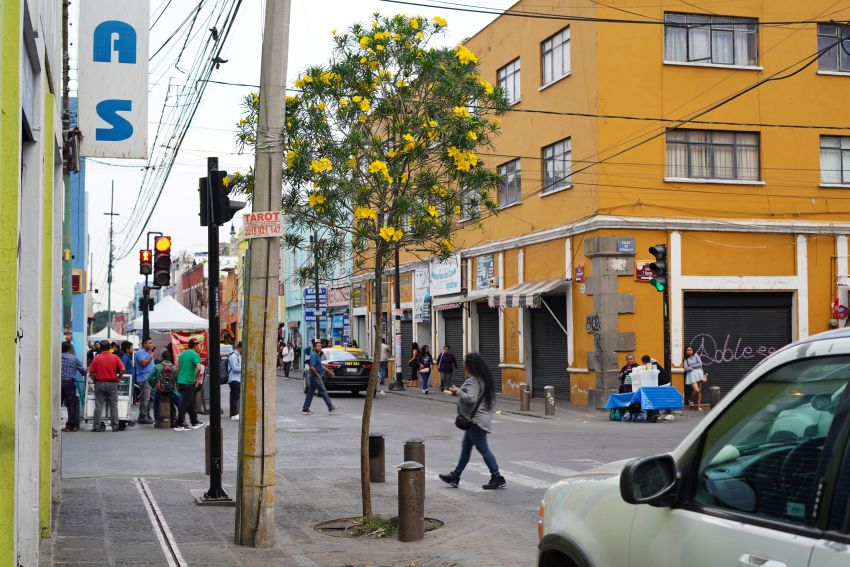
Sometimes, walking through the concrete jungle of Puebla city, in central Mexico, the only trees I see are the hardy, invasive ones growing out of the cracked walls of abandoned buildings. The government planted a few trees around the city centre two years ago, but with no nearby rubbish bins the young, skinny trees — surrounded by concrete — often become de facto rubbish traps.
The contrast with many Global North cities, with nature strips along footpaths and huge central parks and botanical gardens, is stark. Canberra ranks highest globally for green space, with 420m²/person, followed by Wellington, Ottawa, Helsinki, Oslo and Stockholm. Sydney is 19th, with 220m²/person, and all the top 20 cities are in the Global North.
Puebla has just 2.4m²/person — 1% of Sydney’s rate — and other Global South cities are not much better off: Mexico City has 6m² and Bogotá 5m².
Even measured as a percentage of total area, the top cities are in the Global North — Moscow (54%), Singapore (47%), Sydney (46%) and Vienna (45.5%). The bottom cities are in the Global South: Dubai (2%), Istanbul (2.2%) and Mumbai (2.5%). Within cities, green space is unevenly distributed, typically concentrated in wealthier suburbs.
The World Health Organisation set a minimum of 9m² per person, with an ideal of 50m². Despite the serious environmental and health consequences of low green space, Puebla’s city and state governments are planning a massive transport project that would reduce the city’s green space further.
Shrouded in corporate interests and opacity, and prioritising the needs of foreign and domestic tourists over locals, the project is typical of investor-led urban policies that increase the global green space gap.
Disposable parks
The Morena state government first announced the Cablebús transport project in December last year, with protests against it beginning in February. With a budget of 6.75 billion pesos (AU$555 million), the aerial cable car system would only cover 13 kilometres and require 96 towers and nine stations located in the city’s few remaining parks, as well as in public spaces and squares.
Almost 1000 mature trees would be chopped down. The project also bypasses lower-income areas, where more people rely on public transport. While cable cars make sense in Mexico City, with its large swaths of informal and low-income housing on steep hillsides, Puebla is flat.
Antonio Ferrer, from the Puebla-based Citizen’s Agenda for Trees and Green Areas, tells me that “Parks represent less than 1% of the city of Puebla. Ecological corridors are increasingly fragmented, and that threatens wildlife, like the Coopers hawk.
“The Cablebús is also an attack on our right to a healthy environment.”
In Puebla, urban planning outside the historic centre has, for decades, been modelled on the United States — often with US companies and contractors directly involved. This means car-centric urban planning and large department stores (mostly transnationals), in a region where most people can’t afford cars. The public transport system is disorganised and neglected; buses are over-crowded, and travelling just 5 kilometres can take an hour.
Selene Agustín, also an activist in the Citizen’s Agenda for Trees and Green Areas, says “We need more buses, a larger and better bike path network, better pedestrian infrastructure and more local and city parks.”
Why green spaces matter
Green spaces are vital for cooling (suburbs with vegetation can be up to 14°C cooler), improving air and water quality, reducing noise and supporting biodiversity. In cities like Puebla, with low-quality infrastructure and drainage and short but intense rainy seasons, green spaces are vital in preventing floods by absorbing water and reducing runoff.
Spending at least two hours a week in nature is associated with better health, including lower risk of chronic diseases, faster recovery from surgery, reduced stress, anxiety and fatigue and improved cognitive performance.
Green spaces are also important recreational and social spaces. The scarcity of parks can lead to fear and distrust of public areas, increasing dependence on commercial spaces and consumerism for socialising. People with little disposable income can feel locked out of socialising all together.
“It’s become so normalised,” Agustín says. “People are growing up without trees or green spaces nearby and then have little sense of how to appreciate them or look after them.
“In a city like this, grey, concrete, with crap public transport, owning a car becomes something to aspire to — even a necessity — to avoid the over-crowded buses and the blazing sun.”
Ferrer says that “living in Puebla, with so little green space, makes us feel stressed, irritable and sometimes even hopeless”.
Urban green spaces decreasing
Global South cities, overall, have just one third of the green space of Global North cities, due to lower state income and budgets for street infrastructure and high levels of exploitation by the Global North.
While wealthier cities are treated primarily as places to live in, cities like Puebla are used by transnationals for car manufacturing (Audi and Volkswagen in Puebla’s case), textiles and other kinds of export industries supplying Global North markets.
Unequal trade agreements, such as the North American Free Trade Agreement between Mexico, the US and Canada, have forced millions of small-scale farmers to migrate to cities, where many settle in informal housing without planned parks.
In addition to worldwide challenges like gentrification, many Global South cities also navigate the legacies of colonialism and imperialism, including large informal settlements and higher rates of urban growth.
Under pressure from transnationals and organisations, such as the International Monetary Fund, cities like Puebla and Mexico City are constantly being privatised, with corporations taking over public spaces — including parks, squares and cultural buildings — and commercialising them.
Since public parks are much less profitable uses of land compared to AI data centres, industry or residential towers, urban green space is declining globally. One study of 344 cities found an overall reduction of 63 million m2 between 2023 and 2024.
Imposing public works
The Morena state government is bending over backwards for big business, awarding the Cablebús contract to European company Doppelmayr and announcing yet another industrial park for Puebla.
Promoted by the national government as “Economic Development Hubs”, these industrial zones receive public funding for business infrastructure, with water, electricity and other services provided, along with incentives for transnational and domestic corporations.
The Puebla hub, announced late last year, will be located in San José Chiapa, a lower-income area with an Indigenous Nahua community and small farmers. It would include pharmaceutical and food companies and a Google AI laboratory.
More than 100 companies will benefit from 275 hectares of state-owned land. The project will consume precious water — severely scarce in the region — and generate copious amounts of rubbish and contamination.
Doppelmayr already holds multiple cable car contracts across Mexico, with state governments paying a total of 22 billion pesos (AU$1.8 billion) for construction, then more money for maintenance and operation. With contracts like these, companies often overestimate costs to receive bigger payouts, then cut corners in construction, while often bribing local officials to get the contracts.
In Michoacán state, there were significant protests against Doppelmayr’s cable bus system last year. Isidro Ramos Sandoval, the lawyer who filed a case to stop the project, was murdered in March that year. No one has been prosecuted.
Doppelmayr and local governments in Puebla and in Mexico City have failed to conduct the legally required studies before project approval, including environmental impact, technical, financial and mobility assessments. In Puebla, the government said its studies are “reserved” for the next five years, meaning the public isn’t able to see them.
Agustín notes that Mexico has ratified the Escazú Agreement, a landmark 2018 treaty for Latin America and the Caribbean mandating public participation in environmental decision-making.
“The Cablebús project isn’t based on any real analysis of mobility needs in Puebla,” says Ferrer. “Any such analysis should consider accessibility, short trips by carers and sustainability.
“It also doesn’t have the necessary land-use permits. It is incompatible with various laws and regulations, but the mayor, José Chedraui, says he will change whatever to ensure the project goes ahead.”
Defending green spaces
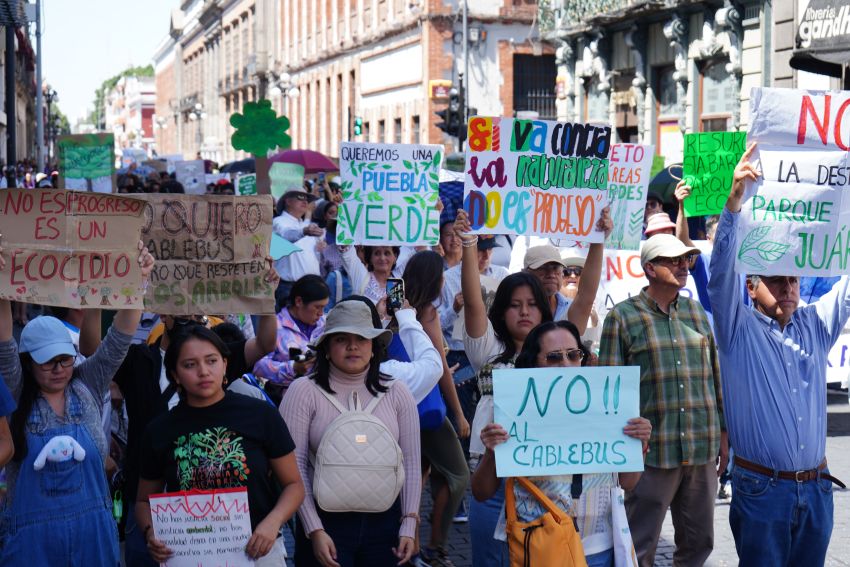
Communities affected by proposed Cablebús stations in parks have organised locally, and marched together with academics, student groups, transport and environmental collectives, lawyers’ organisations and other civil society groups.
“Apart from the marches, there have been information requests, lawsuits, declarations, forums, artistic actions and creative workshops and social media campaigns,” says Agustín. “The movement is growing.”
“In response, the state and city authorities have only insulted us, accusing us of being ‘bots’ and members of the opposition, or of having political party interests,” says Ferrer. “But we don’t — we’re just citizens fighting for our right to information, fighting for an appropriate use of public funds, wanting to live in a healthy environment and for the few remaining green spaces to be protected.”
[Tamara Pearson is an Australian-Mexican journalist, editor, activist and literary fiction author living in Puebla, Mexico. Her latest novel is The Eyes of the Earth, and she writes the Global South newsletter Excluded Headlines.]