
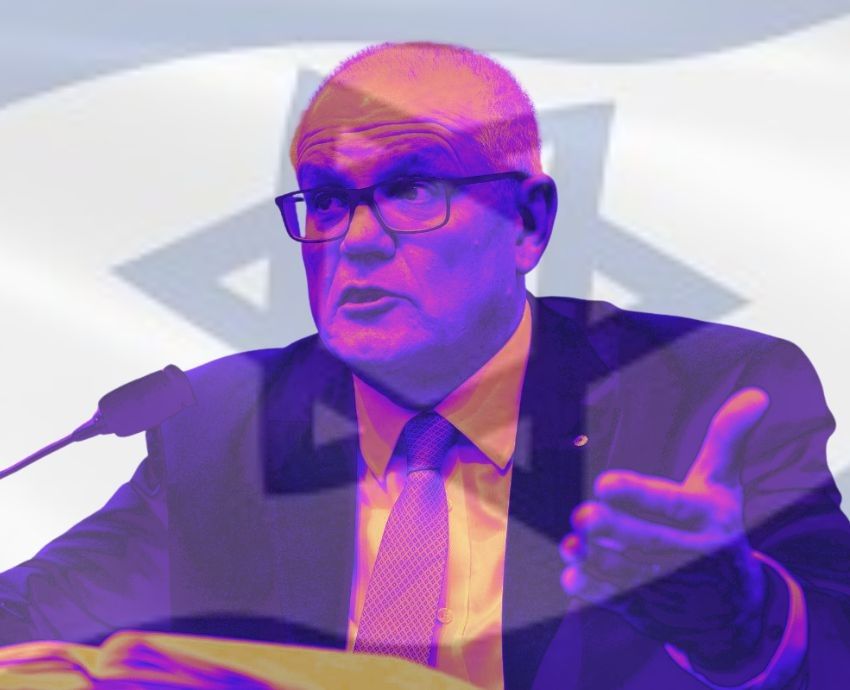
Former Coalition Prime Minister and faithful Pentecostal Scott Morrison was in good company as one of various politicians of the right (and far right) hue invited by Israel’s Minister for Diaspora Affairs and Combating Antisemitism Amichai Chikli.
The occasion was the second international conference on combating antisemitism, January 26–27, at Jerusalem’s International Convention Center, ambitiously titled “Generation Truth”.
The attack by two Islamic-State-inspired gunmen last December 14 on people attending a Hanukkah event on Bondi Beach had supplied Morrison with a hot script.
Anthony Albanese’s government had been under pressure from Israeli Prime Minister Benjamin Netanyahu for allegedly going soft on Palestinians and Morrison was in hearty agreement. He claimed that Labor had “walked away from the Jewish state while antisemitism has taken root in Australia”, feeding the hate through Labor’s unilateral recognition of Palestinian statehood.
In keeping with various right-wing Christian groups, Morrison believes Israeli interests need to be protected and treasured against other, undesirable members of the book. Christians and Jews can make a common alliance against their enemies, even if evangelical Christianity has a well-stocked reserve of antisemitic attitudes.
While PM, Morrison recognised West Jerusalem as Israel’s capital, despite its contested status in international law, going so far as to open a Trade and Defence Office there in 2019. In 2021, the Coalition officially adopted the controversial International Holocaust Remembrance Alliance definition of antisemitism, which conflates criticism of Israeli policies with antisemitism.
Since losing office, Morrison has been further courting Israel’s favour by attacking the UN for being a forum for antisemitism.
Morrison’s January 27 address recapitulated these points and more. He pointed to a five-fold rise in antisemitic incidents in Australia, following the October 7, 2023, attacks on Israel.
Context, such as Israel’s historical suppression of Palestinian autonomy and its ruthless campaign of pulverisation in Gaza, was absent.
Regular protests on Gadigal Country/Sydney — including a Sydney Harbour Bridge march numbering anywhere between 100,000 to 300,000 people —and in Naarm/Melbourne, were all cut from the same cloth of antisemitism. Again, Israel’s conduct and policies deserved no mention, while slogans such as “From the river to the sea” and “Globalise the intifada” could only be seen as antisemitic declarations.
Morrison also linked these protests and a softer approach to Palestinian statehood directly to the Bondi attacks, his mind unblemished by any understanding about what IS is, and its hostility to Hamas. There were shades of the sham groupthink on monolithic communism that marked Cold War analysis from Washington to Canberra. Just as communism of the Chinese, Soviet and Vietnamese character was just communism, so can all forms of Islamism be considered identical.
The usual cod analysis of the “progressive left”, with its “neo-Marxist identity frameworks” and the “radical right”, with its “conspiratorial and ethno-nationalist forms”, were offered, both serving as the conduit for “grievance politics”. “When failure is moralised as systemic injustice, liberal norms collapse,” Morrison said.
This is the golden apologia for Israel writ large.
Morrison’s real concern kept to the theme pushed by Chikli. Whatever the issues on the left and right of politics, Islam posed the greatest antisemitic threat, with its “imported European conspiracy theories, recasting Jews as a hidden enemy responsible for global disorder”.
His solution to such malignancy in a Western secular context? More religion, not less.
Morrison quoted rabbi Jonathan Sacks quoting Jonathan Swift: “We have just enough religion to make us hate, but not enough to make us love.” But the faith in question had to be of the “good” sort, an inward, individual consideration, rather than the “bad” variety that externalised the grievance and prompted people of conscience to join public protests.
That bilious right-wing figures demanding the expulsion of Palestinians from the West Bank and Gaza have more than enough religion to go around (Israel’s national security minister Itamar Ben-Gvir and finance minister Bezalel Smotrich come to mind) suggests this formula to be flawed.
But Morrison singled out Islamic leaders and institutions within Australia as alone in lacking accountability. What was needed was “a recognised accreditation framework for imams, a national register for public-facing roles, clear training and conduct requirements, and disciplinary authority for governing councils”. Sermons should also be translated into English and links to foreign Islamic groups policed and curbed.
Liberal Senator Andrew Bragg has spoken approvingly of Morrison’s positions, saying Australian Muslims have to “take some responsibility” for terrorist acts. “Unfortunately, there has been a mutation of Islam in Australia and other Western countries where they have sought to kill citizens, not just Jewish people, but other citizens,” Bragg told ABC Radio on January 28.
The Australian National Imams Council, the Australian Federation of Islamic Councils and the Islamic Council of Victoria (ICV) were unimpressed. As ICV chief executive Zakaria Wahid said, the Australian government did “not hold entire communities accountable for acts of violence committed by individuals, and the same standard must apply to Muslims”.
[Binoy Kampmark lectures at RMIT University.]