
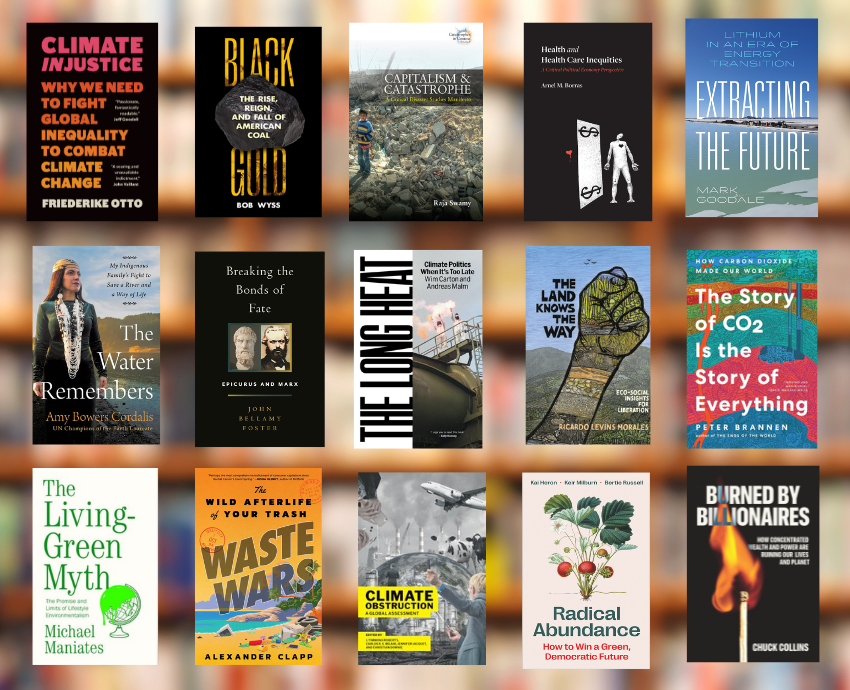
Climate and Capitalism editor Ian Angus presents a bumper crop of books for reds and greens to check out over the holiday break.
* * *
Climate Injustice: Why We Need to Fight Inequality to Combat Climate Change
By Friederike Otto
Greystone Books
Climate scientist Otto shows how global inequality is exacerbating the effects of climate change and exposes damning truths about the failures of political and social infrastructures around the world — failures that ensure the rich are protected while others bear the brunt of climate disasters.
Black Gold: The Rise, Reign, and Fall of American Coal
By Bob Wyss
University of California Press
As the coal industry developed, so did clashes between powerful tycoons, coal miners and innocent families. Exploitation and avarice led to victimisation, deadly violence and ultimately a militant union movement. Today, coal combustion plays a major role in deepening the global climate crisis, endangering still more lives.
Capitalism and Catastrophe: A Critical Disaster Studies Manifesto
By Raja Swamy
Berghahn
The term “natural disaster” looms large in conventional discourse. Given the links between capitalism, climate change, pandemics and war, the distinctions drawn between human activity and “natural” hazards are unsupportable. Swamy offers a Marxist framework for the study of disasters, viewing them as moments that reveal class power in operation.
Health and Health Care Inequities: A Critical Political Economy Perspective
By Arnel M Borras
Fernwood Publishing
Borras uncovers the root causes of health and healthcare inequities, including unequal wealth and power among policy advocates, the dominance of big business and neoliberal state policies. He challenges prevailing narratives, showing that capitalism, integrally imbricated with neocolonialism, racism and sexism, is the fundamental driver of health and healthcare inequities, and argues for socialist solutions.
Extracting the Future: Lithium in an Era of Energy Transition
By Mark Goodale
University of California Press
The lithium economy is deeply embedded in a system that relies on resource extraction, unsustainable economic growth and geopolitical violence. Goodale traces the development of Bolivia’s closely guarded lithium project, highlighting the fundamental contradiction of a green energy transition that is dependent on a non-renewable resource.
The Story of CO2 is the Story of Everything: How Carbon Dioxide Made Our World
By Peter Brannen
HarperCollins
CO2 isn’t just a byproduct of burning fossil fuels — it is also fundamental to how our planet works. All life is ultimately made from it, and it has kept Earth habitable for hundreds of millions of years. Understanding the carbon cycle sheds light on the causes of environmental catastrophe — and the solutions.
The Water Remembers: My Indigenous Family’s Fight to Save a River and a Way of Life
By Amy Bowers Cordalis
Little, Brown & Company
A moving multigenerational memoir of Indigenous resistance, environmental justice and a Yurok family’s fight to protect their legacy and the Klamath River. As General Counsel for the Yurok Tribe, Cordalis held powerful corporate interests accountable for environmental destruction and spearheaded the largest river restoration project in history.
The Land Knows The Way: Eco-Social Insights for Liberation
By Ricardo Levins Morales
RLM Arts Studio
A memoir of a committed life, an activism manual, a meditation on ways to creatively and effectively respond to living in times that are, on the one hand, unprecedented and unique, and on the other, part of longstanding and familiar historical cycles. The son of a world-leading Marxist biologist is a visual artist and fighter for social justice with his own powerful voice.
The Long Heat: Climate Politics When It’s Too Late
By Wim Carton and Andreas Malm
Verso
The world is crossing the 1.5°C global warming limit, perhaps exceeding 2°C soon after. What is to be done when these boundaries, set by the Paris Agreement, have been passed? Carton and Malm deliver a scathing critique of proposals to geo-engineer our way out of climate disaster — only social and political transformation can save humanity.
Breaking The Bonds Of Fate: Epicurus and Marx
By John Bellamy Foster
Monthly Review Press
Karl Marx wrote his doctoral thesis on Epicurus, but until now little attention has been given to how the ideas of the ancient Greek materialist philosopher influenced Marxist thought. Foster’s pathbreaking and insightful study transforms our understanding of the profound connections between these two great thinkers.
Radical Abundance: How to Win a Green Democratic Future
By Kai Heron, Keir Milburn and Bertie Russell
Pluto Press
Capitalist “abundance” means we have too much of what we don’t need and too little of what we do. We need an alternative, a world of human and non-human flourishing made possible by democratically planned production. The authors argue that a world of radical abundance can only be made by taking control of our collective reproduction in the here and now.
Burned By Billionaires: How Concentrated Wealth and Power Are Ruining Our Lives and Planet
By Chuck Collins
The New Press
The actions of the top .01% have severe consequences for the rest of us, especially those of marginalised identities. Collins takes down the “myth of meritocracy”, unravelling how the rich rig the game in their favour, resulting in a concentration of wealth in the hands of a tiny (but growing) class of billionaires — leading to intense income and political polarisation.
The Living Green Myth: The Promise and Limits of Lifestyle Environmentalism
By Michael Maniates
Wiley
We are told that changing individual behaviour will save the planet. Maniates says that is a con that fosters pernicious assumptions about social change, separates individuals from their real power in the world and fuels damaging consumption. It thrives because it meets the short-term priorities of governments and business, not the long-term needs of the planet’s human and non-human inhabitants.
Waste Wars: The Wild Afterlife of Your Trash
By Alexander Clapp
Hachette
Rich world garbage has spawned a massive, globe-spanning, multi-billion-dollar economy, one that offloads our consumption footprints onto distant continents, pristine landscapes and unsuspecting populations — often with devastating consequences for the poorest nations of the world.
Climate Obstruction: A Global Assessment
Edited by J Timmons Roberts, Carlos Milani, Jennifer Jacquet and Christian Downie
Oxford University Press
Over 100 experts systematically expose the complex, organised and well-funded operators who have actively resisted and undermined policy efforts to address climate change. They make the case that as climate action becomes globalised, efforts to obstruct it have become more deceptive, widespread, better funded and dangerous.
[Reprinted from Climate and Capitalism, where this column appeared in two parts. Inclusion of a book does not imply endorsement.]