
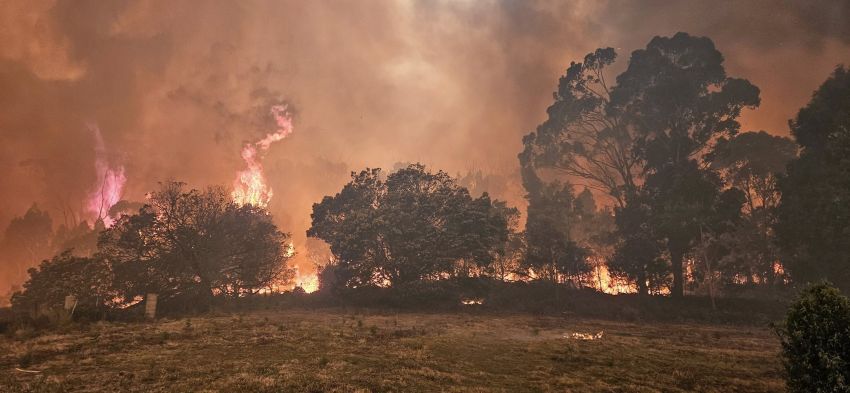
After a period of hotter-than-normal temperatures and below-average rainfall, a series of intense bushfires swept across the New South Wales central and mid-north coast and Tasmania’s east coast, destroying dozens of houses. A NSW firefighter died while working in one of the bushfire zones on December 7.
The Bureau of Meteorology has ominously predicted “unusually high” summer temperatures for most of Australia, heralding a higher risk of extreme bushfires, storms and heatwaves.
Australia is already experiencing climate impacts — longer droughts, more frequent and intense heatwaves, rising sea levels and ocean acidification — due to 1.5ºC of warming. It is becoming increasingly clear that we are in a climate emergency, driven by intensive fossil fuel use — the biggest driver of climate change.
The federal government’s National Climate Risk Assessment, released in September, outlines some of the predicted climate change impacts. With warming of 3ºC above pre-industrial levels by 2100 — which is the most likely scenario based on current emissions pathways — Australia would experience catastrophic climate-related impacts.
Heat-related deaths are expected to rise by dramatic percentages, particularly in the major cities: Gadigal Country/Sydney (440%); Garramilla/Darwin (420%); Boorloo/Perth (300%); and Naarm/Melbourne (260%). Heatwaves already cause more deaths than floods, bushfires and cyclones combined, killing an estimated 1009 people in 2016–19.
Sea levels are likely to rise one metre — having already risen 20 centimetres, on average, since 1880 — doubling the number of people exposed to coastal hazards to 1.5 million by 2050. Under this scenario, Magan-djin/Brisbane would experience 314 days of flooding each year, on average.
The Global South is the most badly impacted, mostly due to industrial countries’ fossil fuel dependence, rising greenhouse gas emissions and a lack of adequate climate adaptation.
Australia plays a major role in driving global climate change, as the second-biggest exporter of greenhouse gas emissions through coal and gas, which represent three times its domestic footprint.
A Lancet climate change report published in October details the millions of needless deaths each year due to heat, air pollution, disease spread and worsening food insecurity. Heat-related deaths have risen by 63% since the 1990s, causing, on average, 546,000 deaths annually in 2012–21.
Longer and more extreme bushfire seasons driven by climate change caused an estimated 154,000 deaths last year. Human activity has added 40 days, on average, to the global bushfire season.
Fossil fuel-derived outdoor air pollution caused 2.5 million deaths in 2022, while indoor air pollution caused 2.3 million deaths.
However, the governments and corporations that contribute to these preventable deaths will happily keep exploiting fossil fuels as long as they stand to profit. As of March, the world’s 100 biggest oil and gas companies were on track to produce, by 2040, nearly three times more greenhouse gas emissions than the limit to keep global warming to 1.5ºC.
Stockholm Environment Institute’s Production Gap report, released in September, found that the 20 biggest emitting countries' official targets for fossil fuel production in 2030 would produce emissions 120% higher than is consistent with 1.5ºC global warming and 77% more than 2.0ºC.
Australia's Labor government contributes to this terrifying scenario, despite claiming to be committed to climate action. While discussing the government’s new emissions target in September, climate change minister Chris Bowen dubiously claimed that it is pursuing “maximum possible effort”.
But Labor’s 2035 emissions target of 62–70% below 2005 levels is grossly inadequate. Even a 70% reduction aligns with 2.3ºC of warming, it is not enough to avoid the catastrophic climate impacts which even Labor’s own National Climate Risk Assessment identified.
Labor is strongly committed to supporting the fossil fuel industry, providing about $12.5 billion in fossil fuel subsidies over 2024–25 — mostly in tax concessions. This costs $28,381 for every minute of every day.
The government has budgeted for more than $55 billion in subsidies over the lifetime of fossil fuel projects and programs — a 3% rise on the previous financial year.
Labor has approved 32 new or expanded fossil fuel projects since 2022, which makes it directly implicit in worsening future bushfires, hurricanes, droughts and floods. There are at least 42 coal and gas projects waiting for approvals.
Meanwhile, Labor’s Disaster Ready Fund, to aid “emergency response and recovery” and “natural disaster resilience”, has a balance of just over $5 billion, with just $200 million allowed to be withdrawn annually. The fund has been criticised for lack of transparency or community involvement in long-term planning, and an unjust 50% co-contribution requirement.
The Prime Minister’s claimed concern for those impacted by the climate emergency rings hollow while he backs the fossil fuel industry. Thousands of activists shone the spotlight on the PM’s climate deception at the Rising Tide People’s Blockade, which succeeded in shutting down the world’s biggest coal port in Muloobinba/Newcastle for a weekend.
First Nations custodians’ fight to save ancient petroglyphs from destruction by fossil fuel and fertiliser projects on the Murujuga (Burrup) Peninsula in Western Australia is another example. Building a mass climate movement is the only hope to stop the corporate-driven fossil fuel expansion.