
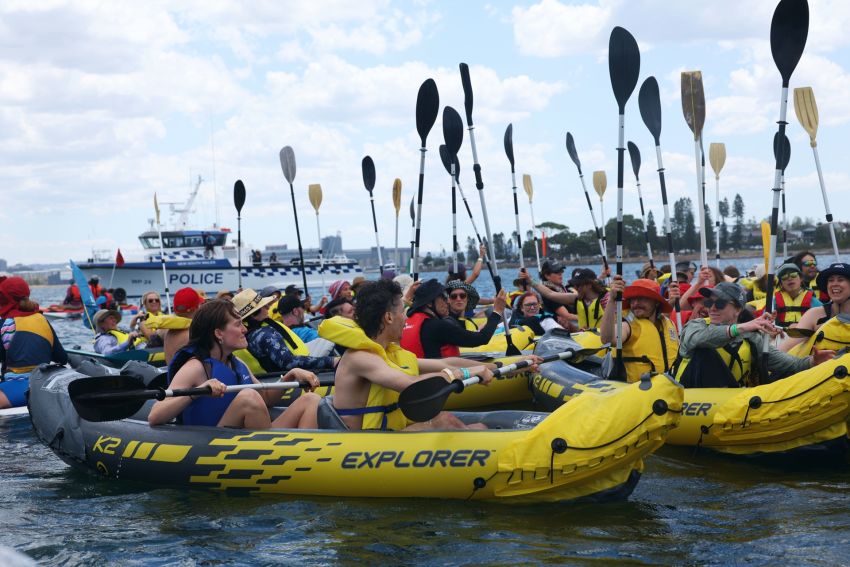
As Prime Minister Anthony Albanese crowed about Labor’s amendments to the Environment Protection and Biodiversity Conservation Act (EPBC Act) on November 27, thousands of people were preparing to blockade the world’s biggest coal port in Muloobinba/Newcastle.
Young people, First Nations, climate and justice activists showed their opposition to the political and corporate elites that refuse to take action to curb dangerous carbon emissions.
Earlier, environment minister Murray Watt had cynically declared he would make a deal with the Greens or the Coalition to get Labor’s amendments through. While the Greens secured some concessions and agreed to support the bills, they said the changes were “woefully short” of what is needed.
The Greens managed to cut the deadline for the logging industry to comply with the laws from three years to 18 months. Until now, it had been exempt.
Also, the coal and gas industries will now be unable to fast track major projects — in 30 days — as Labor had proposed.
The EPBC Act will retain a “water trigger” — requiring federal government assessment for big coal and gas projects that will have significant impacts on water resources (even though this has not always been effective).
Labor had threatened to remove it, although it has been suggested this was more a bargaining chip to secure the Greens’ support.
Adam Morton argued in the Guardian that the EPBC Act, originally legislated under Coalition Prime Minister John Howard in 1999, “does not prioritise environmental protection” and has “spectacularly failed to deliver it”. He said a better approach would have been “to scrap and replace the act”.
Labor’s amendments failed to consider climate impacts. The Greens had called for a “climate trigger”, which would have forced the minister to consider climate impacts before approving projects.
Labor refused to consider it.
While fossil fuel corporations will have to report expected emissions over the life of the project, these will not be taken into consideration when deciding if such a polluting project gets approval.
While, theoretically, the environment minister can consider climate impacts, there is no requirement that they do.
The recent deadly storms in South and South East Asia, which have killed more than 1600 people, show the climate catastrophe is already here and the window to take effective climate action is rapidly closing.
Big business was happy with Labor’s changes to the environment laws — Chevron confirmed a $3 billion expansion of its Gorgon LNG facility on the North West Shelf in the wake of their passage.
As the major parties continue to do the bidding of fossil fuel corporations, the climate movement faces a major challenge to grow and diversify.
The only real hope for preventing climate breakdown lies with grassroots activism and resistance — such as the Rising Tide People’s Blockade, where 8000 people succeeded in shutting down the world’s biggest coal port for a weekend.
The Port of Newcastle had scheduled 15 coal ships over the weekend, which was cut to five. According to Rising Tide, all but two ships were stopped.
“Capitalism is sending us to the brink of extinction, so we’re rising up,” Socialist Alliance organiser Rachel Evans told Green Left. “Labor has dumped workers in the fossil fuel industry down the drain by refusing to come up with a just transition for sustainable jobs in the Hunter and elsewhere.”
Another activist said: “I’m protesting the fact that the coal billionaires are not paying as much tax as I am.”
Another blockader said that he was concerned that Australia is not doing enough to meet its global climate targets. “Politicians are sitting pretty in Canberra, while workers in the Hunter region are edging closer and closer to complete collapse of the industry,” another said.
Another said: “If we keep burning fossil fuels, that is a death sentence for humanity and the ecological systems that support life on earth”.
Rising Tide has methodically worked hard over several years to mobilise many thousands to the Port of Newcastle to oppose bipartisan support for expanding Australia’s reliance on, and export of, fossil fuels.
However, to stop the fossil fuel industry and its bought-and-paid-for governments from destroying our future, the climate movement faces a challenge to involve communities whose current focus is, understandably, on their livelihoods.
Challenging Labor’s hollow claim to support workers as well as the climate has to become central to growing the movement.
[Alex Bainbridge is a long-term climate activist and a member of the Socialist Alliance.]