
The Age published a report on November 8 with some colourful confessions from former Australian army rifleman Oisin Donohoe.
Donohoe alleged that the private security responsible for overseeing “unlawful non-citizens” transferred from Australia to Nauru would be staffed by members of the Finks outlaw motorcycle gang.
“It was pretty confronting to know that an outlaw motorcycle group was running a company that had got a government contract”, he said. It was “mind-boggling” that such figures could participate in a “contract to oversee quite a significant national security item on the agenda”.
This takes the privatisation of security to a new level.
Safe Hands Security, the labour-hire company responsible for recruitment, is steered by Finks gang leader Ali Bilal and generously staffed by members of his bikie gang.
Since February, the company has been negotiating with Nauru Community Security, the entity responsible for providing escort to the Nauru Regional Processing Centre in the form of a Quick Reaction Team (QRT).
According to Donohoe, no security clearance was needed for recruits, while the Australian Federal Police (AFP) was engaged in logistical matters relating to the transfers. Furthermore, he has evidence that Bilal was directly overseeing recruitment for the QRT.
In further troubling revelations for Labor, a second whistleblower, home affairs assistant secretary Derek Elias, has shown how rotten the awarding and implementing of contracts regarding offshore detention has been.
This decay was already noted in a 2023 investigation by the Age, the Sydney Morning Herald and 60 Minutes.
A money trail could be found going from the home affairs department to businesses controlled by Nauru’s politicians. A good number benefited, including current Nauruan President David Adeang.
Risking public prosecution for disclosing protected information, Elias is eminently qualified to comment, having overseen the contract regime from 2019–21.
In an interview with 60 Minutes, he noted the rampant abuse of taxpayer dollars on inflated contracts, the payment for services never delivered and expenditure on such luxury assets as mansions, yachts and art by unscrupulous contractors.
This grotesque résumé did nothing to stop Nauru being promised Australian largesse to the sum of $2.5 billion to resettle a cohort of designated “unlawful citizens” who could not be indefinitely held in Australian detention.
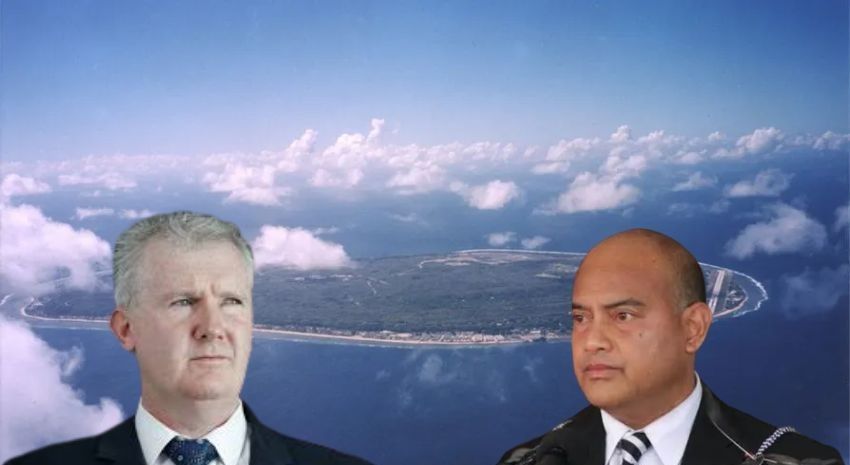
That shady understanding was reached between Australian home affairs minister Tony Burke and an eager Adeang.
Until that point, penal purgatory had been an Australian specialty for those arriving by boat without the legitimising paperwork.
The 2023 High Court decision in the NZYQ case made it clear that it was illegal to indefinitely hold refugees or asylum seekers who could not return to their countries of origin or find resettlement in a third country. A punitive arm of bipartisan refugee policy had been amputated by judicial fiat.
Releasing such individuals was the last thing either Labor or the Coalition wished for. Incidents of recidivism were given bloated coverage. Those who had committed no offences were bundled together with those who had, and served their time, in the rhetoric of hysteria. How, then, to get rid of them?
A reliable vassal state that had been plundered for its main resource — phosphate — was ready and willing. Labor was eager to run roughshod over procedural fairness.
The Anthony Albanese government duly amended the Migration Act 1958 in August to enable the deportation of non-citizens without notice or a right to appeal, supplementing existing, draconian machinery, introduced last year, to jail those refusing to cooperate in their own deportation.
Surreptitiously, Canberra began to revitalise Nauru, ignoring the recommendations of former domestic intelligence spy chief Dennis Richardson in his October 2023 review of regional processing arrangements. (An unclassified version of the report was released in February last year).
The payments to Nauru are intended to come in the form of an initial sum of $408 million, followed by $70 million worth of annual payments over the course of 30 years. Finks promises to feature most prominently in this.
Nauru has also become an absurdly outgrown feature of Australia’s fixation with Chinese influence in the South Pacific.
The Nauru-Australia Treaty of December last year reads like an open chequebook for the acquisitive Adeang and his grasping cronies.
Australia, for instance, promises support for the island’s “economic resilience, fiscal stability and prosperity”, critical infrastructure such as “sustainable banking services”, collective security and “consultation on Nauru’s security and defence-related needs”.
Such undertakings are done with a haughty caveat: Australia has the right to veto the involvement of any foreign power regarding Nauru’s critical infrastructure and security.
Given these considerations, Donohoe is adamant that Canberra’s professed ignorance regarding bikie involvement in the offshore detention system is unsustainable. “I don’t think there’s any way possible they [the federal government agencies] didn’t know.”
The matter looks worse given his complaints to the Australian Tax Office, the Australian Securities and Investments Commission and the AFP.
And, despite knocking at the door of senior Labor and Coalition MPs, only one crossbencher, Jacqui Lambie, was willing to put questions to parliament.
The home affairs department is denying the existence of any contracts with Safe Hands. With hand-washing vigour, it claims there is no link between the refugee deal and the security arrangements being put in place on Nauru.
Private contractors tend to be the quotidian thugs of refugees and asylum seekers; having bikie gangs run the odious show may be a distinction without a difference. Organised crime long offered its attractions for government agencies and courting its members so blatantly has its gruesome logic.
But Labor, again shown up for its callousness and injudiciousness, prefers secrecy. Referring the matter to another secretive body, the National Anti-Corruption Commission, will further serve the cause of opacity.
[Binoy Kampmark lectures at RMIT University.]