
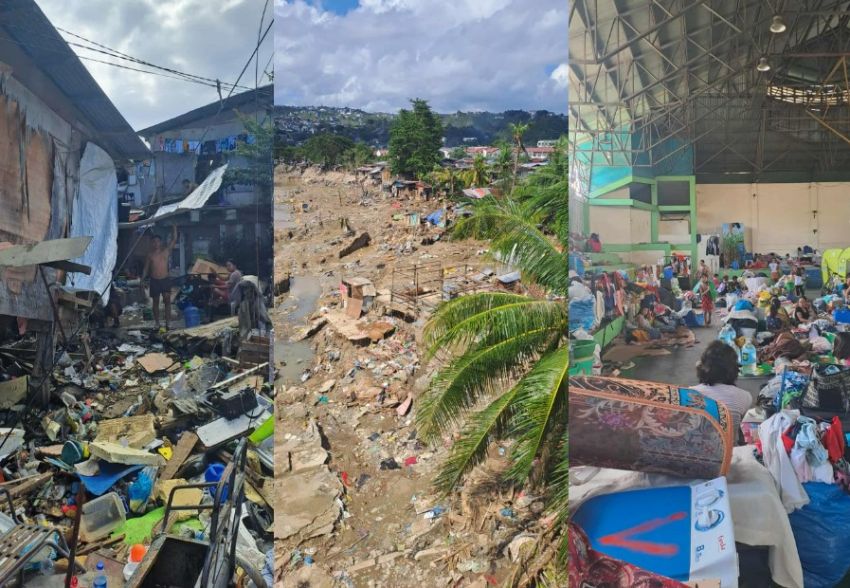
As governments geared up for the COP30 climate conference in Brazil, the Philippines was hit by two climate disasters on November 3 and 9.
As the recovery effort from Typhoon Kalmaegi and Super Typhoon Fung-wong continued, Green Left’s Peter Boyle spoke with environmentalist and socialist Khyl Ramos about the impact of these events, grassroots and government responses and the struggle for climate justice. Ramos is a member of the Partido Lakas ng Masa (Party of the Labouring Masses, PLM) and works on the PLM’s green communities program.
* * *
Super Typhoon Fung-wong has come to the Philippines hot on the heels of Typhoon Kalmaegi. Can you give us a picture of the scale of the impact of these events?
These two typhoons, striking within a week, have brought unprecedented devastation to different parts of the Philippines.
Typhoon Kalmaegi (locally known as Typhoon Tino) affected the Visayas, while Super Typhoon Fung-wong (locally known as Super Typhoon Uwan) carved a path of destruction across Luzon. These calamities have left communities reeling, particularly as they came in quick succession amid ongoing recovery efforts from a recent 6.9-magnitude earthquake in Cebu [in September].
In the case of Kalmaegi, the Visayas bore the brunt of the storm’s impact. Cebu was the hardest hit, recording at least 141 deaths, 57 missing and 123 injured, followed by Negros Island, where at least 40 people died and dozens more went missing. Across the Visayas, at least 224 people died, 135 reported missing, and 156 injured as of early November.
Entire communities were swept away by flash floods and landslides, displacing hundreds of thousands of residents. Local officials described it as the worst flash flood in Cebu’s history, affecting 35 municipalities and forcing more than 450,000 people to evacuate.
The huge volume of rainfall caused rivers to overflow and tore through cities like Danao, Mandaue and Talisay. In some areas, even large concrete homes were submerged, an indication of how extraordinary this flood was. Many communities remain without electricity and clean water.
PLM has active chapters in these affected provinces, and its Cebu headquarters was temporarily converted into an evacuation centre accommodating 30–40 families.
This has allowed our local community organisers to speak directly with residents, hearing firsthand accounts of loss and anger over the failures of both local and national disaster preparedness systems.
Residents told them that they hadn’t evacuated initially because previous floods never reached their neighbourhoods. However, this time, even elevated areas went under. The destruction was compounded by environmental degradation, with active quarrying and reclamation operations weakening natural barriers and drainage systems and worsening the flood impact.
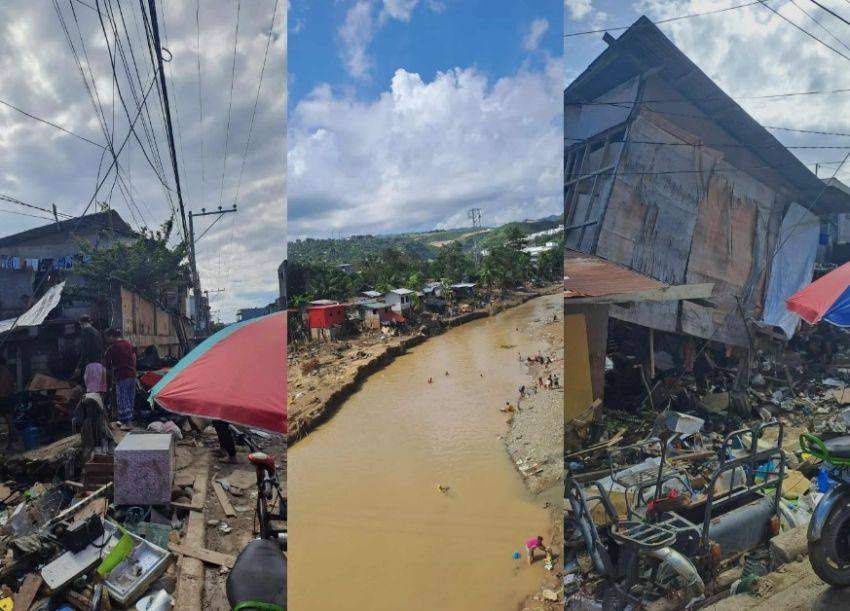
Just as the country began recovering from Kalmaegi, Super Typhoon Fung-wong — the 21st typhoon to hit the Philippines this year — made landfall.
It was one of the largest in recent years, its massive 1118-mile (1800 km)-wide band of wind and rain covering nearly two-thirds of the archipelago. Though it skirted parts of the Visayas already battered by Kalmaegi, its main impact was in Luzon, where it triggered flash floods, landslides and coastal storm surges, particularly in the Bicol Region and the province of Aurora.
Fung-wong displaced 1.4 million people, left eight dead and knocked out power for nearly 3 million households.
In Catanduanes, floodwaters rose to rooftop levels, trapping residents in low-lying neighbourhoods. Many of those affected were already recovering from previous disasters, highlighting how the cycle of vulnerability deepens with each successive storm.
In response, the national government has declared a year-long state of emergency, recognising the cumulative impact of these disasters, with nearly 2 million affected and more than half a million displaced, on top of the earthquake damage in Cebu.
But beyond statistics, these storms lay bare the growing violence of the climate crisis. According to scientists, the rate of super-typhoons hitting the Philippines has doubled over the past two decades, and the country now suffers an average of US$3.5 billion (A$5.4 billion) in climate-related damages annually.
What we are seeing in the Philippines is climate injustice in real time: communities already marginalised by poverty, displacement and environmental exploitation are the first and hardest hit. The stories here are not just stories of disaster — they are stories of systemic neglect and the urgent need for global solidarity to confront the root causes of this worsening crisis.
In previous disasters, the Philippine government has struggled to respond promptly and effectively. Is it the same again and what is behind this?
Unfortunately, yes, as what we are seeing again is a disaster made worse by corruption, neglect and a governance system that prioritises profit over people. As such, Fung-wong and Kalmaegi have once more exposed not just the vulnerability of our communities but also the rot at the core of Philippine governance systems.
In July, just months before these storms, the country was disturbed by revelations of a ₱118 billion (A$3 billion) flood-control corruption scandal. Funds intended for disaster prevention and mitigation were allegedly funnelled to favoured contractors, lawmakers and political allies.
A case in point was in Bulacan, a flood-prone province, where a ₱55 million (A$1.4 million) flood-control project was declared “completed” on paper but was non-existent in reality. Residents there have been enduring floodwaters that take months to subside because the promised infrastructure was simply never built.
Significantly, this is one of the biggest corruption scandals in recent Philippine history, and yet, a hundred days after the exposé, not a single major figure has been jailed. That says everything about the impunity and elite capture of the system.
Consequently, this scandal sparked widespread outrage and spontaneous protests, especially among young people and Gen Z activists, who have been at the forefront of demanding accountability.
The government’s disaster response has been slow, fragmented, and largely performative. While millions suffer, traditional politicians (or trapos as we call them) are more focused on band-aid or non-existent solutions.
In Cebu alone, where ₱26 billion (A$680 million) was allocated for 414 flood-control projects, many turned out to be “ghost” or substandard projects (similar to Bulacan). These collapsed during the typhoons, causing deaths and further flooding.
Alarmingly, reports surfaced that eight local officials travelled to Europe even as Kalmaegi approached. This is not just incompetence — it is contempt and disservice for the people they are supposed to serve.
The problem goes deeper than disaster mismanagement — it is structural. We are dealing with a governance model rooted in corruption, political dynasties and capitalist interests, where disaster funds become personal profit streams. There is no accountability, no long-term planning and no participatory mechanisms that empower communities to prepare for and respond to crises.
Behind these failures is massive environmental destruction, which worsens disaster impacts.
The government has allowed illegal logging, mining and dam construction in ecologically critical areas like the Sierra Madre mountain range — the country’s last frontier of biodiversity and a natural buffer against typhoons.
Under the guise of “development”, corporations backed by political elites have continued these extractive projects, such as the controversial Kaliwa Dam, which threatens indigenous communities like the Dumagat-Remontados. Even the Department of Environment and Natural Resources has sanctioned these operations.
Environmental defenders who stand against this system face harassment, red-tagging [labelling as terrorists] and even killings. In line with this, the PLM continues to campaign against the Kaliwa Dam through its green communities initiative, building grassroots power and strengthening community resistance against destructive and profit-driven projects.
Until corruption, elite rule and the commodification of development are dismantled, disasters like Fong-wong and Kalmaegi will continue to expose how deeply unjust our political and economic structures remain.
Cuba was hit recently by Hurricane Melissa, which wreaked havoc throughout the Caribbean, but it managed to pre-emptively evacuate more than 750,000 people from low-lying and coastal areas and mobilise emergency resources. Could the Philippines learn from this?
Absolutely. Cuba’s experience shows us that disaster preparedness is not just about technology or resources, it’s about political will, trust and the class character of the state.
Cuba, shaped by a workers’ state and mass-led institutions, exercises governance through popular power grounded in local and national people’s assemblies. That is why, while Cuba faced the same impact under Hurricane Melissa, it reported only one fatality.
The Philippines, by contrast, recorded hundreds of deaths from Typhoons Kalmaegi and Fong-wong. That difference speaks volumes, not about geography, but about how power is organised, and whose lives the system is built to protect.
Cuba has managed to build one of the world’s most effective disaster preparedness systems, despite six decades of United States economic blockade and severe resource constraints. The key lies in its socialist orientation: disaster risk reduction is treated as a public duty, not a business opportunity.
Every cent of Cuba’s budget is invested in saving lives, through early warning systems, community mobilisation and education, rather than exploited through corruption. In contrast, the Philippine government’s disaster response remains largely reactive, profit-driven and plagued by corruption. When massive flooding hit, entire communities were left defenceless — not because of the disaster itself, but because the funds meant to protect them had already been stolen.
Cuba’s strength lies in its culture of prevention and collective responsibility. Disaster response is woven into daily life through vulnerability mapping, nationwide evacuation drills and grassroots participation.
The Cuban state prioritises human life above profit. By contrast, in the Philippines, resilience is romanticised and misused, a political narrative that glorifies survival while masking government failure. Leaders parade the idea that “Filipinos can survive anything”, while continuing to deny people the resources and governance systems that would make survival unnecessary in the first place.
Further, Cuba offers a striking example of how nature-based and science-driven approaches, for example Tarea Vida (Life Task) [its state plan to tackle climate change], can be effectively integrated into disaster risk reduction and management. It recognises the vital ecological roles of mangroves, wetlands and coastal forests as natural barriers.
In contrast, the Philippines continues to prioritise concrete infrastructure over ecological protection, cutting budgets for climate science, disaster communication and community preparedness, even as billions of pesos flow into flood-control projects riddled with corruption.
Cuba’s experience shows that when working people hold economic and political power, societies become more humane, equitable and resilient to the climate crisis. Its framework demonstrates that real sustainability cannot exist under systems built on exploitation, but only under those rooted in collective welfare and harmony with nature.
For PLM, this is precisely the vision: a people’s government grounded in socialist and ecosocialist principles, where planning, resource use and disaster response serve the needs of the masses and not the greed of the elite. Cuba proves that an alternative system is not only possible, as it is already working.
Experts have calculated that while the richest countries in the Global North are responsible for 90% of global warming, 90% of the costs of the impacts of global warming (and 99% of the deaths caused) are in countries in the Global South. What do you think should be done about this?
The climate crisis is, at its core, a crisis of injustice and inequality. This is a product of centuries of exploitation by capitalist systems that enriched the Global North while devastating the Global South. This asymmetry reveals what climate justice movements have been saying all along: climate change is not a neutral ecological problem but a profoundly political one.
As such, we must move beyond rhetoric and make mechanisms like the loss and damage fund truly work, delivering real financial and technical support to Global South communities.
There should be reparations for historical and ongoing harm. The principle is simple: those who polluted the most must pay the most. Climate finance must therefore be reframed through accountability, not just about mobilising funds, but about dismantling the global systems that enabled such destruction.
Developed countries must commit to deep emissions cuts, phase out fossil fuels and end the operations of major carbon polluters. One powerful example of resistance is unfolding in the Philippines, where 67 survivors of Super Typhoon Odette (Typhoon Rai) in 2021 have filed a groundbreaking case against Shell this year. This case challenges decades of corporate climate denial and ecological destruction, which made disasters like Odette far deadlier, killing more than 400 people, displacing 3.2 million and destroying more than 1.4 million homes. Legal and grassroots actions like these are essential in demanding accountability and setting precedents for reparative justice.
But beyond litigation and finance, the struggle for climate justice is also a struggle for systemic change. Financing alone will not solve the problem if the world remains governed by the same extractive and profit-driven systems that created it.
What we need is not just climate reform, but a socialist alternative to the climate crisis, one that ends the commodification of nature, labour and life itself. This means confronting the systems that allow corporations to plunder lands, exploit workers and profit from disaster recovery. It means reclaiming our economies, reorienting production toward need rather than profit, and centring community-led adaptation and decision-making.
As with PLM, it is through a gobyerno ng masa (government of the masses) who must lead this transition. Such a system could serve as a model of governance, where people’s councils, not corporate elites, shape policies over land, water and energy.
Ultimately, the answer lies in collective liberation, such as building global solidarity to dismantle the structures of imperialist extraction that define our world. The fight for climate justice is inseparable from the fight for social justice, and it is only through a system that prioritises life over profit that we can truly survive and thrive in the face of the climate emergency.
COP 30 has just begun in Brazil. What message should the delegates there take from the experiences of countries like the Philippines from these recent extreme weather events?
As COP30 opens in Brazil, the message from countries like the Philippines should be loud and clear: we contribute less than 1% of global carbon emissions, yet we are among the most devastated by the climate crisis. Every super typhoon, every submerged village, every displaced community is a living testament to a system that puts profit before people.
These so-called “natural” disasters are not natural at all; they are the outcomes of exploitation, extraction and oppression maintained by the Global North and its corporate allies. While the richest nations continue to burn oil and profit from carbon markets, the Global South is left drowning in the consequences. From flood-control corruption scandals to the destruction of our mountains and coasts by mining and dam projects, we see how capitalism and corruption intertwine to deepen vulnerability and erase accountability.
What delegates in Brazil must hear is this: we don’t need more pledges — we need system change. There must be an end to corporate capture, extraction and plunder of the Global South’s lands, waters and labour.
COP cannot continue as a stage for elite greenwashing while communities are dying. We demand a rapid, just and equitable transition — an ecosocialist one at that — that dismantles fossil capitalism, ends the oil imperialism and centres the working class and marginalised peoples in shaping climate solutions.
There is blood on the hands of big polluters and political elites who claim climate leadership while perpetuating this crisis. They should not only pay as they must be held accountable. The climate emergency is not an accounting error to be offset; it is a crime against humanity and nature.
If COP30 is to mean anything, it must not be another platform for posturing while the world burns. It must become a people’s COP — one that listens to indigenous communities, farmers, fisherfolk, women, youth and workers who live the realities of climate destruction.
Only through an ecosocialist principle, where power rests in the hands of the people and production is reoriented toward social and ecological wellbeing, can we avert further catastrophe. Anything less is complicity.
