
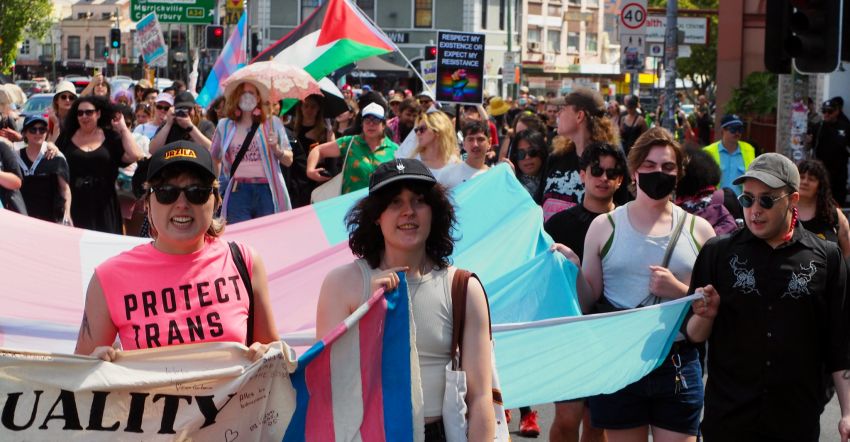
What is at the heart of wanting to include NSW Police at Mardi Gras? Is it a fear that, if they are not included, it will give them licence to brutalise the LGBTIQ community more? Or refuse to work with us?
If so, that is a terrible indictment of an institution that supposedly provides safety and protection.
That might be a bad faith interpretation of Protect Mardi Gras (PMG), the group campaigning to “keep Mardi Gras inclusive”.
There are four vacant board positions to be filled in the Mardi Gras election on November 29. There are also nine resolutions, including for Mardi Gras to commit to the Boycott, Divestment and Sanctions campaign, endorsed by the pro-Palestine movement, and to disinvite NSW Police from marching in a formal parade float.
Pride in Protest is campaigning for these two resolutions, arguing that Mardi Gras should embrace its radical protest history.
Perhaps the reason for PMG wanting to include the police in the parade is because these queers have friends and family in the police and want them to march. While that may be understandable, it is a misunderstanding of why so many Pride marches, across the world, have banned police — specifically in uniform — from marching.
Queers who want police to march at Mardi Gras don’t see, or understand, the real critique of police as a fundamentally harmful institution. Police are not friends of working-class queers, or queers who protest against a genocide or mentally ill and drug dependent queers.
PMG’s call for police to be included in the parade serves queers — whom the mainstream deem worthy of protection — mostly white, affluent professionals who have no hesitation in calling police if they become the victim of a crime. Perhaps PMG is eager to return a favour?
Police may no longer be locking up gays for being gay, but plenty of communities remain the targets of their brutalisation.
For instance, police harassment of First Nations communities means Australia has the highest incarceration rate, based on race, outside Apartheid-era South Africa.
PMG lacks a theory of change that is grounded in solidarity with people and communities most likely to be over-policed and incarcerated.
What is the role of police? Upholding the status quo and the protection of private property. And this often means protection of the racist, colonial structures of the status quo.
Police will side with a landlord when they want to kick out a tenant struggling to pay rent. Police will protect a weapons expo, even in a genocide, and brutalise those protesting it. Police will strip search, violate and charge people for possession of small amounts of drugs.
If PMG believes that police do harm some communities, how does it think the institution can be transformed? I’ve asked, but have always been pointed to a website — which didn’t give any real answer.
There are multiple levers for change and a spectrum of tactics.
I understand that sometimes you have to work on the “inside” to achieve specific change, and you do have to compromise and shift tactics. If that is what will save lives right now, I’ll do it.
But one thing I would never do is enter a fight without a demand. PMG has no demands, just a weaponised understanding of “inclusion”. PMG would have one believe that not letting police into the parade is “exclusionary”. It does not critique its practice of policing poverty and those with mental illnesses and drug dependency.
PMG talks up “strategic inclusion”, “building broad alliances” and “unity”. But these often-overused words are aimed at “respectable” queers, who defend the status quo.
Mardi Gras has radical potential; it could be a powerful platform to organise for social change, for solidarity across diverse communities and against injustice.
Solidarity is transformative; it creates bonds and builds social cohesion. Instead of focusing on solidarity with police, PMG should focus on solidarity with Palestinians, the Muslim community, refugees and asylum seekers and First Nations communities.
Mardi Gras is both a party and a protest, but PMG is trying to make it a party only. The police are not our allies and we should be under no illusion that they ever will be, as that is not their institutional function. If the state decides to take a Trumpian-style heel turn on LGBTIQ rights, the police will be there to enforce it with bells on and a gun on their hip.
[Troy Thrace is a community organiser campaigning for a vote for Pride in Protest in the Mardi Gras board elections. You can follow his rants, ruminations and reviews about politics and film on his Letterboxd.]