-
Sixty years ago, in June 1954, a CIA-orchestrated coup ousted the reformist Guatemalan government of Jacobo Arbenz Guzman. The coup installed a brutal right-wing regime and decades of bloody repression. This event, so notorious in the annals of US imperialism, also Guevara. For it was in the Central American nation, where Guevara's Latin American road trip culminated, that the strands of his early thought Marxism, anti-imperialism, indigenismo were fused in a dramatic, galvanising moment. -
The European parliamentary poll on May 25 was dominated by the victories of the xenophobic and racist National Front (FN) in France (26%, 24 Members of the European Parliament) and the United Kingdom Independence Party (UKIP) in Britain (26.8%, 24 MEPs) — triggering a fit of mainstream media angst.
-
In Washington, the Foreign Relations Committee of the US Senate approved, in a 13-to-2 vote, the “Venezuelan Human Rights and Democracy Protection Act” on May 20. The bill includes sanctions on key Venezuelan government representatives and at least US$15 million to “defend human rights… and strengthen the rule of law”. Committee chair, Democrat Robert Menendez, played a lead role in the writing of the proposed legislation. He plans to present the bill before the whole Senate in the coming weeks.
-
“We walked and walked and walked for days until we finally settled on the beach of Damour,” said 80-year-old Um Zohair. “On the beach we fetched green banana leaves together and with bamboo sticks we made a hut that sheltered us for three months on the sand.” Sixty-six years ago, Um Zohair was one of hundreds of thousands of Palestinians ethnically cleansed from their homeland, Palestine. “That was the first time we were displaced,” she said. Since the ethnic cleansing of Palestine in 1948, a series of upheavals and struggles has marked Palestinian refugees’ nomadic life in exile.
-
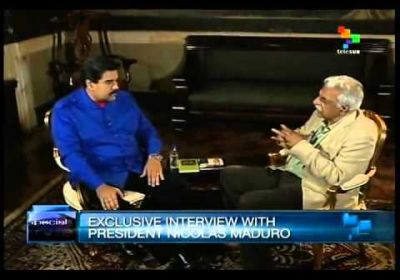
Venezuela and Palestine have signed fresh agreements on oil, taxation and diplomatic cooperation, Venezuela Analysis said on May 19. The agreements were made during a visit by Palestinian president Mahmoud Abbas to Venezuela. In a key agreement, Venezuela created a new corporation, Petro-Palestina, through which Venezuelan state oil company PDVSA will send oil to Palestine at a subsidised price. Venezuelan president Nicolas Maduro committed to sending an initial shipment of 240,000 barrels of oil.
-
Sonny Melencio is chairperson of the Filipino Party of the Labouring Masses (PLM) and a former council member of Solidarity of Filipino Workers (BMP). Melencio is also involved in a new coalition against the established “political dynasties” in the Philippines, called Alliance for Truth, Integrity and Nationalism (ATIN). -
Bolivian indigenous group the National Council of Ayllus and Markas of Qullasuyu (CONAMAQ) made headlines this year with its threats to blockade the Dakar rally when it passed through Bolivia's highlands region. This was not the first time that the group caught the attention of the world’s media. Leaders of CONAMAQ have been regularly quoted in the media due to their outspoken criticism of the government of president Evo Morales ― Bolivia's first indigenous head of state. The articles frequently describe CONAMAQ as “the main indigenous organisation in Bolivia's highlands”. -
A recent spate of high-profile campaigns against industrial projects based on extracting raw materials has opened up an important new dynamic within the broad processes of change sweeping South America. Understanding their nature and significance is crucial to grasping the complexities involved in bringing about social change and how best to build solidarity with peoples’ struggles. Many of the campaigns target that specific mining, oil, agribusiness or logging ventures share common elements. -
After a few years in the making, Partizan Travel has finally been launched. It is a social enterprise that provides progressive-minded people across the world the chance to visit various countries in a different, authentic way. Visitors will learn about those nations by meeting grassroots activists and hearing about the history and reality of their struggles. They will take part in political events, enjoy local culture and traditional food.
-
The private media and important actors both at home and abroad, including Washington, have downplayed, and in some cases completely ignored, the terrorist actions perpetrated against the Venezuelan government over the past three months. Among the latest examples that have gone underreported abroad is the assassination in late April of Eliezer Otaiza, a historic leader of the Chavista movement and president of the Caracas city council. -
A high stakes game in the north of Ireland’s unfinished peace process played out before the world’s media last week, writes Irish Republican News.
-
A familiar sea of red shirts, large banners and a revolutionary sing-along soundtrack: at first glance this year’s march for the International Workers Day on May 1 was business-as-usual in the Andean city of Merida. The celebratory atmosphere was due in part to the announcement by Venezuelan President Nicolas Maduro on April 30 of a 30% rise in the national minimum wage.