-
Kobane’s epic resistance against the assault of the genocidal Islamic State (IS) gangs had entered its fourth week by October 10. The defence had held out against overwhelming odds. The defenders had been forced back, but their lines had not been broken. In some neighbourhoods, street fighting was taking place. -
A desperate battle by progressive Kurdish-led resistance fighters is seeking to defend Kobanê from ISIS fundamentalist forces. Kobanê is in Rojava, or Western Kurdistan, is a predominantly Kurdish area in northern Syria that is a semi-autonomous “liberated zone” experiencing a social revolution. -
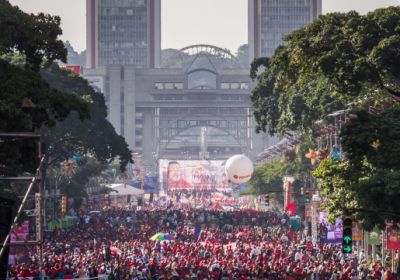
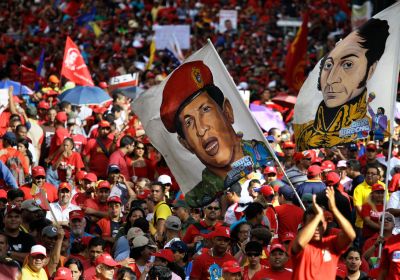
"Venezuela: The revolution continues," was the theme of a solidarity conference held at Redfern Town Hall here on October 6. About 120 people attended the conference, which was organised by the Embassy of the Bolivarian Republic of Venezuela, in conjunction with the Australia-Venezuela Solidarity Network (AVSN), the Bolivarian Circle, the Latin American Social Forum (LASF), other solidarity organisations, unions, and political groups, including Socialist Alliance. -
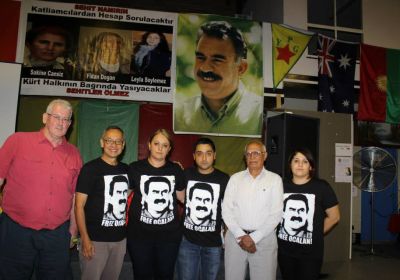
Snap protest was held on September 29 and October 7 in Sydney by members of the progressive Kurdish community. It was called in response to news that ISIS killers had entered the besieged town of Kobane, which is part of the Rojava Kurdish liberated zone in northern Syria. On Friday morning (October 10) members of the community will a protest fast in Sydney Town Hall Square from 9am. A flyer by the Kurdish Association distributed by the Kurdish protesters/hunger strikers in Sydney says:
-
Below is the first part of a statement initially released by Socialist Alliance in Australia on September 24 and updated on October 4. In Sydney, on Friday morning (October 10), members of the community will a protest fast in Sydney Town Hall Square from 9am.
-
After speaking at the United Nations climate change summit on September 23, Venezuelan President Nicolas Maduro seized the chance to visit community leaders, local activists and grassroots groups in an event hosted by Hostos Community College of the South Bronx in New York City. About 1000 people attended the event, which was organised by Citgo, a subsidary of Venezuela's state-own oil company. Many arrived early to wait outside for good seats and to hold signs welcoming Maduro as “president of the people”. The Bronx community
-
Those who were expecting to see the supporters of Scottish independence dispirited ― and who hoped that the issue of independence was settled for at least a generation ― were quickly disappointed after the September 18 referendum. This defeat, in which the pro-independence vote lost by roughly 45% to 55%, bears the seeds of future victory ― for at least three reasons. -
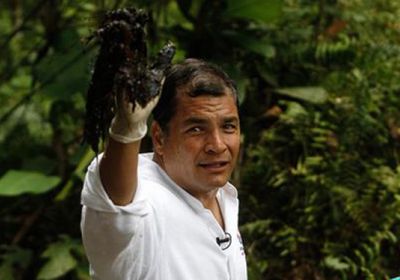
Cables from the first term of Ecuadorian President Rafael Correa show how the US sought to defend the interests of US companies in Ecuador, and protect the position of foreign investors in general. Moves against the power of transnational corporations by Correa's government, first elected in 2006, were seen as attempts to increase control over the economy, which the US government views as the domain of private interests. The US Embassy in Quito therefore tried to influence Ecuadorian economic policy in conjunction with allies from other embassies and from within the private sector.
-
On September 24, one day after the United Nations climate summit in New York once more failed to come up with any form of serious action to confront the climate crisis, Filipino socialist group Party of the Labouring Masses released the statement below. * * * Philippines President Benigno Aquino concluded his United Nations speech in New York on September 23 by posing the question: What more can we do? The question is rhetorical, even hypocritical, as the president well knows what needs to be done: to address the demands of the mass movements, which he has heard, but not heeded.
-
With the US and allied nations, including Arab countries, carrying out air strikes in Syria, the Turkish government is trying to convince the West it does not support the Islamic State (IS) forces the US is targetting. Newly elected President Recep Tayyip Erdogan (the former prime minster) linked the adjective “terrorist” with “IS” for the very first time on September 23 during a US TV interview while attending the United Nations climate summit. “Turkey will do whatever needs to be done to stop this terrorist organisation, militarily, and politically,” he said. -
Besieged since September 15, the northern Syrian Kurdish-majority city of Kobane (whose Arabic name is Ayn al-Arab) has mounted a heroic, all-out resistance to the murderous Islamic State gangs. As of September 25, despite the superior heavy weaponry deployed by the IS, it appears that fierce resistance and determined counter-attacks have halted or slowed the assault. Nonetheless, the IS has pushed closer to the city centre than ever before and the situation remains perilous. -
This year’s September 11 Catalan national day (Diada) demonstration, in support of the Catalan parliament’s planned November 9 popular consultation on Catalan statehood, was the biggest since the present cycle of mobilisations for Catalonia’s right to self-determination began four years ago.