-
SOUTH AUSTRALIA’S ABORIGINAL COMMUNITIES TO REMAIN OPEN Remote Aboriginal communities in South Australia will remain open despite federal funding cuts. Last year, the federal government announced it would leave it up to the states to fund remote communities. About 150 Aboriginal communities in Western Australia are under threat of closure after the Western Australian government refused to step in and fund them. -
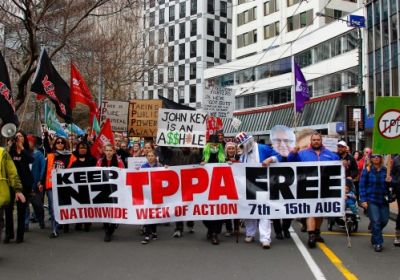
United States politics is witnessing a new sorry spectacle — and one with real consequences for Australia, as well as other nations on the Pacific rim. US President Barack Obama is trying to drum up support from his party to implement the agenda of the huge corporations that sought to block his election and re-election via the proposed Trans-Pacific Partnership (TPP) “free trade” deal involving 12 Pacific rim nations.
-
Australian Nuclear Free Alliance released this statement on April 14. *** A delegation of Australian nuclear free campaigners travelled to Canada to present at the World Uranium Symposium being held in Quebec City on April 14 to 16. The group included representatives from Aboriginal communities impacted by nuclear projects and national environment groups. -
As the Galilee Basin project faces legal challenges by Aboriginal and other community groups and international banks refuse to finance it, the environment movement is focusing its campaign on ensuring that the Australian Big 4 banks also withhold finance. -
Günter Grass, who was one of Germany’s most important post-war novelists, died on April 13 at the age of 87 in the town of Lübeck, in northern Germany. Grass was perhaps most famous for his 1959 book The Tin Drum, a novel that embodied fantastical elements in its critique of Weimar and Nazi Germany. As such, his style bore resemblances to Latin America’s genre of magical realism. In 1979, the book was turned into an Academy Award winning film by Volker Schlöndorff, which won the Oscar for best foreign film. -
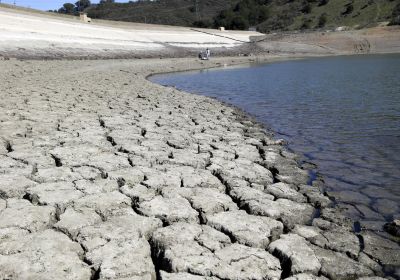
Jay Famiglietti, a senior water scientist at the NASA Jet Propulsion Laboratory in California, made a dire warning in March: there is only one year's worth of water left in the state's reservoir storage and river basins. Famiglietti said even nature's oldest water backup supply —groundwater — could be gone soon after the reservoirs dry up. About 38.8 million people live in California, which produces much of the United States' food. California's drought is throwing the ecology of the region into crisis, and ordinary people are scrambling for ways to help. -
Police have cautioned the Knitting Nannas Against Gas that their actions could be illegal and warned them to stop protesting. For three years the group has met weekly outside the offices of MPs in NSW to protest against coal seam gas development in the state. The nannas say their knitting is a form of non-violent political activism to remind politicians they are being watched. -
The Guardian newspaper was first published in Manchester in 1821. It is generally regarded as a centre-left paper that employs some very fine journalists. Its online edition is one of the most widely read in the world and its combined print and online editions reach some 9 million readers. The paper’s environmental coverage is provided by a team of seven environmental writers and each month four million visitors go to the Guardian for its environmental coverage. -
Ten years ago, the uranium price was on an upward swing. South Australians were dazzled by the prospect of becoming the 'Saudi Arabia of the South' because of the state's large uranium deposits and the prospect of a global nuclear power renaissance. Those comparisons didn't stand up to a moment's scrutiny — Australia would need to supply global uranium demand 31 times over to match Saudi oil revenue. -
David Pocock is a rugby player in the Australian national rugby union team. He was also recently arrested. In reacting to his arrest and the reason for it, some have suggested that Pocock may not be the right man to captain the Wallabies in the future.
-
Why would a 54 year-old woman make a decision to lock herself onto the train tracks of the world’s biggest coal port? Annette Schneider, an artist and farmer from Monaro in NSW, explained to Green Left Weekly that her action on March 31 was a direct result of her fear of catastrophic climate change.
-
An unprecedented climate change-fueled drought contributed to the political unrest in Syria, says a new paper published in the Proceedings of the National Academy of Sciences, the Huffington Post reported on February 3. The article said the Syrian drought, which began in late 2006, dragged on for three years and was the worst on record.