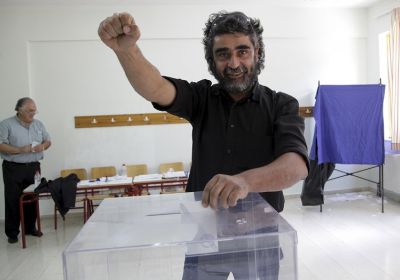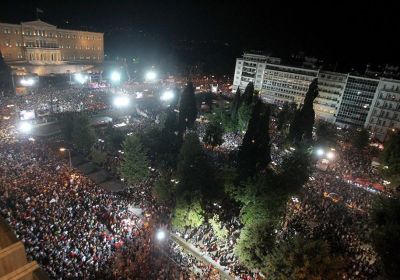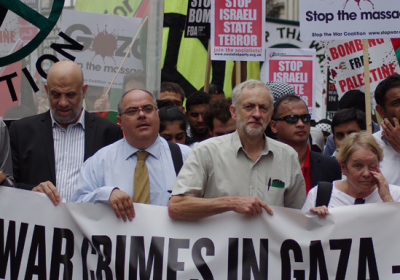
With what appears a landslide win amid a high turnout, all indications are Ireland has voted "yes" to marriage equality in a referendum on legalising same-sex marriages. This is the first time marriage equality has been put to a popular vote anywhere in the world, and makes Ireland the 21st nation to legalise same-sex marriages.
-
With what appears a landslide win amid a high turnout, all indications are Ireland has voted "yes" to marriage equality in a referendum on legalising same-sex marriages. This is the first time marriage equality has been put to a popular vote anywhere in the world, and makes Ireland the 21st nation to legalise same-sex marriages.
-
You would not have thought it possible, but Tony Abbott appears to be degenerating — in literacy skills as well as morality. Having campaigned on a simplistic three word slogan, in office, he's decided that's two too many, and has cut “Stop the boats” to “Nope, nope, nope.” -
The May 2015 budget was framed by the Abbott government with one issue in mind — winning the next federal election. Although there are some members of the Coalition keen on an early election, it seems unlikely to be called until sometime next year. -
With the support of all of the political parties in Dublin's parliament (the Dail), a May 22 referendum on same-sex marriage could bring official state recognition for Ireland’s gay community and their relationships for the first time.
-
It is a point of honour for the Venezuelan government that despite the sharp plunge in oil prices and acute shortages of goods, President Nicolas Maduro has ruled out austerity measures. In a recent TV interview with former vice president Jose Vicente Rangel, Venezuelan Central Bank president Nelson Merentes explained why, saying: “Do you remember what happened on February 27, 1989?” -
A special May Day conference was convened on May 1 and 2 by the five trade unions affiliated to the Right2Water campaign, which is leading the huge struggle against water charges in Ireland. The conference discussed a set of core principles that will underpin a “Platform for Renewal”, with the aim to unite left and progressive forces before the next general election. -
Britain's May 7 elections revealed the deep divides emerging in British society and offered the promise of a constitutional crisis and social struggles to come. Most commentators had expected the result to be a hung parliament; polls had consistently shown the Conservative (Tory) and Labour parties to be neck and neck. In Scotland, the polls pointed to a wipe-out of the previously dominant Labour Party, with the Scottish National Party (SNP) poised to make sweeping gains on a platform of opposing austerity and Trident nuclear weapons.
-
A commentator for the mainstream Barcelona daily La Vanguardia reported on May 9 on a conversation he overheard in a lift between two “executives of a certain age”. They were talking about an opinion poll giving the radical, movement-based ticket Barcelona Together the lead in the March 24 election for Barcelona City Council. Executive A: “Have you seen that [incumbent Barcelona mayor Xavier] Trias is losing?” Executive B: “Yes, [lead candidate for Barcelona Together Ada] Colau is winning.” -
This statement was released by the executive committee of Left Unity, a left-wing party in Britain formed after a call by film-maker Ken Loach for a new party to the left of Labour in 2013, in response to the May 7 general election won by Prime Minister David Cameron's Conservative Party.
-
Prime Minister David Cameron's Conservative Party won a clear victory in Britain's May 7 general elections. In Scotland, however, the Scottish National Party dramatically rose from six seats to 56 out of 59, in a clear sign of opposition to the brutal austerity backed by the major parties in Westminster. -
For three months, from November to February, the Spanish economic and political establishment was in a state of barely suppressed panic. In national opinion polls, support for the “reds” - in the form of radical new force Podemos - had overtaken that for the establishment parties, the ruling People’s Party (PP) and the opposition Spanish Socialist Workers Party (PSOE). -
Speaking to party activists after the left-wing Socialist Party (SP) once again recorded a positive result in the March 18 provincial elections, party leader Emile Roemer said: “This is an historic evening. We have become the biggest left party in the Netherlands. “The SP is a powerful factor in the Senate. An ideal starting point for the SP to be elected to government at the next general election.”