-
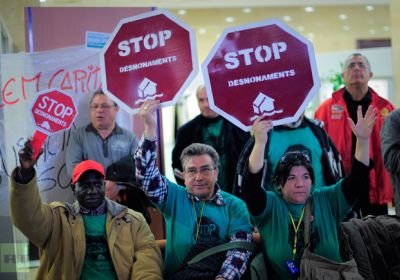
Jesus Posada, the right-wing People’s Party (PP) speaker of the national Spanish Congress of Deputies, received a delegation on February 12 presenting a People’s Legislative Initiative (ILP). The initiative had the support of more than 1.4 million signatories, 900,000 more than required by law. -
Ecuadorian President Rafael Correa was re-elected in the first round of the country's February 17 presidential poll. Preliminary results released with 30% of the votes counted gave Correa 58% of the votes, compared with 24% for the runner-up, right-wing banker Guillermo Lasso, ABC.net.au said on February 18.
-
The British government's controversial back-to-work programmes lay in tatters after the Court of Appeal ruled their regulations unlawful on February 12. Three judges unanimously ruled that the regulations which most of the schemes have been created must be quashed. The ruling is a huge setback for the Department for Work and Pensions (DWP) whose flagship reforms have been beset with problems from the beginning, with campaigners and unions accusing ministers of effectively introducing forced labour.
-
Comedian and socialist Mark Steel addressed a protest against cuts and privitisation at Sussex University on February 12. Students at Sussex University have been occupying the university's conference centre since February 6 against the university's outsourcing of key services.
-
Greenwash: Big Brands & Carbon Scams Guy Pearse Black Inc., 2012 264 pages, $29.99 (pb) The response of big business to global warming, their propaganda would have us believe, is to ride to the rescue by reducing their carbon emissions. As Guy Pearse shows in Greenwash, however, this is just a marketing ploy to attract the dollars of environmentally concerned customers. -
There has been much speculation in the international media over the future of Venezuela in light of the poor health of Venezuelan President Hugo Chavez. The Venezuelan government reported on February 4 that Chavez's recovery in Cuba, from a cancer-related operation in December, was proceeding well. -
For a moment he lost himself in the old, familiar dream. He imagined that he was master of the sky, that the world lay spread out beneath him, inviting him to travel where he willed. It was not the world of his own time that he saw, but the lost world of the dawn -- a rich and living panorama of hills and lakes and forests. He felt bitter envy of his unknown ancestors, who had flown with such freedom over all the earth, and who had let its beauty die. -- Arthur C. Clarke, The City and the Stars Capitalism stands as a death sentinel over planetary life. -
The shale gas industry-commissioned white paper, The Global Anti-Fracking Movement: What it Wants, How it Operates and What’s Next, makes for some very interesting reading. It was produced late last year by Control Risks, an “independent, global risk consultancy specialising in helping organisations manage political, integrity and security risks in complex and hostile environments”. -
Statement on the military intervention in Mali by the Africa Network of the Committee for the Abolition of the Third World Debt (CADTM), January 29. * * * -
“France is in Mali for the long haul.” That was the headline of France’s daily newspaper Le Monde on February 4. The newspaper's front page, as well as pages 2 and 3, were devoted to a discussion over “what next” for France in Mali.
-
Furious protests have exploded onto Tunisia's streets and a general strike has been called after the assassination of left-wing politician and lawyer Chokri Belaid on February 6. Belaid was head of the far-left Party of Democratic Patriots (PPD). His killing is Tunisia's first reported political assassination since independence. -
Important rallies were held across the country in defence of the single parent payment on February 5. After having the welfare safety net in Australia for some time, it seems insane there is a need to protest to protect such rights. But protests like these made welfare a reality in the first place. These protests are defending an unprecedented attack, it's a return to the action that made social welfare possible. To do so, it is important to understand the reason that welfare is under attack in the first place.