-
It seems the one thing all Australians can agree on is that they hate Tom Waterhouse. It is not much of a surprise, since anyone watching any sporting event is bombarded with ads for his sports betting business prominently featuring his smiling face. -

There are more than half a million poor or socially marginalised children in Greece, while 322,000 of these are in dire straits materially, the Athens-Macedonia News Agency said on May 22. The shocking statistics were found in a “The state of the children of Greece 2013” report by the United Nations International Children’s Emergency Fund (UNICEF), in collaboration with the University of Athens.
-
Human rights and other social activists in Cambodia are shocked at the unprovoked use of three water cannon against a peaceful protest in the capital Phnom Penh by a group (mainly women) from a community evicted from their homes around Boeung Kak Lake. Three protesters were injured.
-
Francisco Louca is an economics professor at the Technical University of Lisbon. Louca was part of the student movement against the Salazar dictatorship in the 1970s. He was a founding member of the Left Bloc, launched in 1999 when several left groups united. He served as the Left Bloc's chief coordinator between 2005 and last year. He was interviewed by Mark Bergfeld, a London-based socialist activist. The interview is abridged from MRZine. * * * -
The People's Assembly is electrifying the movement against austerity in Britain. Hundreds of new people are flocking to People's Assembly meetings around the country to hear speakers like author Owen Jones, comic Mark Steel, anti-war activist Lindsey German, trade unionists and local campaigners outline the need for coordinated national resistance to the government's plans.
-
After a relatively quiet couple of years, the Unite union, which organises fast food and other previously unorganised sectors, has burst into action with a vigorous industrial campaign against McDonald's.
-
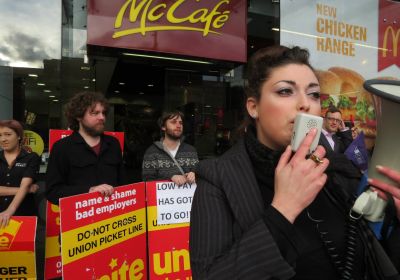
The first McDonald's strike ever in Wellington took place on May 22. At 8am, five of the seven workers on shift came off the job and joined the picket line that had been set up outside Bunny St McDonald's. It was a noisy, lively affair, with Fightback member and Wellington Unite union organiser Heleyni Pratley leading the way with chants, songs and the occasional speech to the people passing by. Pratley explained why the strike was being held and why the public needed to respect the picket line.
-
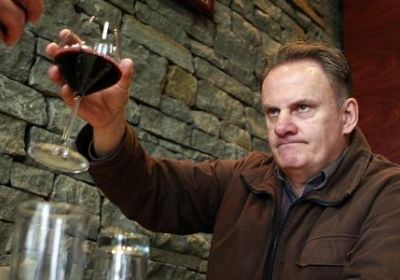
Quarterly Essay Issue 49 2013 'Not Dead Yet: Labor’s post-left future' By Mark Latham Black Inc 2013 Margaret Thatcher may be dead, but Thatcherism is alive and well and living in the bowels of social democracy if Mark Latham’s contribution to the latest Quarterly Essay, “Not Dead Yet: Labor’s post-left future”, is anything to go by. -
An important summit of global significance, held in Brazil May 16-20, has largely passed below the radar of most media outlets, including many left and progressive sources. This summit was not the usual type, involving heads of states and business leaders. Instead, it was a gathering of social movement representatives from across Latin America and the Caribbean -- the site of some of the most intense struggles and popular rebellions of the past few decades. -
Socialist activists are involved in political struggles across many different issues. From equal marriage rights to defending education, refugee rights to the environment, socialists help organise and lead these campaigns, and seek to win important political reforms around them. It might seem contradictory for socialists to fight for reforms. Since socialists oppose capitalism and the capitalist state, why is it that they campaign for measures that encourage the expansion of the capitalist state? -
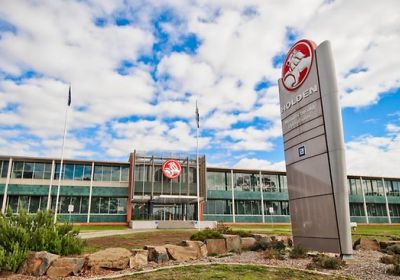
In the wake of Ford's decision to close up in Australia, at the cost of 1200 jobs directly and potentially more 10,000 manufacturing jobs all up, fellow corporate giant Holden publicly said it was “ready to seek” more government subsidies. -
I had to spend some time in waiting rooms for medical checkups recently. It was an opportunity to glance through glossy magazines. In its latest issue, National Geographic magazine has an article entitled “Is Australia the Face of Climate Change to Come?”. It said that after a major spike in extreme weather over the past few years, scientists were looking at “the lucky country” as a “bellwether for the Earth's changing climate”. It may not be so lucky for us but I guess being a bellwether is useful.