
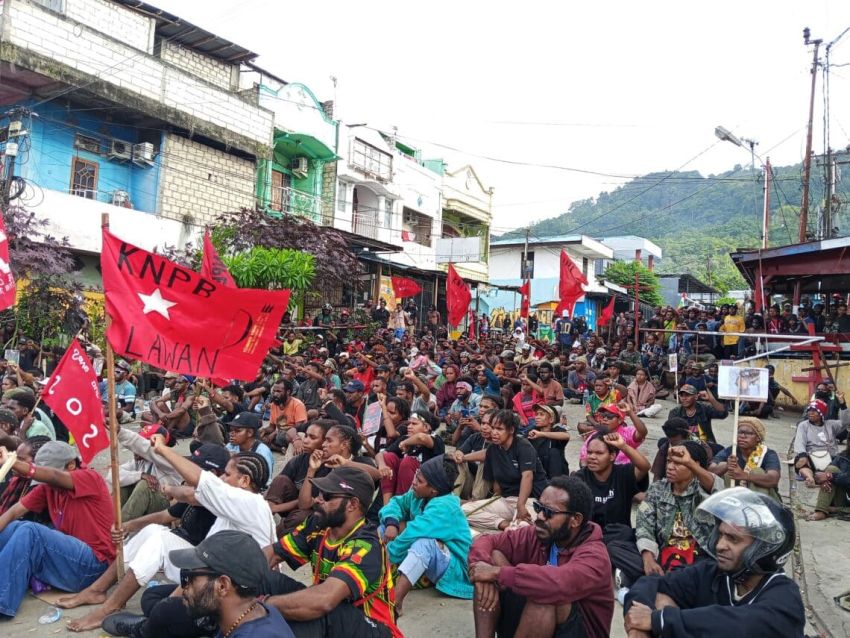
Protests across West Papua on August 15 marked 64 years since a United States-brokered deal between the Netherlands and Indonesia robbed West Papuans of their right to self determination.
The 1962 New York Agreement brought the former Dutch colony under Indonesian control.
Police attacked hundreds of members of the West Papua National Committee (KNPB) and students from Cenderawasih University (Uncen) in Jayapura City on August 15, after security forces blocked the protest from marching to the Jayapura Regent's Office.
According to Jubi, three demonstrators were shot and several others injured when police clashed with protesters in the residential housing area of Perumnas III Waena in Heram District. Frengky Kabak, the Deputy Chair of the Uncen Student Executive Board, was one of the students shot by police.
The Uncen Student Consultative Assembly is urging the Royal Papua New Guinea Regional Police to take responsibility for the shootings.
A spokesperson for the students said Kabak was admitted to hospital after being shot, while two other victims were cared for by their families. They warned of broader student protests if responsibility was not taken.
The protesters had been planning to march to the Papuan People's Representative Council (DPR) office, to present their demands but police had blocked them.
After trying to negotiate with police, a scuffle broke out as officers attempted to disperse the protest. Police fired tear gas and water cannon at the demonstrators.
Hundreds of police remained in the area after the protest had been dispersed.
On the same day, demonstrators in the Sentani area were also blocked by security forces, according to the Sentani regional head of the National Committee for West Papua (KNPB), Sadrack Lagowan. He said the demonstration had been part of a national KNPB action, entitled “Papua, a military and humanitarian emergency zone” and the crowd from Sere and Theys Field marched to Post 7 “where they were met by security forces using water cannons”.
The KNPB had tried to submit official notifications to government and security institutions for the peaceful protest, but were intimidated and attacked by police while attempting to do so.
Australia-West Papua Association (AWPA) spokesperson Joe Collins said: “We are told by governments that the human rights situation in West Papua is improving. However, the crackdown on peaceful demonstrators on August 15 proves otherwise”.
Under the New York Agreement, the Dutch were to leave the colony of West New Guinea (West Papua) and transfer sovereignty to the United Nations Temporary Executive Authority. After seven months, the UN would transfer power to Indonesia, on the proviso that a referendum be held to determine Papuan preference for independence or integration with Indonesia.
Indonesia held a sham referendum on independence in 1969 — the so-called Act of Free Choice. West Papuans call this the “Act of no free choice”, because Indonesia handpicked 1025 people to vote on behalf of all Papuans and, under coercion, they voted to remain with Indonesia.
“Every year West Papuans commemorate this tragic event in their history. In the past, security forces have responded with a heavy-handed approach to any demonstrations on August 15,” Collins said.
During the August 2024 commemoration, police forcibly dispersed peaceful protests in the towns of Nabire, Wamena and Sentani, as well as in Jayapura City. Human Rights Monitor said about 222 protesters were arrested and 41 injured as police forces dispersed the crowd with batons, teargas and rubber bullets.
Meanwhile, clashes between the West Papua National Liberation Army and the Indonesian occupying forces continue.
The ongoing military operations in the territory have internally displaced more than 126,000 people. A Project Multatuli investigation found that West Papua now hosts 74,297 soldiers across 31 regencies. Of those, 17,780 are rotational troops drawn from across Indonesia. The cost of mobilising and sustaining their operations in Papua is estimated at Rp2.34 trillion (around A$182 million) a year.
Jubi reports that West Papuans report seeing more military personnel deployed in the territory with the Indonesian military using drone technology. A new drone command has been set up to support military operations in Papua.
In addition, Papuans have to contend with massive environmental destruction being caused by agricultural projects, such as the Merauke Integrated Food and Energy Estate, and projects to convert forests into rice fields, sugarcane and palm oil plantations.
Ahead of the Pacific Islands Forum Leaders Meeting, August 30 to September 4, in Palau, Collins said: “The Australian government prefers to ignore the situation in West Papua.
“However, a simple action Canberra could do is to support and urge the Pacific Islands Forum leaders to again pressure Jakarta to allow the UN High Commissioner for Human Rights to visit West Papua to investigate the human rights situation in the territory. That is what the West Papuans are asking for.”