“On June 1, 2014, Salvador Sanchez Ceren, historic leader of the Frente Farabundo Martí para la Liberacion Nacional (FMLN), was inaugurated as President of El Salvador,” CISPES.org said on June 3.
Pakistan is witnessing a rise in fanaticism. Ever since last year’s electoral victory of the right-wing Pakistan Muslim League-N (PML-N) and Pakistan Tehreek-Insaaf (PTI), right-wing ideas have become more popular.
Banned terrorists networks are able to work publicly using different names, or sometimes even under their own name. There is no state control of their activities.
With this right-wing turn, the mosques are full of worshipers. More and more young men grow beards to show their identity as Muslims. Religion is used to silence arguments. Violence has become a norm.
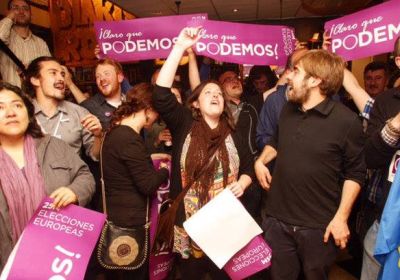
“Riot police were on standby as tens of thousands took to the streets in Madrid, Barcelona and other cities across Spain on Monday to demand a vote on whether to rid Spain of its royal family,” Al Jazeera reported on June 3.
Willy Meyer, who was elected to European parliament in the May poll as lead candidate for United Left (IU), has demanded a binding referendum to allow the people of Spain to choose between the current model of a parliamentary monarchy or a republic. The call came after the June 2 announcement of Spain's King Juan Carlos that he would abdicate in favour of his son, Felipe.
The US House of Representatives disregarded regional consensus on May 28 by voting to impose sanctions against Venezuela.
The vote by acclamation was overwhelming, despite a last-ditch appeal by Michigan’s John Conyers and 13 other progressive Democrats who opposed sanctions and called for restoration of diplomatic relations between the two nations.
They pointed out that regional bodies, including the Organisation of American States, the Caribbean Community and the Union of South American Nations (UNASUR), had all rejected the case for sanctions.
In 2012, Quebec’s student movement carried out a months-long strike, managing to push back and hold off a neoliberal government’s bid to raise tuition fees.
Repeatedly mobilising upwards of 200,000 people at monthly “mega-manifs”, the “Maple Spring” was an all-too rare win against the forces of austerity, and so it captured imaginations around the world.
About 300 garment workers, NGO staff, civil servants and media staged a “fashion show” at the United Sisterhood Alliance-Worker’s Information Center (US-WIC) in Phnom Penh on May 25, called “Beautiful Clothes, Ugly realities”.
As the Cambodian government still bans its opponents from using Freedom Park for protests, the fashion show was seen as a new, creative way of getting across our message.
There has been a minor earthquake in Irish politics in recent days. Republican party Sinn Fein has made a breakthrough into mainstream southern Irish politics. It almost doubled its vote to 17% in municipal polls for the southern state and won more than 20% in the European election.
This was alongside a surge of electoral success from those further to the left and independents.
Overall in the municipal elections in Ireland's south, Sinn Fein won 150 seats and those further left won about 40.
The Venezuelan government and the commune movement are taking steps to move towards the creation of what is referred to as a “communal state”, which involves community groups assuming collective control of local production and decision making.
Communes in Venezuela are formed out of groups of community councils, which are small neighbourhood groups representing 250 to 400 families. In communal councils, local residents organise to develop their local community and run community affairs. They can also receive public funds to undertake social projects in their area.
About 150 people took to the streets of Brisbane on May 24 to protest against biotechnology corporation Monsanto, one of the foremost proponents of genetically modified (GM) technologies.
The event was part of an international day of action that called for all products with genetically modified organisms to be labelled, Monsanto products to be banned in Australia, and a more transparent handling of GM products by the Australian government.
Speakers described the history of Monsanto and neoliberal laws and free trade agreements that help the corporation.
The open letter below was submitted to Prime Minister Tony Abbott on May 23 at the Australian book industry awards in Sydney. Released by the editors of literary journals Meanjin and Overland, it has been signed by dozens of writers. You can read the full list here.
* * *
Dear Prime Minister Tony Abbott, Treasurer Joe Hockey and Minister for Arts George Brandis.
With right-wing parties gaining footholds throughout the world, Colombia followed suit with the far-right party, Democratic Centre (CD) winning with a narrow lead in the first round of the presidential elections on May 25. CD won just under 30% of the vote.
The election presented Colombians with a five-party choice, ranging from the leftist Alternative Democratic Pole (Polo) with Clara Lopez to the CD's Oscar Ivan Zuluaga and his major rival, incumbent President Juan Manuel Santos from the Social Party of National Unity.