-
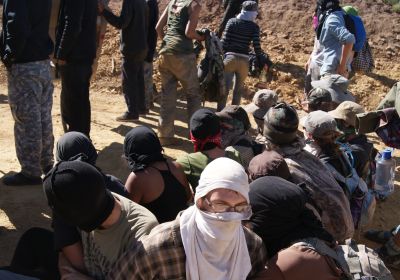
Iranian asylum seeker and aspiring architect Reza Berati was beaten to death inside the Manus Island detention camp more than two months ago, during what former employees of the detention centre described as “inevitable bloodshed”. Now, the five witnesses who say they can identify those who allegedly kicked, punched and beat the 23-year-old until he succumbed to massive head injuries, have been receiving death threats from local security guards. -
A three-day photo exhibition at Fremantle's Victoria Hall brought the human rights crisis gripping Sri Lanka to a wider audience. "Sri Lankan Genocide 2009" exhibits images taken by various photographers documenting the months before and after the massacre of more than 40,000 Tamil civilians by the Sri Lankan Army in May 2009. -
Eliza June, one of the students who took part in the Education Action Group protest during the ABC’s political panel show Q&A on May 5, is pumped by the response to the action.
-
Before Hugo Chavez became president of Venezuela in 1999, the barrios of Caracas, built provisionally on the hills surrounding the capital, did not even appear on the city map. Officially they did not exist, so neither the city nor the state maintained their infrastructure. The poor inhabitants of these neighbourhoods obtained water and electricity by tapping pipes and cables themselves. They lacked access to services such as garbage collection, health care and education. -
Campaigners for Scottish independence have received another boost as a branch of the public sector trade union Unison sided “positively with the Yes side” in a debate on Scotland's September 18 referendum on whether to remain part of Britain.
-
For a man who spent nearly four decades of his 76 years under the restrictive eye of the United States correctional system, few have ever touched as many lives as Rubin “Hurricane” Carter. The world-class boxer-turned-wrongfully accused prisoner-turned-advocate for the rights of the unjustly jailed succumbed to cancer on April 20. But his memory and work will endure as long as there are people outside and inside the prisons of the world fighting for justice.
-
Boots Riley is lead singer of US-based hip-hop group The Coup and a radical activist, heavily involved in Occupy Oakland and other struggles. He was a featured speaker at the Marxism 2014 conference in Melbourne over April 17-20 where Green Left Weekly's Gemma Weedall spoke to him.
-
Alexis Tsipras, leader of Greece party SYRIZA and the Party of the European Left's candidate for president of the European Commission, released a statement on May 2 in opposition to the arrest of Gerry Adams, president of the Irish republican party Sinn Fein, on April 30.
-
Green Left Weekly's Peter Boyle spoke to Kevin Lin, who is doing research for his PhD at the University of Technology Sydney on the labour movement in China, about the background to a new wave of strikes in the country. -
I am one of the organisers for the March in March and March in May and a social justice advocate. The leaflet for the Sydney Institute dinner [held on April 28] declares that the honourable Tony Abbott has had a “long and distinguished political career”. I disagree with this statement, and from here on will refer to our prime minister as the dishonourable Tony Abbott. Since taking office in September last year, the dishonourable Tony Abbott and his government have worked hard to undermine the needs and rights of Australians, giving us plenty to get worked up about. -
The United States Supreme Court ruled on April 22 that states can ban affirmative action in admissions to their public universities. At issue was a constitutional amendment passed in Michigan that banned consideration of race in admissions to the state’s education institutions. States that have banned affirmative action in higher education, such as Florida and California, as well as Michigan, have recorded a significant drop in the enrollment of Black and Latino students. -
On my wall in London is my favourite photograph from South Africa. Always thrilling to behold, it is Paul Weinberg's image of a lone woman standing between two armoured vehicles, the infamous “hippos”, as they rolled into Soweto. Her arms are raised, fists clenched, her thin body both beckoning and defiant of the enemy.