
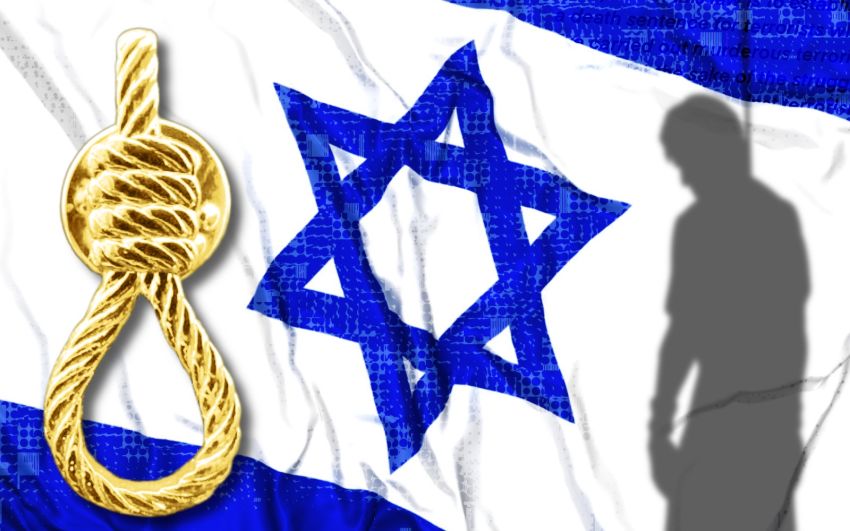
The Israeli Knesset passed the Penal Bill (Amendment – Death Penalty for Terrorists) on March 30, a law that expands the use of the death penalty for offences of a terrorist nature.
The death penalty had previously existed in Israeli law for war crimes but was abolished in 1954 for ordinary crimes in peacetime. Technically, it remained on the books for crimes against the Jewish people, crimes against humanity and certain cases of martial law.
The law’s purpose is to establish the death sentence “for the sake of the struggle against terrorism” for those who have carried out lethal attacks against the Israeli state, citizens and residents, for reasons of enhancing “deterrence”, for preventing attacks involving the taking of hostages, for sheer retribution and for prescribing “arrangements for the execution of this penalty”.
Its purpose is also tellingly discriminatory — imposing the death penalty for the deliberate killing of a person with the intention of “negating the existence of the State of Israel”.
Hanging is mandated, access to legal counsel restricted and visits from family members for the condemned heavily circumscribed. The list of those permitted is authoritarian and bleak: prison officers, authorised religious officials, official visitors, those authorised by the minister, attorneys and physicians.
The bill also limits accountability by minimising external oversight and granting immunity to those responsible for carrying out executions.
The law purposely creates two legal frameworks. The death penalty will apply to the Occupied West Bank, but exclude the illegally annexed part of East Jerusalem and Israel itself.
Military courts with jurisdiction in the West Bank are authorised to impose the death penalty even in the absence of prosecutorial request and only in unspecified special circumstances order a life sentence. A simple majority will be adequate. Israeli citizens responsible for killing Palestinians will continue to be tried in Israel’s civilian court system with scandalous leniency.
This latest development is ominous for Palestinians, given the astonishing conviction rate of 99.74% of such defendants and the ongoing incarceration of 9500 people, including 350 children and 73 women deemed “unlawful combatants” and held without trial.
By contrast, between 2005 and 2024, Israelis tried for crimes committed in the West Bank could be assured of a conviction rate barely touching 3%.
During the debate on the bill, some members of the Knesset boisterously turned up wearing gold pins shaped in a noose. Members of the ultra-nationalist racist Otzma Yehudit party were particularly egregious, with national security minister Itamar Ben-Gvir noting their “commitment to the demand for the death penalty for terrorists” and sending “a clear message that terrorists are deserving of death”.
Ben-Gvir also dismissed the Israeli Medical Association’s opposition to the bill as needlessly squeamish, saying he had received “100 calls from doctors who said: ‘Itamar, just tell us when’.”
That’s the Hippocratic Oath out of the window.
That drew the ire of opposition leader Yair Lapid, who lamented in a Yesh Atid party meeting that images of the “pins with a noose are spreading throughout the world and causing indescribable damage”.
Yair Golan, party chief of the Democrats, saw the gesture as obscenely sinister. “When a government uses the imagery of death to project strength, it is no longer fighting terrorism; it’s rehearsing dictatorship.”
Adam Coogle, deputy Middle East director at Human Rights Watch, said: “Israeli officials argue that … imposing the death penalty is about security, but in reality, it entrenches discrimination and a two-tiered system of justice, both hallmarks of apartheid.
“Combined with its severe restrictions on appeals and its 90-day execution timeline, this bill aims to kill Palestinian detainees faster and with less scrutiny.”
Erika Guevara-Rosas, Amnesty International’s senior director of research, advocacy, policy and campaigns, also condemned the amended law for not only being cruel, discriminatory and contemptuous of human rights, but for dismantling “fundamental safeguards to prevent the arbitrary deprivation of life and protect the right to a fair trial”. Guevara-Rosas said it further empowers “Israel’s system of apartheid, which is maintained by scores of discriminatory laws against Palestinians”.
While these criticisms of this brutal law are accurate, they ignore the possibility that Israel, having passed such legislation, is facilitating something even graver. As Volker Türk, the United Nations human rights chief, said: “The application to residents of the occupied territory would constitute a war crime.”
This bill is the start of a series of measures signalling Israel’s intention to further limit Palestinian resistance to its predations with punitive finality. This beds down previous laws, such as the Jewish supremacist nation-state law of 2018 and the 2003 Citizenship and Entry into Israel Law.
The Knesset’s Constitution, Law and Justice committee on March 24, for instance, advanced the Tribunals’ Law (“Prosecution of Participants in October 7 Massacre events”) bill for a second and third reading. It aims to establish a tribunal approximating to a military court to try individuals who participated in the October 7, 2023, attacks.
Such a body will be granted powers not only to impose the death penalty but modify accepted rules of procedure and evidence in cases “deemed necessary for the clarification of the truth and the performance of justice”.
[Binoy Kampmark lectures at RMIT University.]