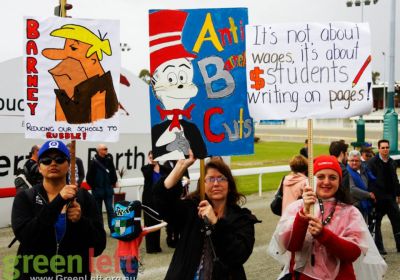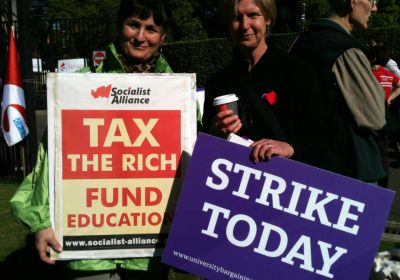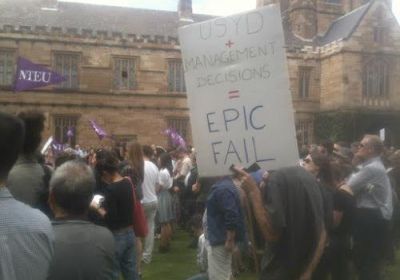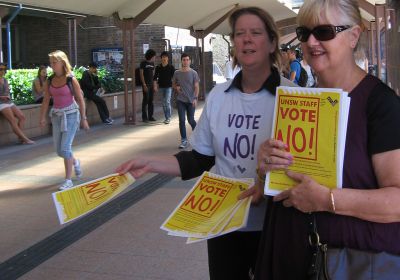
Students supported teachers and staff in their one-day strike at the University of Sydney on March 7.
Read a statement by the National Tertiary Education Union explaining the reason for the strike.
Photos: Peter Boyle.
-
-
Staff and students from across all six University of Western Sydney (UWS) campuses protested on November 21, in opposition to university management plans to axe several courses. Among the courses to go are Arabic, Spanish, Italian, the Bachelor of Communication sub-majors in writing, performance and animation, and the entire Economics degree. Along with these, the jobs of 29 academics in the School of Business and a further 25 in the School of Humanities and Communication Arts will be cut.
-
Students and staff at the University of Sydney ramped up the campaign against management's proposed staff cuts last week, after management ignored a deadline set by the rally and occupation on April 4 to withdraw the cuts by the end of the Easter break. Four hundred students rallied on the university's front lawns on April 24. Students from more than eight classes walked out to join the rally. In one case, a lecturer emailed her students in advance to tell them to walk out of their class and join the protest. -
All suggestions of an insipid and apathetic Sydney University political culture have been shot dead over recent weeks by an inspired campaign by staff and students to defeat Vice-Chancellor Michael Spence's plans to cut 340 university staff, and cut courses and the budget by a further $28 million. Starting with a stunt at Orientation week, which disturbed Spence's opening address at the Great Hall, and a rally and march through the centre of the university, students have ensured that they've kept the pressure on Spence and his management cronies. -
About 150 members of the National Tertiary Education Union (NTEU) at the University of New South Wales and Macquarie University have been stood down after taking part in lawful and protected industrial action. The union put a ban on the transmission of student results after more than two years of negotiations failed to make progress on improving job security, pay and other conditions for staff. A key sticking point in the negotiations is management’s unregulated use of fixed-term contracts and casual employment. -
The National Tertiary Education Union (NTEU) at the University of New South Wales (UNSW) has vowed to fight the imposition of a “sub-standard” enterprise bargaining agreement (EBA) after a majority of general staff voted in favour of the agreement in a September 29-October 1 poll. The agreement fails to meet award protections that limit the use of fixed-term employment, allowing for further deregulation of the workforce. It also reduces flexibility on annual leave entitlements and allows for forced redeployment within the university. -
The National Tertiary Education Union (NTEU) at the University of New South Wales (UNSW) is calling on professional, technical and general staff to reject a management offer of a new enterprise bargaining agreement (EBA). The union says it fails on salaries, job security and on respect. The offer will be put to a ballot of all non-academic staff this week, following a deal between the Community and Public Sector Union (CPSU) and university management. Both unions cover non-academic staff. The CPSU will be campaigning for a “yes” vote. -
In an attempt to divide staff, on September 13 management at Macquarie University (MQ) proposed to split the current Enterprise Agreement in two, and tried to ram through a second-rate agreement for general staff. If successful this would mean MQ general staff would have the worst conditions of any of the 26 agreements across Australian universities. This has angered the local National Tertiary Education Union (NTEU) branch. The NTEU is campaigning to defeat the push by calling for a “No” vote in a ballot of general staff set to open on September 23. -
The National Tertiary Education Union (NTEU) welcomed the announcement of Senator Chris Evans to a portfolio responsible for skills, taking in higher education and TAFE. It also welcomed the reappointment of Senator Kim Carr to the portfolio of innovation, industry and science, but reiterated concerns that a narrow focus on skills risks undervaluing the sector. -
After a successful strike and picket line on August 8, Victoria University’s (VU) vice chancellor, Liz Harman, agreed to negotiate on pay and conditions. Until then, senior management had demanded that promised pay rises this year be in return for abandoning regulation of workloads in the current enterprise bargaining round. The National Tertiary Education Union Branch (NTEU) has now suspended its bans on releasing results. Stood down union members have been reinstated. -
BRISBANE — A meeting of about 150 members of the National Tertiary Education Union (NTEU) at the University of Queensland on August 5 passed a motion of no-confidence in UQ vice-chancellor Paul Greenfield. The meeting voted to start rolling stop-works within two weeks if they do not receive an improved pay offer from university management. UQ staff are due to receive only a 3.1% pay increase for 2010. An NTEU leaflet said that, by comparison, the vice-chancellor’s salary rose by $110,000 in 2009 to $989,999, an increase of 12.5%. -
A prolonged industrial dispute is continuing at the University of New South Wales (UNSW) as a result of the ongoing refusal of vice-chancellor Fred Hilmer to bargain in good faith with the National Tertiary Education Union (NTEU) over staff concerns about pay and conditions — especially job security. Hilmer’s intransigence should come as no surprise. When Hilmer announced his decision to take up a tidy $750,000 annual salary package as vice-chancellor of University of New South Wales back in 2005, he said partial deregulation of education was like being “half pregnant”.