-
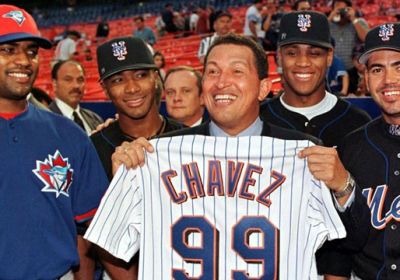
The death of Venezuelan President Hugo Chavez on March 5 will mean unseemly celebration on the right and unending debate on the left. Both reflect the towering legacy of Chavismo and how it challenged the global free market orthodoxy of the Washington consensus. Less discussed will be that the passing of Chavez will also provoke unbridled joy in the corridors of power of Major League Baseball (MLB). -
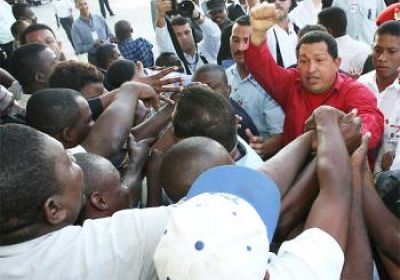
Tens of thousands of Haitians spontaneously poured into the streets of the Haitian capital, Port-au-Prince, on the morning of March 12, 2007. Venezuelan president Hugo Chavez had just arrived in Haiti all but unannounced. A multitude, shrieking and singing with glee, joined him in jogging alongside the motorcade of Haiti’s then President Rene Preval on its way to the National Palace (later destroyed in the 2010 earthquake). -
When Hugo Chávez triumphed in the 1998 presidential elections, the neoliberal capitalist model was already floundering. The choice then was whether to re-establish the neoliberal capitalist model — clearly with some changes including greater concern for social issues, but still motivated by the same logic of profit seeking — or to go ahead and try to build another model.
-
On Tuesday 5 March, at the age of 58, Venezuelan president Hugo Chávez lost his almost two-year battle with cancer and passed away. Within seconds of the news being announced, the wheels of the global media bandwagon went into overdrive, with largely unsurprising results, in both the US and British media.
-
Hugo Chavez cut a wide swath on the international scene, more than that of any other leader in the recent history of Latin America, putting forth a vision of a world based on equitable relations among nations and peoples. His rise to hemispheric prominence began at the third Summit of the Americas in April 2001 in Quebec, Canada when the newly inaugurated George W. Bush attempted to ram through the Free Trade Area of the Americas that was to extend from the Arctic Circle to Tierra del Fuego in South America. -
When Association pour une Solidarità Syndicale Étudiante (ASSÉ) announced that it would be breaking ranks with its more moderate colleagues in the student federations and boycotting the new government's education summit, it was clear that they were taking a huge risk. When they called a mass demonstration for the last day of the education summit and publicly announced that it would be the largest demonstration since the end of last year's unlimited general strike, and that they expected in the neighborhood of 10,000 students to show up, they were doubling down with reckless abandon.
-
The dominant media narrative about the two-day all-India strike, called by trade unions for February 20 and 21, was one of “hooliganism” by workers and inconvenience caused to the “public”. As usual, the main demands of the striking workers found little space in the media's discussion of the strike. The working class — usually invisible, both at the workplace and where they live — attained visibility on TV screens only as a “mob”. Workers, whose labour is, after all, the source of all production, are seen and shown as a source of wanton and mindless destruction. -
The stock market has surged past its former high recorded in October 2007, before the financial crash and Great Recession. “With the Dow Jones Industrial average [at] a record high,” writes a columnist in a front page article in the New York Times, “the split between American workers and the companies that employ them is widening and could worsen in the next few months as federal budget cuts take hold”. “That gulf helps explain why stock markets are thriving even as the economy is barely growing and unemployment remains stubbornly high. -
The central European nation of Slovenia is being shaken by the first huge uprising since it became an independent country in 1991. The protests are directed against all political elites, austerity measures, and the capitalist system as a whole.
-
When Venezuelans return to the polls in new presidential elections on April 14, analysts are predicting a decisive win for Nicolas Maduro, the candidate of the United Socialist Party of Venezuela (PSUV). In December, the late president Hugo Chavez urged his supporters to back Maduro as PSUV candidate should Chavez’s worsening health prevent him from fulfilling his presidential term. Under the Venezuelan constitution, new elections must be held within 30 days of the resignation or death of the president. -
US Senator says drones killed 4700 “A high-ranking US senator has estimated America's use of drone strikes has killed about 4,700 people, including civilians. “Republican Lindsey Graham is the first US government official to offer an estimate on the total number of fatalities in America's secretive drone war. “'Sometimes you hit innocent people, and I hate that, but we're at war ...' Mr Graham told the Easley Rotary Club ...” “The strikes have been condemned by rights groups as extrajudicial assassinations.”
-
Palestinian political prisoner and hunger striker Samer Issawi wrote in the Guardian on March 3: “Do not worry if my heart stops. I am still alive now and even after death, because Jerusalem runs through my veins. If I die, it is a victory; if we are liberated, it is a victory, because either way I have refused to surrender to the Israeli occupation, its tyranny and arrogance.” As of January, according to Palestinian human rights groups, Israel held 4812 Palestinian prisoners in its jails.