
On my wall is the front page of the Daily Express of September 5, 1945, and the words: “I write this as a warning to the world.” So began Australian journalist Wilfred Burchett's report from Hiroshima. It was the scoop of the century.
For his lone, perilous journey that defied the US occupation authorities, Burchett was pilloried, not least by his embedded colleagues. He warned that an act of premeditated mass murder on an epic scale had launched a new era of terror.
-
-
Trade unions, environmental and Maori groups have united to oppose passage of new laws threatening collective bargaining and basic rights in the workplace. The Employment Relations Amendment Bill, introduced by the government in April, seeks to remove existing requirements for employers to negotiate collective agreements, and rest and meal break provisions.
-
 The proposal by Russia, accepted by the regilme of Bashar Al-Assad, for Syria’s chemical weapons to be turned over to an international authority (presumably the United Nations) for destruction, has temporarily put off Washington’s plans for war against Syria. Obama has postponed asking Congress to approve of his plans to attack Syria. This represents a political defeat for the war drive. Even if Washington scuttles the proposed agreement and goes ahead with war, it will do so with even less support at home and abroad than it had before the Russian proposal.
 -
New Zealand celebrities have joined protests against proposed law changes that will remove the right of public consultation on applications for deep sea oil and gas drilling. Law changes will also remove the right to protest at sea. Actors Sam Neill, Lucy Lawless and Robyn Malcolm, former Supreme Court judge Sir Ted Thomas and many others have joined Maori and environmental groups to condemn the government’s plans.
-
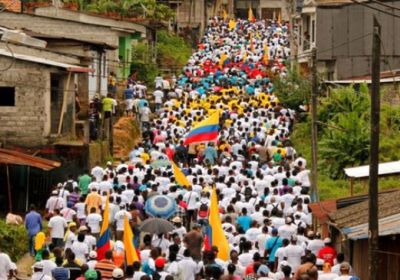 Representatives of the Colombian rural poor (campesinos) began negotiations with the government on September 12, three-and-a-half weeks into an uprising against “free-trade” policies. By blockading highways and stopping work since August 19, Colombian campesinos made a dramatic statement for a fairer economy and greater independence from the United States. The central demand was and is the abolition of the free-trade agreements (FTAs) with the US and EU, and guaranteed minimum prices for their agricultural products.
 -
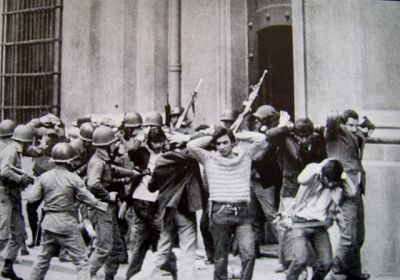 September 11 is a date forever associated with mass murder of civilians — and this was the case nearly three decades before the 2001 terrorist attacks on the Twin Towers in New York. This year, September 11 marks the 40th anniversary of the US-organised military coup that overthrew the elected left-wing government of Salvador Allende and installed a brutal dictatorship headed by General Augusto Pinochet. The day was the start of a nightmare for Chileans, as a reign of terror crushed left-wing groups, trade unions and popular organisations.
 -
The Philippines’ Million People March, against the so-called pork barrel system of corruption, is the latest in a series of huge protests worldwide, which exploded with the United States’ Occupy Movement and the Arab Spring of 2011. The Luneta rally was attended by at least 200,000 people (according to government estimates). However, aerial footage of the event showed attendance was almost certainly higher. The Luneta rally was part of nationwide and global protests, involving a further 500,000 people in major cities in the Philippines and by Filipino communities worldwide.
-
 An uprising of the rural poor (campesinos) in Colombia entered its 11th day on August 29. An estimated 250,000 people took part in strikes and highway blockades across the South American country's highlands, where most of Colombia’s population of 42 million is concentrated. The central objective of the uprising is to guarantee minimum prices for agricultural products, and to annul Colombia’s free trade agreements (FTAs) with the United States and the European Union.
 -
Venezuela has agreed to sell oil to the Palestinian Authority (PA) at a “fair price” as part of new energy agreements with the Middle Eastern government. The deals, made during a meeting between Venezuelan foreign minister Elias Jaua and his PA counterpart Riyah al-Malki in Caracas on August 24, include the training of Palestinians in the handling and distribution of oil. Jaua referred to the deal as “an agreement of cooperation and solidarity … the sale of fuel at a fair price”.
-
In 1986, Israeli scientist Mordechai Vanunu took a courageous moral stand against nuclear weapons. Vanunu exposed Israel’s secret nuclear weapons arsenal to the world after becoming disillusioned with his work as a technician at Dimona Nuclear Research Centre in Israel. Vanunu revealed Israel had hundreds of advanced nuclear warheads ― the sixth largest stockpile in the world. Under a policy of nuclear ambiguity, Israel still officially denies it has nuclear weapons, despite Vanunu’s revelations and other widespread evidence to the contrary.
-
In response to a chemical weapons attack by unknown perpetrators on August 21, US President Barack Obama, in a “coalition of the willing” with the governments of Britain and France, has made escalating threats for a military attack on Syria. With the likelihood of Russia and China opposition in the UN Security Council, Obama has indicated that his coalition, calling itself the “international community”, may strike Syria unilaterally.
-
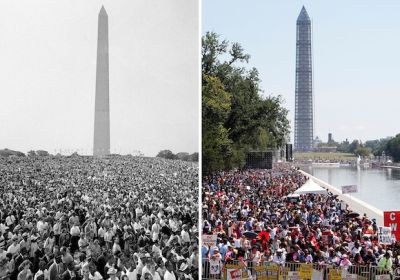 Black America is hurting — from the suppression of voting rights, to police violence to the lack of access to good jobs, education and housing. Tens of thousands of people were determined to bring that message to Washington, DC, on August 24. About 100,000 people gathered in front of the Lincoln Memorial as part of a demonstration to mark the 50th anniversary of the 1963 March for Jobs and Freedom, where Martin Luther King gave his famous “I Have a Dream” speech.