The Organization of American States has announced it will hold an emergency meeting to discuss whether to suspend Venezuela for violating the OAS Charter. OAS Secretary General Luis Almagro said on May 31 that Venezuela had suffered "grave alterations of democratic order."
-
-
Venezuelan President Nicolas Maduro has hit out at “mounting aggressions” against his government after it was confirmed that a US plane had twice violated Venezuelan airspace. The US Boeing 707 E-3 Sentry is reported to have illegally entered Venezuela’s national airspace on May 11 and 13. Both incursions were detected by Venezuela’s Bolivarian air force and have sparked rumours that the US might be conducting covert spying operations over Venezuela. “This plane has all the mechanisms to carry out electronic espionage,” said Maduro on his television program on May 17. -
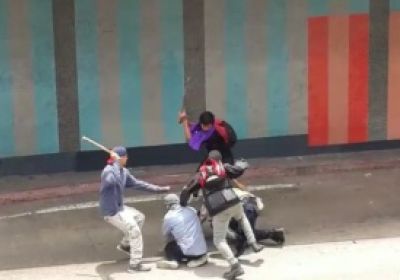
Right-wing protests hit the streets of Caracas and other cities across Venezuela — and in some cases turned violent, attacking police and other targets. The protests were part of a May 18 national day of action to demand that electoral authorities speed up the process of scheduling a recall referendum against left-wing President Nicolas Maduro. The national mobilisation came after right-wing leader Henrique Capriles gave a press conference on May 17 in which he invoked violence and called for the country's armed forces to “pick a side”. -
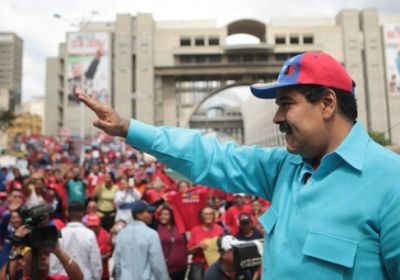
Venezuela's socialist president Nicolas Maduro told a crowd of supporters on May 15 that to increase productivity and help alleviate scarcity of basic products facing the South American nation, all businesses and factories closed down by their owners would be seized and handed over to their workers so production could be restarted. “A stopped factory [is] a factory turned over to the people,” Maduro said. “The moment to do it has come, I'm ready to do it to radicalise the Revolution.”
-
Venezuela's right-wing opposition coalition, the Roundtable of Democratic Unity (MUD), has officially launched its signature collection campaign to force a recall referendum this year against socialist President Nicolas Maduro. Thousands of opposition supporters flocked to sign the petition in public squares across the country on April 27 after MUD spokespeople confirmed they had received the official go-ahead from Venezuela's National Electoral Council (CNE). -
Photo: Albaciudad.org.
The Venezuelan Supreme Court unanimously ruled on April 11 that a controversial “amnesty law” passed by the country's right-wing opposition-controlled parliament is unconstitutional, Venezuela Analysis said the next day.
-
United States President Barack Obama renewed an executive order, first issued a year ago, on March 3 that declares Venezuela “an unusual and extraordinary threat to the national security and foreign policy of the United States”, TeleSUR English said the next day. The order allows the US government to impose sanctions on Venezuela. In protest, Venezuela has withdrawn its charge d'affaires, Maximilian Arvelaez, from the United States, TeleSUR English said on March 9. -
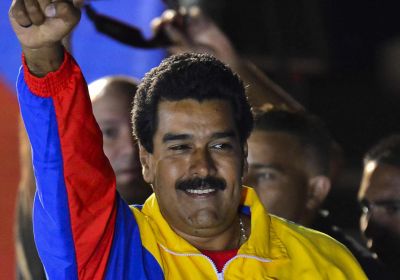
Peace, unity and prosperity was the message on March 5, which marked the third anniversary of the death of Venezuela's late socialist president Hugo Chavez.
-
Venezuelan President Nicolas Maduro announced the creation of a National Productive Corporation on February 22, as part of a new socialist enterprise system aimed at coordinating efforts among existing state, communal and mixed firms. Speaking from the Ana Maria Campo Petrochemical Complex in Zulia state, the socialist leader said the new entity would be tasked with unifying the more than 1000 public enterprises in a “single vision of planning, management, productivity, and maximum efficiency”. -
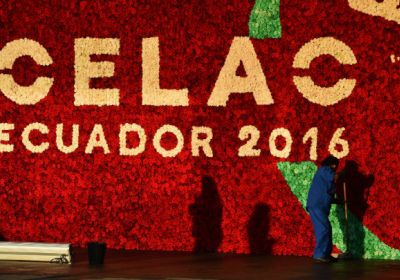
The 2016 summit of the Community of Latin American and Caribbean States (CELAC) began on January 26 with the meeting of foreign ministers and chancellors of the Latin American nations at the headquarters of the Union of South American Nations (UNASUR) in Mitad del Mundo, Quito, Ecuador. CELAC, a regional body involving all nations in the Americas except for the United States and Canada, was officially created in Caracas in 2011 under the leadership of then-Venezuelan president Hugo Chavez. -
Venezuela's President Nicolas Maduro has announced the establishment of a committee to oversee the creation of a revolutionary assembly on January 23. The assembly will bring together the country's progressive social movements and socialist politicians to reinvigorate the Bolivarian revolution, Maduro said. Maduro oversaw the first meeting of an interim committee, which will lead to the creation of the broader people's congress, being called the Congress of the Homeland. About 100 people were sworn-in to the committee. -
In the aftermath of Venezuela's right-wing US-backed opposition securing its electoral win over President Nicolas Maduro's United Socialist Party of Venezuela (PSUV) in the December 6 National Assembly elections, the South American country is heading for two confrontations, each reinforcing the other — a political and an economic one. The future is very uncertain.