-
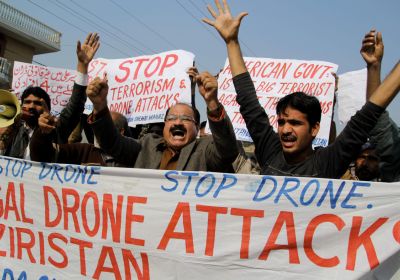
A US drone attack in North Waziristan in Pakistan’s Federally Administered Tribal Areas (FATA) killed 20 people on July 16. It brought the number of people killed by US drones in North Waziristan since June 12 to 50. The July 16 Nation reported, “five drones are still flying over the Datta Khel area and hampering the relief activities underway there. This … is fomenting a fear of the death toll rising.” -
Pakistan is witnessing a rise in fanaticism. Ever since last year’s electoral victory of the right-wing Pakistan Muslim League-N (PML-N) and Pakistan Tehreek-Insaaf (PTI), right-wing ideas have become more popular. Banned terrorists networks are able to work publicly using different names, or sometimes even under their own name. There is no state control of their activities. With this right-wing turn, the mosques are full of worshipers. More and more young men grow beards to show their identity as Muslims. Religion is used to silence arguments. Violence has become a norm. -
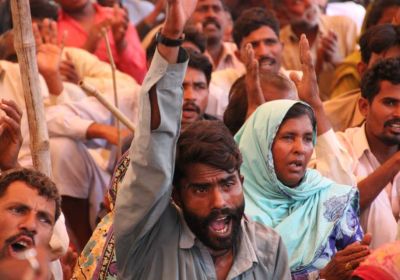
A four-day sit-in by brick kiln workers in Lahore in late April ended after successful negotiations held with the labour minister over their demand of implementation of a minimum rate of 740 rupee (about $8.1) per thousand bricks. Workers from all over the Punjab took part in this sit-in. After daily threats by government and police, the labour minster finally agreed to negotiate with leaders of the workers. Brick kiln workers are among the most exploited in Pakistan. There is widespread use of child labour and debt bondage ― both against the law in Pakistan. -
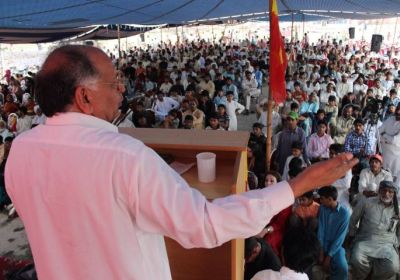
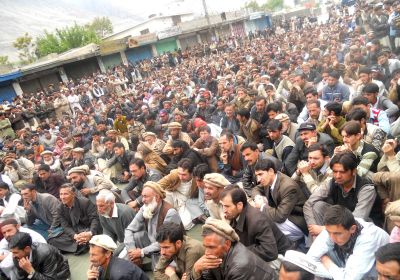
A powerful popular protest is sweeping through the Pakistani-occupied disputed territory of Gilgit Baltistan. Since April 15, an indefinite sit-in strike (dharna) has been waged, uniting for the first time groups from a range of political and religious backgrounds against the removal of a longstanding wheat subsidy.
-
Farooq Tariq, the general secretary of the Awami Workers Party (AWP) in Pakistan, will be one of the international guests at the 10th national conference of the Socialist Alliance, to be held in Sydney over June 7 to 9. He will speak on “The Struggle for Democracy and Justice in Pakistan” on June 7 at the Addison Road Community Centre in Marrickville. Visit www.socialist-alliance.org for more details. Ahead of his trip, Green Left Weekly's Peter Boyle spoke to Tariq on Pakistani politics. * * * -
It stands to reason that the perpetrators of crimes against humanity have a vested interest in silencing those who speak out against them. So it is not surprising there has been an intensified campaign of repression in Pakistan against those speaking out against the US bombing campaign in Pakistan's north-west.
-
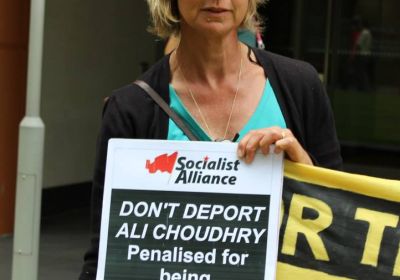
Campaigners for equal rights had their first win for 2014 as a Pakistani-born gay man, Ali Choudhry, obtained a temporary deportation reprieve just as nation wide protests began on January 7.
-
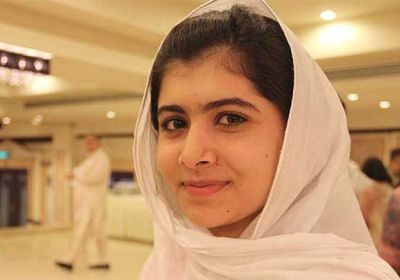
At just 16 years old, Malala Yusufzai is the youngest person to be nominated for the Nobel Peace Prize. When the Pakistani teenager was shot in her head by Taliban gunmen because she spoke out about her right to education, it sent shock waves around the world. The Western media took notice. Her attack was used as an excuse by Western media and governments to justify the invasion of Afghanistan. Malala is a courageous young woman, whose brave example in the face of barbaric violence is being used to justify the barbaric military violence associated with the occupation of Afghanistan. -
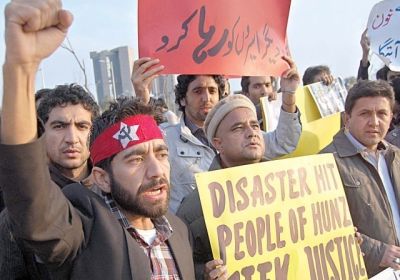
A terrible disaster unfolded in 2010 in the Hunza Valley in Gilgit Baltistan (a formerly self-governing territory occupied by Pakistan since 1948). For protesting for people's rights in the aftermath of this disaster, three left-wing activists have been sentenced to 10 years jail. In July 2010, a huge landslide blocked the Hunza River and formed a gigantic 19 kilometre-wide lake, which submerged four villages. About 25 people lost their lives and 6000 people were displaced. -
A right-wing wave swept Pakistan in the May 11 general elections. At the federal level, the conservative Pakistan Muslim League-Nawaz (PMLN) will form the government having won 35% of the vote. Former Pakistani cricket captain Imran Khan's party, Pakistan Tehreek Insaaf, came second with 19% of the vote and surprised many. The Pakistan People’s Party (PPP), the ruling party for the past five years, came third with only 15% ― thanks to Sindh where it was able to fetch most of its votes.
-
Air pollution is an emerging environmental issue in the big cities of Pakistan. Dust and smoke particles in Pakistan are generally twice the world average and five times higher than in the developed world. Though some of the pollution comes from natural sources, most is the result of human activities. The biggest causes are fossil fuel-burning power plants and cars. Combined, these two sources are responsible for about 90% of all air pollution. The most serious issue relating to air pollution in Pakistan is the presence of excessive suspended particulates matter (SPM).
-
Najeeba Wazefadost came to Australia as a child refugee in September 2000 by a perilous journey by boat. She is now president of Hazara Women of Australia and I interviewed her for Green Left TV at a 500-strong Hazara community demonstration in the centre of Sydney on February 20 to protest the ongoing massacres of Shia in Pakistan.