
Indonesia has introduced a new criminal code to replace laws inherited from the Dutch colonial era. Green Left’s Peter Boyle spoke to Rudi Hartono, managing editor of the Indonesian progressive publication Merdika.id about the impact of these new laws.
* * *
While this new criminal code being officially presented by President Prabowo Subianto's government as a progressive and historic step, there are provisions in the new laws that attack democratic rights and political freedoms. What is your assessment?
Yes, as of January 2, 2026, two major legal instruments have come into force: the new Criminal Code (KUHP) and the new Criminal Procedure Code (KUHAP). Both are framed as part of a "decolonisation" agenda. However, the reality tells a different story.
The new Criminal Code still inherits problematic provisions from the colonial-era code, such as Article 218 on insulting the President and Vice President, and Article 240 on insulting the government and state institutions. These articles share the same spirit as the Dutch East Indies Criminal Code (Wetboek van Strafrecht voor Nederlandsch Indië or WvS). Much like the concept of Lèse-majesté, these provisions seek to protect the prestige of those in power — a concept that should only exist within a monarchy. Historically, these laws were used to silence Indonesian independence activists like Sukarno, Hatta, Semaoen and others.
As a republic that upholds democracy, these articles should have been abolished after independence. Unfortunately, that did not happen. It was only in 2006 that the Constitutional Court struck down these defamation articles, deeming them contrary to democratic principles and human rights. Yet, in this new Criminal Code, many articles continue to stifle freedom of expression, such as Article 256 on mandatory notification for demonstrations; Article 264 on spreading "uncertain, exaggerated, or incomplete" news; and Articles 188 and 190, which prohibit the dissemination of Communism, Marxism-Leninism, or any ideology deemed contrary to Pancasila [the state philosophy].
Meanwhile, the new Criminal Procedure Code grants "superpower" authority to the police and investigators, allowing them to conduct arrests, searches and wiretapping without court authorisation. Thus, this is not decolonisation, but "re-colonisation".
The core essence of colonial law — which glorifies the authority of power — is preserved, despite being at odds with republicanism and democracy. Furthermore, many of these articles are irrelevant to modern times.
Indonesia continues to ban Communism and Marxism-Leninism as threats, as if the mindsets of Indonesian officials are still trapped in the Cold War era. In reality, Marxism contributed significantly to Indonesia's struggle for independence. Nearly all the founding fathers, including Sukarno, Hatta and Sjahrir, were exposed to Marxist thought, which profoundly influenced their vision for an independent Indonesia.
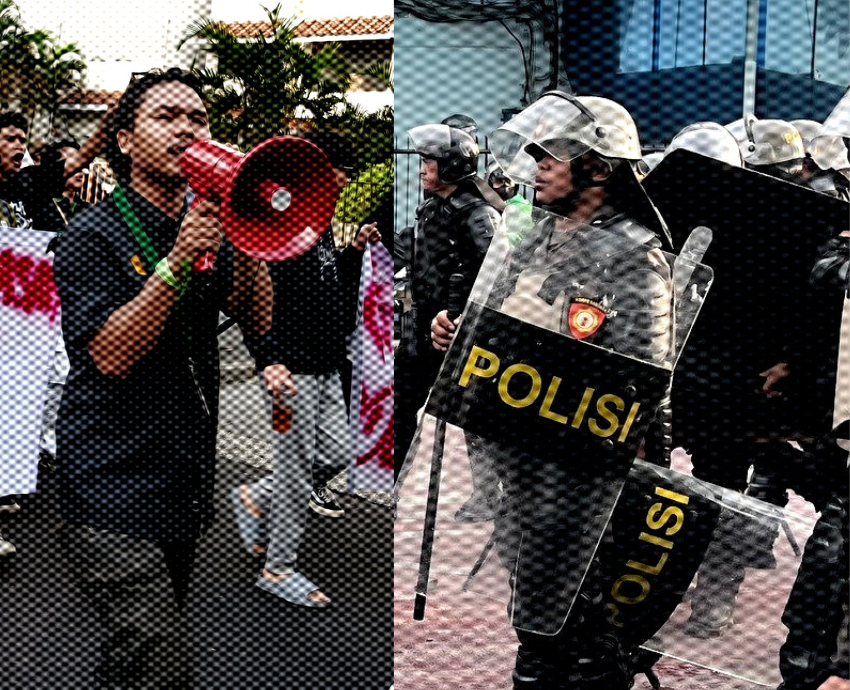
Many activists from the semi-spontaneous youth-led protests, which have taken place throughout Indonesia in recent years, continue to face severe repression, such as arrests and disappearances. Many remain in hiding. Are the new criminal laws part of this wave of repression?
Indeed, since 2019, there has been a surge in protest actions. It began with the #ReformasiDikorupsi (Reform Corrupted) movement opposing the weakening of the Corruption Eradication Commission (KPK), followed by demonstrations against the Omnibus Law, which was seen as detrimental to workers, environmentally damaging, and a threat to farmers and indigenous communities. Later came the #PeringatanDarurat (Emergency Warning) protests against the Prabowo-Gibran coalition’s attempts to sideline small parties and the opposition in regional elections, the "Dark Indonesia" (Indonesia Gelap) protests, and most recently, the #ResetIndonesia demonstrations in late August, 2025.
These protests are noteworthy for several reasons. First, they almost always ignite as social media outrage before transforming into street mobilisation. Secondly, the primary force behind them is the youth, particularly Gen Z, who are fed up with aging politicians and traditional parties. Thirdly, the movement’s character is often described as "Rhizomatic" — borrowing a term from Gilles Deleuze and Félix Guattari — due to its decentralised, leaderless and dynamic nature.
While these young people are still inspired by leftist ideas, particularly those of Tan Malaka, they lean more toward popular culture in their slogans, flags, and struggle strategies. In almost every protest since 2019, the role of organic leftist movements has been nearly invisible. Red flags and yellow stars no longer dominate the protest landscape. Labor unions, including leftist ones, are almost nowhere to be seen.
The protests in late August 2025, which unexpectedly escalated into a large-scale social explosion across 33 provinces, caught the government off guard. Many ordinary citizens — online motorcycle taxi drivers, the unemployed, and common folk — spontaneously joined the fray. There is no denying that since 2019, the escalation of protests has grown larger, which the government has used as a pretext for a harsh crackdown. At least 959 young people have been named suspects and are currently held in various prisons across Indonesia, accused of instigating riots.
Although the protests were eventually suppressed, the root causes and sentiments of dissatisfaction remain immense and possess the potential to spark another massive wave of protests. On social media, resentment toward government statements and policies is often met with the brief command: “Nepal-kan” (“do a Nepal”, referring to the 2024 mass Gen Z protests in Nepal).
Is this increasing repression sign of failure of the Prabowo regime or was a shift to greater authoritarianism always Prabowo’s agenda?
We anticipated this from the beginning. The shift toward authoritarianism began to be felt during Joko Widodo’s era, especially in his second term. Prabowo, with his military background and nationalist-conservative worldview, has simply pushed this trend to a more extreme level. The government’s handling of disasters in Sumatra has been abysmal — slow, incompetent, and poorly coordinated — leading to widespread criticism.
In Aceh, residents frustrated by the government’s refusal to declare a national disaster (which would focus resources, open doors for international aid, and ensure cross-agency coordination) sparked the flying of the crescent moon flag (associated with the Free Aceh Movement). The government, through the military, responded to this dissatisfaction quite brutally. Recently, several critical influencers and academics have faced intimidation, with some even having their homes targeted with Molotov cocktails.
These are grim signs. What makes it more bitter is that as the situation worsens, Indonesian politics lacks a true opposition. Not a single political party in Indonesia has declared itself as being in opposition. On the other hand, within the people's movement, there is no organised political force leading the way. There is no strong leftist party. Almost all labour unions are preoccupied with their own sectoral issues.
However, there is a glimmer of hope: Gen Z.
Currently, Indonesia is enjoying a resurgence in the literacy movement, driven by Gen Z youth. They are unafraid to voice criticism through social media content. The challenge now is how to transform this youthful unrest and dissatisfaction into a political movement that can participate in the country’s political processes. Indonesia needs an alternative political party to channel the grievances of these young people, who will dominate the voter demographics in the upcoming 2029 elections.