-
One Day in December: Celia Sanchez & the Cuban Revolution By Nancy Stout Monthly Review Press 457 pages, US$28.95 Read an excerpt Revolutions are great processes. Thousands and then millions of people, who had previously been excluded from their societies, take centre stage to challenge existing structures. In doing so, these movements of people can create history. These movements can propel people from relative obscurity to truly amazing heights as they are thrust into leading roles by the forces in motion. -
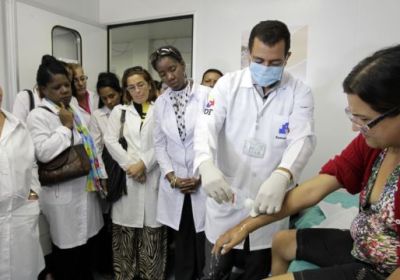
When East Timor won its independence from Indonesia in 1999, the country's medical infrastructure in rural areas was almost non-existent. When then-Cuban President Fidel Castro heard about the problem at a regional summit, he offered to send Cuban doctors free of charge — as many as were needed. So began the largest Cuban medical assistance program outside Latin America. In 2010, after a six year program of study in Cuba, the first of nearly 500 East Timorese medical students graduated and took up their posts in East Timorese villages and towns.
-
In a quirk of history, Margaret Thatcher died a little more than one month after Hugo Chavez. Thatcher was a figurehead for the global class war in the 1980s and '90s known as “neoliberalism”. Chavez was a figurehead for the struggle against it and the alternative starting to be built in Latin America over the past decade.
-
That Cuba has already developed four vaccines or inoculations against different types of cancer is without doubt important news for humanity. The World Health Organisation says each year about 8 million people die from this illness. However, the international mainstream media have almost totally ignored this news. -
Cuba’s ongoing socialist revolution has consistently shown it is adaptable and capable of renewal in the areas of feminism, environmental sustainability, political participation, health and education. Despite the constant and concerted campaign by the United States to undermine the Cuban Revolution, it has achieved many great outcomes, including universal health care, universal education, eradication of illiteracy, low levels of birth mortality and low levels of HIV and AIDS.
-
Sixteen Aboriginal adults in the remote New South Wales town of Wilcannia are the first graduates of a groundbreaking trial literacy program that would not have been possible without the help of a tiny Caribbean nation — Cuba. At the beginning of this year, Cuban educator Jose Chala Leblanch arrived in Wilcannia to help establish the literacy program based on the world-famous “Yes, I Can” teaching method developed by Cuba.
-
This isn’t an obituary. Every now and again those who hope and pray for his death spread yet another rumour, only to be disappointed by a photo or a commentary in that unmistakable style, confirming that Cuban revolutionary leader Fidel Castro is very much alive and making the most of his twilight years. When the inevitable does happen, the world, admirers and detractors alike, will pause for reflection. The corporate media will saturate our inner recesses with words and images that convey, for the most part, how the 1% appraise his life and legacy. Just imagine the gloating on Fox News. -
Operation Miracle, a humanitarian social program created by the governments of Cuba and Venezuela, has made it possible to carry out over 1 million eye surgeries in the South American nation over the last eight years, the Cuban News Agency said. “We’re operating some 5000 patients a week, the same amount of patients who benefited annually in Venezuela before the beginning of the program,” said national coordinator Manuel Pacheco, cited by the Venezuelan News Agency. Operation Miracle began in July 2004, taking care of patients with few economic resources who had eye problems.
-
“Under Raul Castro, Cuba has begun the journey towards capitalism. But it will take a decade and a big political battle to complete, writes Michael Reid”. So began the lead article of the London Economist magazine’s March 24 special issue on Cuba, under the heading “Revolution in retreat”. It is a familiar refrain, but how much truth is there to it? Unfortunately for the credibility of The Economist, authoritative mouthpiece of the Anglo-imperialist ruling class, it’s a dog’s breakfast of factual errors, illogical arguments and wishful thinking.
-
One of the big challenges facing Cuba as it designs climate change adaptation policies is the preservation of its coastal ecosystems against the predicted rise in sea level and increasingly catastrophic extreme weather events. With the country’s 5500 kilometre of coastline and 4000 cays and islets, almost everyone on the Cuban archipelago feels their life is tied to the sea in one way or another. “It’s lovely, but it is also dangerous,” said 78-year-old Teresa Marcial, who lives on the coast in Santa Fe, in the northern outskirts of Havana.
-
At the insistence of the United States and Canada, Cuba was excluded from the Sixth Summit of the Americas, an intergovernmental conference held in Cartagena, Colombia, over April 14-15. As a result of opposition from many Latin American nations over Cuba's exclusion, as well as Argentina's claim to sovereignty over the Malvinas (Falklands) islands, the summit ended with no final declaration signed. The summit, involving all nations in the Americas except Cuba, is ostensibly designed to facilitate dialogue, understanding and cooperation between nations of the region. -
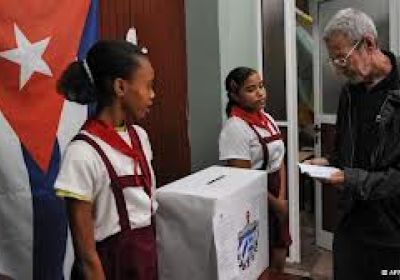
Cuban President Raul Castro has urged the Caribbean nation's citizens to contribute to a free and frank debate on the future of Cuba’s socialist project. For the Cuban Communist Party (PCC), the aim of this debate is twofold: to strive for consensus on a new Cuban model of socialist development and to empower Cuba’s working people to implement what has been decided. In other words, to advance a socialist renewal process in the face of entrenched opposition from within the administrative apparatus.