
At first glance, you might have mistaken London’s packed streets on November 10 for a Mardi Gras carnival. There young faces and large grins, combined with incessant whistle-blowing, trumpet-blasting and drum-beating. All mixed together to form the din of student protest.
The noise took shape and all of a sudden burst from the centre of the crowd, picked up by everyone else: “No ifs, no buts, no education cuts” — the main chants of the 50,000 students marching forward from Westminster to the destination of the Milbank headquarters of the Conservative Party.
-
-
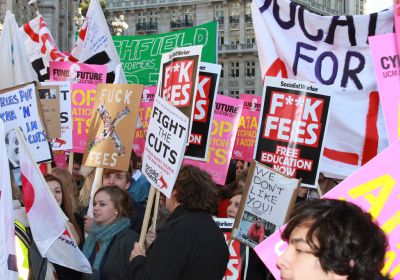 In what Sky News described as one of the largest demonstrations to hit London streets in decades, tens of thousands of students, teachers, staff members and their supporters rallied on November 10 in opposition to the new Conservative-led government’s plan for tuition increases and cutbacks at Britain’s colleges. Organised by the National Union of Students (NUS) and the University and College Union (UCU), the demonstration drew students from across the country for a march through central London, during which students occupied the Conservative Party headquarters.
 -
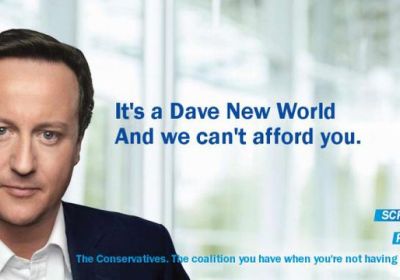 The Conservative Party, or Tories, has never really forgiven the British working class for demanding and winning the creation of the “welfare state”. Gains won included such things as free health care, council homes at affordable rents, and care for the elderly and vulnerable. From the Tories’ point of view, these are all things individuals should sort out for themselves. The modern state should provide the same level of social protection as was available to Queen Victoria’s subjects in the 19th century.
 -
 At least five Vodafone stores were closed in central London on October 30 by protests, TheGabber.org said that day. The protests were against the British government’s alleged decision to give companies, such as Vodafone, huge tax breaks of about £6 billion at a time when ordinary people are having their benefits cut or taken away.
 -
 British rail unions branded Transport for London (TfL) “barefaced liars" after its management attempted to claim minimum disruption during a 24-hour strike on November 3. London Underground services were crippled by strike action called by the National Union of Rail, Maritime and Transport Workers (RMT) and Transport Salaried Staffs' Association (TSSA) over safety-critical job cuts. All 11 of the London’s Tube lines were hit by the walkout. The action was the latest in a series of strikes over plans to axe up to 2000 jobs, including 800 station staff.
 -
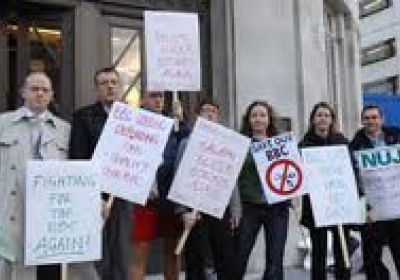 BBC services were severely disrupted after a 48-hour walkout on November 5 and 6 by thousands of media workers. MorningStarOnline.co.uk said on November 5 the workers were fighting the corporation’s “pensions robbery”, which would result in payouts being dramatically reduced. The corporation’s director general Mark Thompson claimed the National Union of Journalists (NUJ) strike had no impact, but viewers and listeners tuned into BBC radio and TV channels to find the flagship program off air.
 -
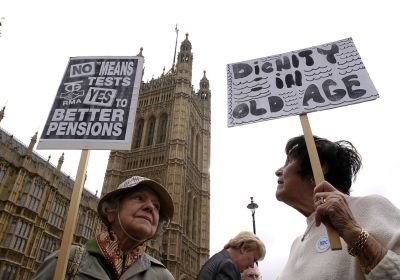 Thousands of pensioners descended on British parliament to reject the government’s pension cuts on October 27. Angry pensioners pledged to escalate the fight against the cuts by joining spirited protests up and down the land against the government’s public spending cuts. Nearly 1000 activists from the National Pensioners Convention (NPC) converged on Westminster to protest against vicious cuts in vital services and to demand a basic state pension of at least £171 a week.
 -
 Out-of-favour Manchester United star Wayne Rooney must look in the papers every morning and think: “How does [Liberal Democrat MP and business secretary in the Tory-Lib Dem coalition] Vince Cable get away with it? “Just like me, a year ago he was a national hero, the embodiment of hope, and now he’s a bumbling fool and revealed as a cheat. But he's allowed to carry on as he pleases and isn’t even substituted. “I want a transfer to the Liberal Democrats.”
 -
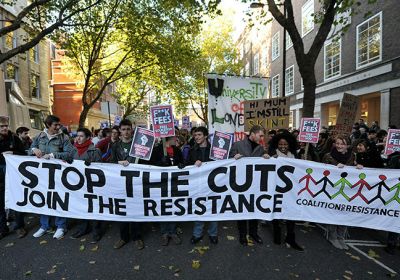
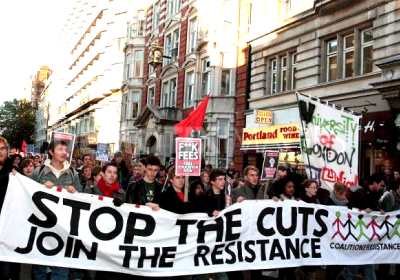 On October 20, thousands of students and workers marched on Downing Street in London to protest against the savage cuts in social spending announced by the Conservative-Liberal Democrat coalition government, Counterfire.org reported that day. The protest was organised by the Coalition of Resistance, Camden Trades Council and the People’s Charter. The cuts in public spending announced by British chancellor George Osborne that day amount to 81 billion pounds.
 -
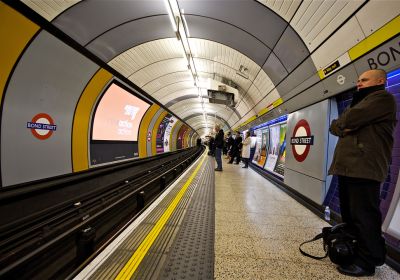 The marvellous part about a transport strike, such as the one on the London Underground on October 4, is the reports on the news afterwards. This is where we’re told: “One plucky commuter beat the strike by breaking into the Imperial War Museum and stealing a Spitfire, which he used to ferry grateful passengers who’d been left stranded by the union in a swamp with little hope of ever seeing their children again.
 -
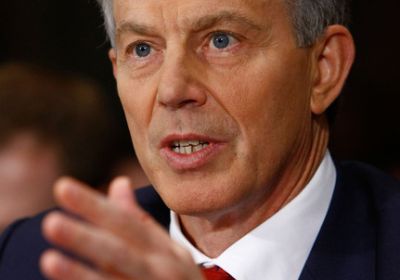 Secret documents disclosed in Britain’s High Court revealed former British prime minister Tony Blair was warned in the weeks after US forces began rounding up terrorism suspects that British nationals held by the US in Afghanistan and Guantanamo Bay were being tortured, the Guardian said on September 30. A January 22, 2002 note from Blair in which he expressed concern about the treatment of British citizens being held by the US appeared, among heavily censored MI5 and foreign office documents, in court hearings in which British citizens are suing the government, MI5 and MI6.
 -
 Britain is said to be approaching its Berlusconi Moment. That is to say, if Rupert Murdoch wins control of Sky, he will command half Britain’s television and newspaper market and threaten what is known as public service broadcasting. Although the alarm is ringing, it is unlikely that any government will stop him while his court is packed with politicians of all parties. The problem with this and other Murdoch scares is that, while one cannot doubt their gravity, they deflect from an unrecognised and more insidious threat to honest information.