
Ecuador withdrew its ambassador from Tel Aviv on July 18 in protest at Israel's offensive, which has already killed more than 700 Palestinians. Middle East Monitor reported that Ecuador's foreign minister Ricardo Patino said: “We condemn the Israeli military incursion into Palestinian territory, we require cessation of operations and indiscriminate attacks against civilians.”
-
-
Venezuela: Social programs expanded in poorest communities The Venezuelan government has initiated its policy of expanding social programs in the country’s most deprived areas in a bid to eradicate extreme poverty, Venezuelanalysis.com said on June 30. The initiative, called “Red Sundays”, involves teams of social program workers visiting poorer communities every Sunday to diagnose which households are deprived of certain basic needs and which social programs are required to attend to these needs.
-
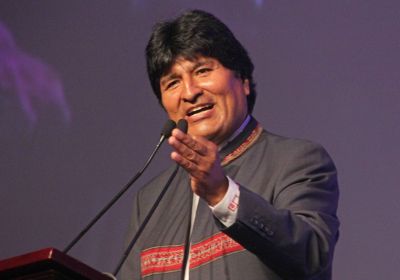 The Summit of the Group of 77 plus China, marking the alliance’s 50th anniversary, closed in Santa Cruz, Bolivia, on June 15 with the adoption of a declaration entitled “For a New World Order for Living Well”. There were delegates from 104 nations out of the 133 from the global South that now make up the Group of 77 plus China. Bolivia is chairing the alliance this year, and its president, Evo Morales, hosted the summit.
 -
 At the G77 plus China Summit held in Bolivia that ended on June 15, several Latin American presidents gave public backing to Venezuelan president Nicolas Maduro. They called for regional unity against an bid for “conservative restoration” under way in the South American country. The summit, held in Santa Cruz, eastern Bolivia, brought together 133 countries, about two-thirds of the member states of the United Nations.
 -
In a May 19 article on US government spying for The Intercept, Ryan Devereaux, Glenn Greenwald and Laura Poitras publish leaked documents that show the US government may have used the Drug Enforcement Administration (DEA) to aid National Security Agency (NSA) spying on US citizens and non-citizens in foreign countries. The leaked documents refer to “a vibrant two-way information sharing relationship” between the two intelligence agencies, implying that the DEA shares its information with the NSA to aid with non-drug-related spying.
-
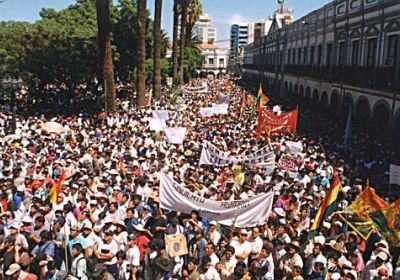 Bolivian indigenous group the National Council of Ayllus and Markas of Qullasuyu (CONAMAQ) made headlines this year with its threats to blockade the Dakar rally when it passed through Bolivia's highlands region. This was not the first time that the group caught the attention of the world’s media. Leaders of CONAMAQ have been regularly quoted in the media due to their outspoken criticism of the government of president Evo Morales ― Bolivia's first indigenous head of state. The articles frequently describe CONAMAQ as “the main indigenous organisation in Bolivia's highlands”.
 -
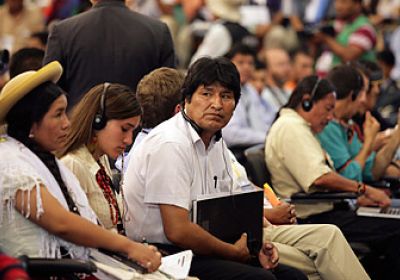 A recent spate of high-profile campaigns against industrial projects based on extracting raw materials has opened up an important new dynamic within the broad processes of change sweeping South America. Understanding their nature and significance is crucial to grasping the complexities involved in bringing about social change and how best to build solidarity with peoples’ struggles. Many of the campaigns target that specific mining, oil, agribusiness or logging ventures share common elements.
 -
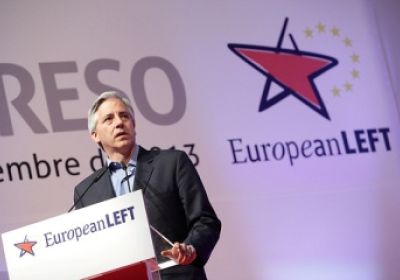
Bolivia's Vice-President Alvaro Garcia Linera, a veteran left activist and Marxist academic, spoke at the December 13-15 congress of the Party of the European Left (PEL).
-
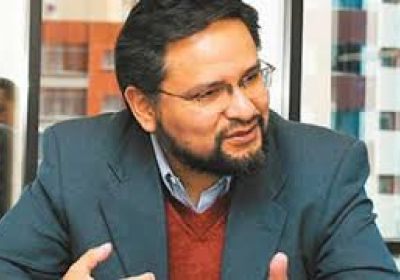 Five months ago, I was in Tarija in southern Bolivia taking part in a forum debating the political process in this country, a process we call the “democratic and cultural revolution”. A participant asked me whether it was possible to deepen this revolution, to make it an economic and social revolution, without the participation of the working class. My immediate response was no.
 -
Bolivia's President Evo Morales issued a government decree on October 7 that allows workers to establish “social enterprises” in businesses that are bankrupt, winding up, unjustifiably closed or abandoned. These enterprises, while private, will be operated by the workers and qualify for government assistance.
-
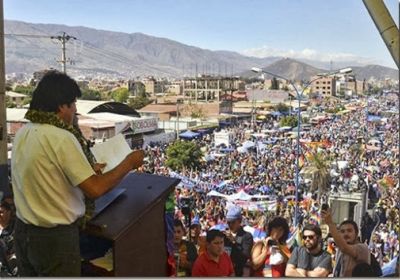 Washington’s refusal to allow Venezuela's President Nicolás Maduro to over-fly its colony of Puerto Rico on September 19 attracted little attention in the North American and European media. But in Latin America this arrogant gesture drew immediate outrage. It recalled the July 2 denial by four European countries — France, Italy, Spain and Portugal — of landing and refuelling rights and passage through their airspace to Bolivia’s president Evo Morales while he was returning home from a trip to Moscow.
 -
Bolivian President Evo Morales plans to file a lawsuit against the US government for crimes against humanity, RT.com reported on September 20. Morales criticised the US for its intimidation tactics and fear-mongering after a plane carrying Venezuelan President Nicolas Maduro was blocked from entering US airspace.