
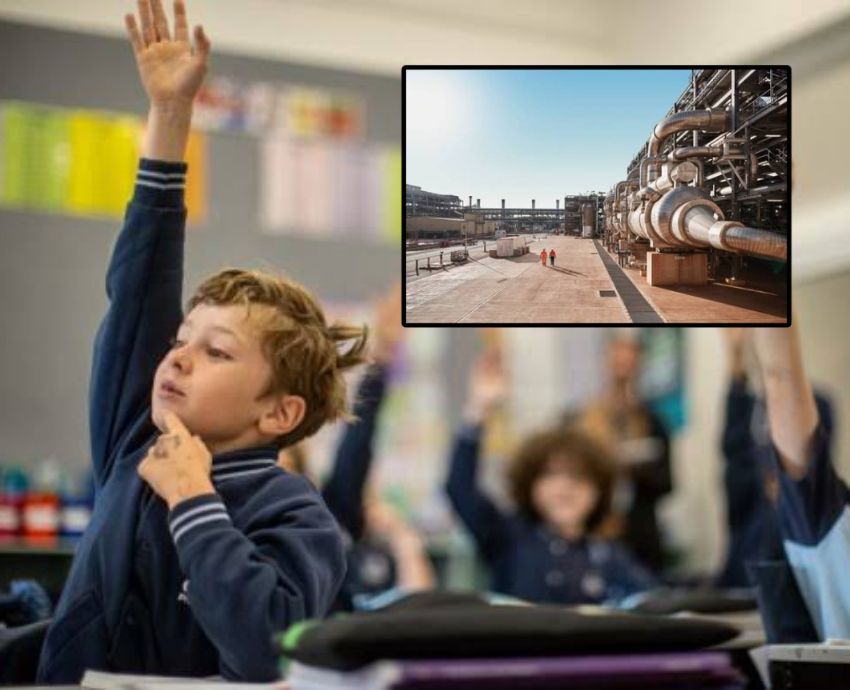
Fossil fuel companies are targeting young people in schools, early childhood centres, museums and community organisations to propagandise about the industry, downplaying its role in causing climate change, a new report reveals.
Comms Declare’s From Cradle to Career: Fossil Fuel Industry Presence in Australian Childhood Settings, released in June, is the first national investigation into the scale of fossil fuel industry engagement with children.
The report, based on publicly available information, found at least 260 fossil fuel industry-linked programs and partnerships across Australia. However, it notes that there would be many more programs, given that many sponsorship deals and educational “partnerships” provide little or no public information about the amount of funding, educational content, program reach or extent of industry involvement.
The report found that fossil fuel companies are spending more than $54.5 million across just six programs in schools, educational institutions and “child-centred initiatives”, including classroom resources, lesson plans, educational activities and career pathway programs.
Queensland gas company Shell QGC has provided more than $10 million to museum programs since 2015, which include children’s “educational” initiatives and classroom resources for teachers. But important topics, such as the role of carbon dioxide in ocean acidification, omit the crucial explanation of where carbon dioxide comes from — the burning of fossil fuels.
Its resources talked up the unproven carbon capture and storage (CCS) “solution” for mitigating climate change over the phase-out of fossil fuels. The now deleted Shell-branded educational activities on the Queensland Museum website included asking students to “design your own [CCS] technology”.
While CCS has been widely discredited, governments and companies continue to insist it does work, to justify continuing to expand fossil fuel production.
From Cradle to Career found that educational resources funded or provided by fossil fuel companies only contain a limited discussion of the contribution fossil fuels make to climate change. Instead, adaptation, false solutions and individual actions were strongly emphasised. This is the opposite approach to the popular high-school climate movement, sparked by the Black Summer bushfires, which popularised the need for systemic change to stop runaway global warming.
A Woodside-branded resource, titled “The Carbon Cycle and You”, seeks to blame everyone equally for the climate emergency. “While we often think that greenhouse gas emissions are only from industrial activities, we all contribute to the global carbon footprint.”
The materials then direct students to consider if they can change their mode of transport to get to school as their personal contribution to limiting global warming.
Together, these materials are a blatant attempt to obscure the fact that the production and burning fossil fuels are the primary drivers of climate change — in which Woodside plays a significant role.
Woodside’s North West Shelf gas extension, approved by the federal government last year, will generate an estimated 87.9 million tonnes of CO2-equivalent emissions annually for 40 years; it is the equivalent of driving 35 million petrol cars every year, or more than Australia’s entire agricultural emissions in 2024 (79.2 million tonnes).
Woodside’s STEM in Schools program in Western Australia involves sending volunteers to deliver classroom science activities promoting oil and gas exploration.
One activity involved primary school students pretending to be an “exploration company” and modelling oil drilling using bread slices, sprinkles and Vegemite.
The From Cradle to Career report also found a number of fossil fuel corporations fund organisations that provide professional development workshops for teachers. One example is Teacher Earth Science Education Programme (TESEP), a registered charity, that provides accredited teacher professional development but has publicly listed “partnerships” with Glencore Coal, Yancoal, Bengalla Mining Company and Energy Australia.
TESEP has produced materials titled “Greening Coal”, which promotes CCS and other dubious technologies and is reported to have trained thousands of teachers and reached, potentially, millions of students.
Fossil fuel companies are also spending millions on advertising and branding for sports and community organisations.
Woodside’s five-year naming rights deal in 2019, renewed in 2024, with Surf Life Saving Western Australia, means the long-running Nippers junior surf lifesaving program has been renamed “Woodside Nippers”.
The 7500 children who participate annually receive uniforms, caps and equipment with Woodside branding, effectively turning them into walking billboards for one of the world’s most destructive fossil fuel corporations.
Such an association with community sports is a bid to buy social licence for destructive projects. As the report points out, these companies are seeking the “normalisation of fossil fuel companies as trusted community partners and socially beneficial institutions”.
Santos explicitly requests that applicants for community funding from it must show how the funded activities will generate “awareness”, “positivity”, “goodwill” and reputational benefit for the company and the oil and gas industry as a whole.
From Cradle to Career explains that fossil fuel companies particularly target regions closely connected to extraction and processing, such as the Pilbara, Kimberley, Gladstone, Western Downs, Hunter, the Cooper Basin and parts of the Northern Territory.
Such revelations of corporate influence on “educational” materials targeted at young people are stark, but unsurprising given the high-school led movement to raise awareness about these corporations’ roles in denying the systemic nature of the climate change problem.
The under-funding of public schools also creates an opportunity for fossil fuel corporations to exploit.
There is overwhelming public support for governments to boost funding and educational resources to schools; the vast sums that state and federal governments spend on fossil fuel subsidies — a staggering $16.3 billion in 2025–26 — could be redirected to do this.
Greens Senator Steph Hodgins-May wants a parliamentary inquiry and said fossil fuel companies should be barred from classrooms.
“‘Get them young’ was Big Tobacco’s strategy, and it appears the fossil fuel industry has copied the playbook from cradle to career,” Hodgins-May said.
“Fossil fuel companies teaching children about climate change is like tobacco companies teaching health education or gambling companies teaching financial literacy.”
[Ben Radford is a pre-service secondary school teacher.]