
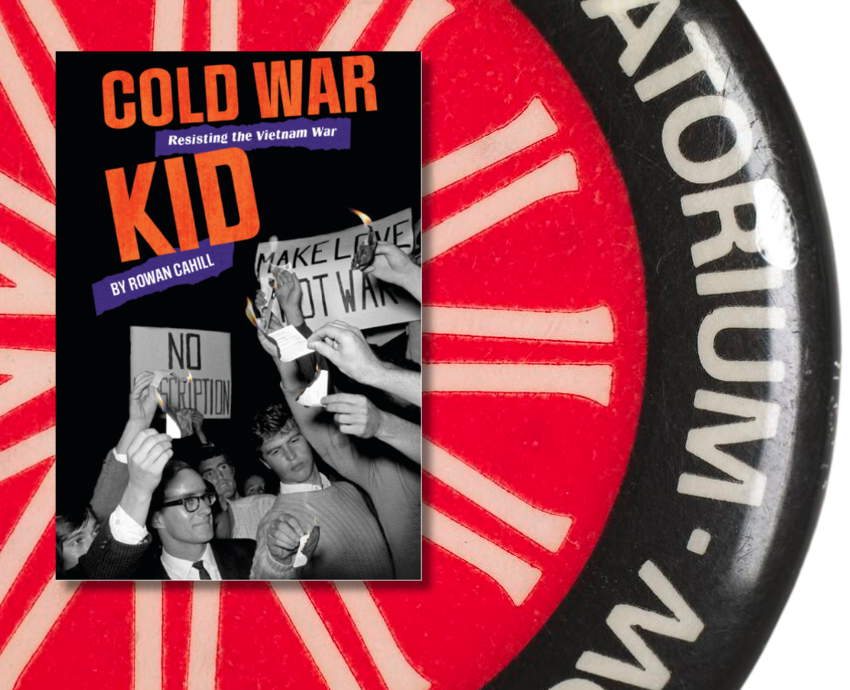
Cold War Kid: Resisting the Vietnam War
By Rowan Cahill
kemblabooks.com
2026
216pp
Cold War Kid: Resisting the Vietnam War is a lively and compelling account of a young man's journey from Sydney suburban larrikin to activist in the historic struggle against conscription and Australia's involvement in the Vietnam War.
At 20 years of age, author Rowan Cahill’s number was drawn in the conscription “death lottery” and he was drafted to fight in Vietnam. The choice he made — to take a stand against conscription and an unjust war — would shape the rest of his life.
The book, published by Wollongong-based Kembla Books, features a useful summary of Vietnam’s history — from the 19th century to the period of French colonisation, prior to the United States-led invasion of the early 1960s. It includes an insight into Ho Chi Minh’s crucial role in the development of the Viet Minh national liberation movement.
“Part One: 1945-1963” provides an account of Cahill’s childhood in then-bushy upper North Shore Sydney, including his outdoor life as a semi-rural kid of the time. Remarkably, his father was a conservative figure, who had even been involved during the 1930s in the semi-fascist New Guard movement, led by Eric Campbell.
“War and an imperial martial spirit were part of our childhood and youth,” Cahill writes. “It was difficult to leave childhood untouched by the idea that war was part of life, and that if called to arms, the individual had duties of compliance and, if needs be, of sacrifice; indeed that this is what being 'Australian' was all about.”
School was imbedded with militarism, from school assemblies to later high school cadet corps. “I entered adolescence believing that with the Gallipoli campaign, Anzac Day was rooted in a military victory.”
This illusion was later shattered by research for a school assignment revealing that “Anzac Day was built on a tragic military blunder”, masterminded by the then First Lord of the Admiralty, Winston Churchill, for political reasons. “The Gallipoli feat of arms was a defeat and a slaughter resulting in some 8700 Australian dead.”
There was no turning back for Cahill from there, in his journey to opposing the Vietnam War and conscription, and his broader radicalisation. “I left school itching to engage with the world in a critical way,” he writes. “I was a rebel-in-waiting, hearing the sound of a different drummer.”
In “Part Two: 1964–1968”, Cahill explains that “Sydney University in the 1960s was largely unprepared for the post-war baby boom that filled its lecture theatres. It was authoritarian in structure and hidebound by tradition. Students were there to be passive recipients of their education.”
At the same time, the US had escalated its invasion of Vietnam, and Australia under Liberal Prime Minister Robert Menzies had immediately joined in. The re-introduction of conscription soon followed.
During 1965, the first year of the National Service Act's implementation, “my birthday marble was drawn in the Blood Lottery — the only lottery I've ever won,” Cahill writes.
Over the next few years, “in a nutshell, I made oppositional decisions in response, destroyed my call-up papers in 1966, took advantage of student deferment, completed undergraduate studies, and refused three times to report for mandatory medical examinations in 1967 and 1968.
Threatened with imprisonment, Cahill registered as a Conscientious Objector. He “numerously fronted courts, and was eventually accorded CO status in 1969".
Cahill deals with the “long and often painful” evolution of his personal anti-Vietnam War and conscription experience over much of the rest of the book.
In 1966, Cahill began writing for the University of Sydney student newspaper Honi Soit, in collaboration with its editor Hall Greenland. He also wrote for the Communist Party of Australia’s publication, Tribune. Cahill then became Director of Student Publications at the University.
He writes that “campus activism against Australia's involvement in the Vietnam War and against conscription began moderately with lectures, teach-ins, leaflets, pamphlets and the like, attempting to proselytise for opposition views in a largely complacent and hostile environment.
“Emotionally and politically there was a vast difference between that experience and the huge front lawn meetings of students and staff, of the three national Moratoriums in 1970 and 1971 then decamping and sweeping out in the vanguard via the university's iconic Front Gates onto Parramatta Road, a sea of placards and banners, stopping traffic, beginning the long march to rallies downtown, where we'd merge with the many more thousands of fellow citizens, becoming part of some the largest protest assemblages in Australian history at the time.”
Cahill also describes his leading role in the so-called “Mini Affair”, when he initiated a student blockade of a police car — a Morris Mini Minor — that was being used to spy on a campus protest meeting. The rebellious students carried the car off campus and into Parramatta Road, with Cahill riding triumphantly on top of the vehicle.
This and other such incidents led to Cahill being targeted by police and the Australian Security Intelligence Organisation (ASIO) over his political activism. He then entered a long battle with the law over his refusal to attend national service medicals, and eventually his application as a conscientious objector.
In “Part Three: Evolutions and Spooks”, Cahill expands on his personal and political battle against conscription, as he became more involved in the growing anti-war and anti-conscription movement on campus, and various public meetings of activists.
In the early days, he writes that he was “outraged and repulsed by the organised violence with which these meetings were broken up by pro-government forces; heckling, speakers pelted with fruit, punch-ups.” But the anti-war movement gradually became stronger and broader, on and off campus.
Cahill details the convoluted court procedures involved in claiming CO status, on the grounds of opposition to all wars, and also to the Vietnam War in particular.
In "Part Four: 1969", Cahill outlines his increasing involvement with the New Left movement on campus and outside — particularly the CPA and its theoretical publication New Left Review. He also commenced studies at Teachers’ College for a Diploma of Education.
In “Part Five: 1970-72”, Cahill takes a job with the Seamen’s Union to write a history of the maritime industry, which was a "life changing experience".
Through this and other work in the Communist and left movement, Cahill drew the conclusion that “in order to build a mass and effective movement with the power to change history, one had to work with many political tendencies, factions and organisations, with people from all walks of life and across divides of class and gender.”
He writes: “Since 1965, when I was conscripted I had become prominent in the anti-conscription and anti-Vietnam War movements, had numerously disobeyed orders to report for Army medical examinations, had courted imprisonment, had nearly been kicked out of university for my campus radicalism, had been before a Magistrate and a District Judge in my successful pursuit of recognition as a CO, had run up a rap sheet of convictions under various State and Commonwealth laws courtesy of my dissident activities, and had developed a leftism that was New Left in some respects but also sought to build bridges with the trade union movement and the old Communist left.”
In his “Epilogue: Ruminations”, Cahill concludes that “history is full of surprises” and “[t]he present and the future are all works in progress”.
Cold War Kid is full of surprises and lively accounts of the personal challenges and achievements of a 1960s’ veteran — during a period that changed the world and revived the movement to fundamentally transform it into a better one.