
When
Where
Parliament House
Federation Mall
Capital Hill ACT 2600
Australia
Why
MISOGYNY. MISOGYNY. MISOGYNY.
When governments cut disability support and call it reform, disabled people and women pay first.
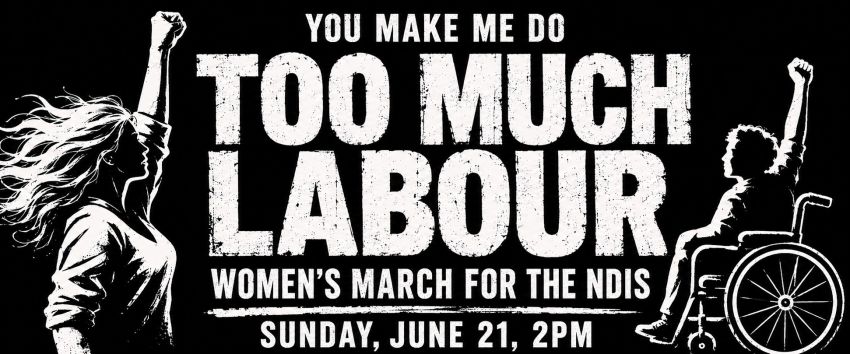
This national mobilisation is led by The Australian Neurodivergent Parents Association and Disabled women.
We do not see disability as a burden.
We see support as a right.
In June, The Australian Senate will debate the 2026 draft NDIS bill and the reform package.
The bill and rules strengthen the role of “family” and “informal supports” in funding decisions. The legal foundation is NDIS Act s 34(1)(e), which asks what it is reasonable to expect families, carers, and communities to provide.
The accompanying draft child rules treat ordinary parental care as the baseline for children under 18.
This includes:
- supervision and monitoring
- personal care and daily living activities
- emotional support
- behaviour support and management
- transport to school, appointments, and activities
- general day to day care expected of a parent
NDIS support is then framed as needs beyond what a parent is “normally” expected to provide.
In practice, this shifts more disability-related care onto women.
Mothers. Grandmothers. Sisters. Aunties.
It also puts pressure on the heavily female disability workforce. Allied health professionals, support workers, support coordinators, and small providers whose jobs depend on funded support.
The July NDIS price cuts are hitting this workforce, and jobs for women are under attack.
Women-led and mother-led allied health businesses are being squeezed by pricing that does not match inflation or the real cost of delivering services. And now, support work is on the chopping block, with Mark Butler announcing a 30 percent cut to support work - which early estimates say could slash over 250,000 jobs from the NDIS.
Mostly, held by women.
These are flexible jobs we have have relied on to balance paid work with caregiving. Jobs that made independence possible, in our local communities. Jobs that reduced reliance on partners and Centrelink. Jobs that helped us leave violence; build savings; and build our lives.
When these jobs go, women are pushed back into unpaid care, financial insecurity, and dependence.
And for many Disabled women, losing support also means losing independence, employment, parenting stability, economic security and safety.
The NDIS Bill 2026 is not gender-neutral policy.
This is the transfer of labour, cost, and risk onto women.
This mobilisation is grounded in international human rights law.
The Convention on the Elimination of All Forms of Discrimination Against Women (CEDAW) protects women’s right to equality, economic participation, and freedom from discrimination and violence.
The Convention on the Rights of Persons with Disabilities (CRPD) protects the right of Disabled people to live independently, participate in society, and access the supports required to do so.
These rights are not separate.
They are woven together.
You cannot achieve gender equality while withdrawing disability support; and you cannot uphold disability rights while relying on unpaid labour from women.
Our organising principles
1. Equal Rights Require Real Support
Rights mean nothing without the support needed to live, work, parent, and participate.
2. You Can’t Build Equality on Unpaid Care
Gender equality collapses when systems rely on women to absorb unpaid labour.
3. Support Is Safety. Independence Is a Right
Without funded, individualised support that is attached to review rights, women and Disabled people lose safety, autonomy, choice and control. We lose the right to self-determine and shape our own fates.
4. Our Fates Are Woven Together
Cuts to support harm Disabled people, women, workers, and families together.
Our demands
1. Remove the expansion of parental responsibility from the Bill
Women are not a free labour force. Most carers are women, and cost shifting onto families is cost shifting onto women.
2. Fix allied health pricing
Index NDIS pricing to inflation and cost of living. Women workers deserve to make ends meet.
3. Protect support work in the NDIS
Support workers are the backbone of the NDIS and most are women. No cuts to community and social participation.
4. Stop the cuts
Without support, Disabled women cannot work, are not safe, and are excluded.
5. Protect individualised early intervention in legislation
Cuts to early intervention hit women and girls first and worst.
6. No FCAs or SNAs; no automation in the NDIS
Standardised assessment tools are shown to fail to recognise and respond to Disabled women and girls, especially those with complex, dynamic or masked Disability presentations. Automation will spread this bias through the whole system. We won't stand a chance.
7. Protect women’s economic capacity, participation and security
Cuts to support push women out of work and into unpaid care, poverty, and dependence. Women lose income, superannuation, and independence.
Who should come?
- Everyone!
- Disabled women
- Women carers
- Mothers, grandmothers, aunties, sisters
- Allied health workers
- Support workers
- Support coordinators
- Women in the care economy
- Families and allies
If your labour, livelihood, family, or safety is being treated as expendable, this is your fight.
Women are tired. We stand with each other, we stand with Disabled people, and we are standing to fight this misogynist law.
You make us do too much labour, Albo. We won't let you make us do more.
For updates check the Facebook event.
Contact
Australian Neurodivergent Parents Association - ANPA
[email protected]
thisisanpa.org
Facebook · Instagram · Patreon