
When Zohran Mamdani was elected as New York City’s first South Asian mayor, one might have expected celebrations across the Indian diaspora, given his strong roots within the community.
Yet, some within the diaspora were plainly furious with Mamdani, ostensibly for his critique of Indian Prime Minister Narendra Modi. They branded Mamdani as anti-Hindu and joined with Zionists in attacking him.
The diaspora’s response to Mamdani, however, reveals deeper fractures, particularly as Hindu nationalism has sought to control it.
The Indian diaspora in the West is globally celebrated for its professional success and often cast as the “model minority”. Yet, a significant segment of this community has, paradoxically, become a pillar of support for right-wing, often xenophobic, movements in India and abroad.
This right-wing shift, primarily driven by the ideology of Hindutva (Hindu nationalism), is not the natural trajectory of a successful immigrant group but rather an ideological project that has sought to dismantle the diaspora’s original deeply progressive and anti-colonial political underpinnings.
Today, that decades-long project is entering a structural crisis. The opportunistic alliances forged by Hindu nationalists are collapsing under the weight of a resurgent Western nativism, leaving the diaspora vulnerable to the very racism and economic exploitation they believed their “model” status and right-wing connections would protect them from.
Radical legacies
Indian migration has occurred in waves, each marked by a distinct economic, social and political character. To understand the engineered shift to the right, we must first recall the radical legacy of the earliest migrants.
The earliest migrants from India were largely indentured workers and farm labourers transported across the British empire and the anglophone world. More than 1.6 million were transported to the Caribbean, Fiji, Mauritius, South Africa and East Africa — under this brutal system.
Others migrated to the North American Pacific Coast, especially in the late 19th and early 20th century and came up against the racialised order of the United States and Canada, which preferred immigrants who could be seamlessly integrated into the fold of whiteness.
Living under conditions of extreme exploitation and daily racism, this earliest diasporic group developed a revolutionary political consciousness. They instinctively recognised the connected nature of racism, exploitation and colonialism.
The Ghadar Movement that emerged from the experiences of these struggles maintained an explicitly left-wing program, joined other anti-colonial movements and expressed solidarity with oppressed people. As Maia Ramnath points out in Haj to Utopia, this broad left orientation included building alliances and drawing ideologically from anarcho-syndicalists, Irish republicans, communists and Egyptian nationalists.
This anti-colonial transnational orientation was a problem for the Hindu nationalists, especially the right-wing, paramilitary, pro-colonial Rashtriya Swayamsevak Sangh (RSS), which sought to organise the diaspora along its own ideological lines.
The formation of the Hindu Swayamsevak Sangh, Vishwa Hindu Parishad (VHP) and other Hindu nationalist organisations aimed to reorient the diaspora abroad. The VHP was established in 1964 and was particularly effective in promulgating its politics and exerting control over diasporic institutions.
Class character
The class character of the Indian diaspora also started to change in the 1960s, driven by critical shifts in the immigration policies of major Western nations. This era saw the dismantling of national-origin quotas in favour of criteria that prioritised education, specialised skills and professional qualifications.
Key legislation included the US’ Immigration and Nationality Act of 1965, which opened entry to Asian immigrants by focusing on family and employment preferences; Britain’s Commonwealth Immigrants Act of 1962, which replaced the right of entry with a selective voucher system prioritising skilled workers; and Canada’s 1967 adoption of the “points system” that formally selected immigrants based on meritocratic factors like education and training.
These policies resulted in a demographic shift from the earlier waves of indentured or farm labourers to highly educated, white-collar migrants — a phenomenon often lamented in India as “brain drain”. This new population segment quickly came to be framed as the “model minority” in their host countries, a myth that fostered a sense of conditional exceptionalism and laid the groundwork for a class-based political reorientation away from solidarity with the working poor and toward communal, Hindu nationalist movements.
Rather than allying with other racialised or marginalised groups in the West, the right-wing diaspora pursued an opportunistic alliance with the political right in their host countries. This alliance was built on three pillars: shared social conservatism; economic alignment with white-collar workers with a pro-business orientation; and in the post 9/11 landscape, shared discourses of Islamophobia.
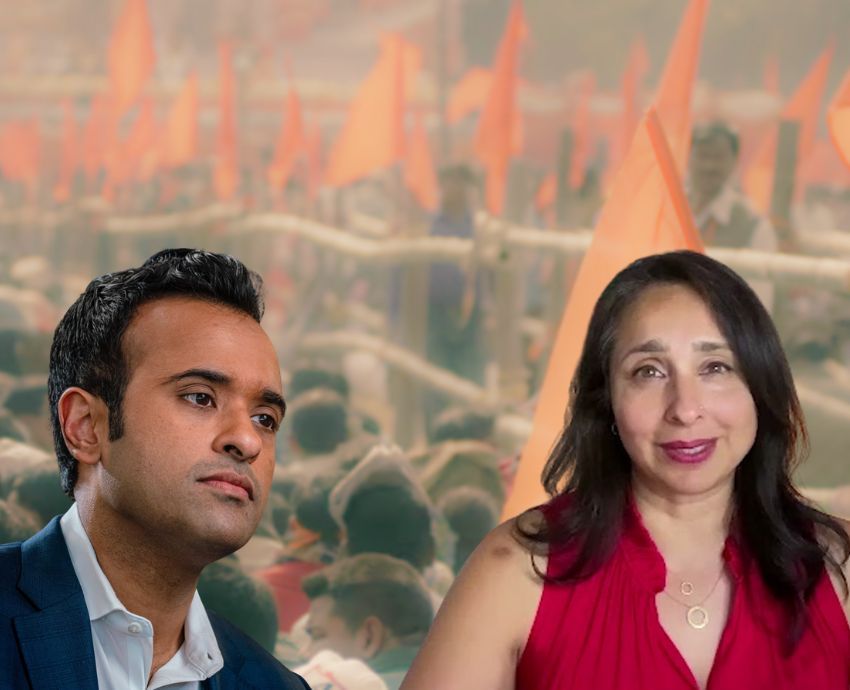
This doesn’t mean that the diaspora had completely turned to the right wing. In fact, the centring of Christian nationalism by the Republicans in the US meant that the largely Hindu Indian diaspora would broadly remain aligned with the Democratic Party. However, the Hindu nationalists who have managed to capture diasporic institutions over the decades have been far more receptive to right-wing overtures. Suhag Shukla, co-founder of the Hindu American Foundation, exemplifies this when she blames immigration backlogs of South Asian immigrants on “illegals”.
Structural crisis
Driven by India’s deepening unemployment crisis, millions of young people now seek opportunities abroad through far more precarious pathways. Many use student visas as a viable immigration route. Unlike earlier immigrants, these migrants often take out extensive loans to join these programs, making their immigration a major financial investment that they must recuperate as soon as possible.
Countries like Australia, Canada and Britain have turned higher education into a lucrative immigration pipeline, extracting exorbitant tuition fees while depending on migrant labour to keep their service economies afloat. These young migrants arrive not as “model minorities” but as indebted workers entering societies already buckling under housing shortages, wage stagnation and rising xenophobia.
As far-right narratives gain mainstream traction, Indian migrants — especially the newest and most precarious — find themselves scapegoated for economic failures they had no role in creating. The Hindu nationalist organisations that long projected an image of prosperous, upwardly mobile Indians abroad have no framework to explain the wage theft raids, deportations, racist attacks and visa clampdowns now facing the community.
US President Donald Trump came into his second term promising mass deportations, which Hindu nationalists sought to explain away as targeted towards the less desirable immigrants. However, by late last year, factions of the conservative movement began framing Indian tech workers as job thieves, weaponising recession anxieties and openly calling for mass reductions in skilled migration. Others, such as Elon Musk, defended the country’s skilled visa (H1B program) as essential for US technology and immigration.
Some — such as biotech entrepreneur and Republican politician Vivek Ramaswamy — have sought to appeal again to the “model minority” myth, unable to grasp the significance of this collapse.
Ramaswamy attempted to frame the need for skilled immigrants around a US culture that “venerated mediocrity”. However, the conservative Republican base he was appealing to did not appreciate being called culturally inferior, even when couched in reactionary talking points, and Ramaswamy was booted from the Trump administration on inauguration day.
The fragility of the diaspora’s right-wing strategy was made even clearer in the controversy surrounding Usha Vance, the Indian-US wife of US Vice President JD Vance — when he said publicly that he “hoped” she would eventually convert to his Christian faith. The Hindu nationalist diaspora that had long invested in proximity to white conservative power received such discourse poorly.
In Australia too, in the face of growing xenophobia, exemplified by the “March for Australia” rallies, organisations such as the Hindu Council of Australia have doubled down on Islamophobic rhetoric.
Reimaging resistance
The diaspora’s rightward shift was never the outcome of innate characteristics — though caste and class privilege did play a role in positioning its members on the social ladder. Organisations linked to the RSS have strategically influenced policy and lobbied the major parties to position themselves as leaders of the Hindu community and the Indian diaspora. Their gatekeeping of community representation has meant that political representatives only engage with the reactionary leadership rather than the diverse community as a whole.
The fantasy of the model minority, the pride manufactured through Modi’s global charisma and the belief that proximity to white conservatism could secure belonging, have all collided with the harsh reality of economic precarity, surging xenophobia and the collapse of the very political coalitions the Hindu right spent years cultivating.
The way forward lies not in doubling down on majoritarian identity, but in reclaiming the radical, solidaristic tradition of earlier migrants.
[Aishik Saha is a researcher and activist with the Communist Party of India (Marxist-Leninist) Liberation.]