
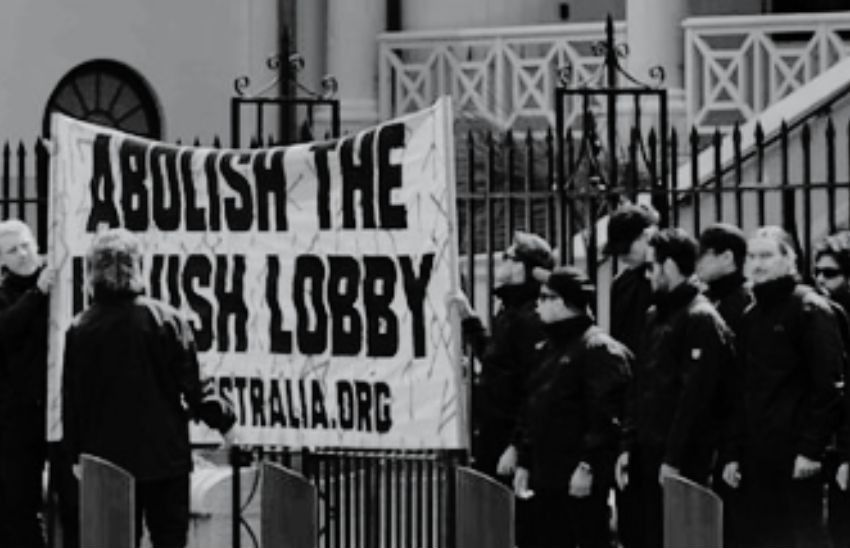
New South Wales Labor has introduced laws it claims are necessary after the neo-Nazi rally outside parliament on November 8. But many are questioning why NSW Police authorised the National Socialist Network (NSN) protest.
The Crimes and Summary Offences Amendment Bill 2025, introduced on November 19, overhauls the 2022 offence of displaying Nazi symbols, which makes such conduct illegal.
It also includes some legislative gymnastics that will allow police to shut down displays that could be Nazi-related. The new indictable offences will also be handled by the NSW Lower Court.
The bill also amends the Form 1 process; it clarifies that the provision providing protesters with immunity to summary offences related to the obstruction of roads is not extended to hate crime laws.
NSW passed the offence of displaying Nazi symbols in August 2022. This law was introduced two months prior to Victoria passing similar laws banning Nazi insignia, after the NSN had gathered in the Victorian Grampians.
Many have asked why NSW Police made no attempt to stop the neo-Nazis after having received a detailed Form 1 in which they stated their purpose was to protest the “Jewish Lobby”. (They are now trying to register with the NSW Electoral Commission as the White Australia Party.)
Section 93ZA offence
NSW Attorney General Michael Daley said in his second reading speech on the bill that the “abhorrent conduct” at the NSN demonstration “highlighted the need to give police and courts greater powers to hold extremists who publicly express Nazi ideology to account”. He said the 60-odd black-clad Nazis bearing anti-Jewish messaging were “absolutely unacceptable”.
A new version of the offence of displaying Nazi symbols will be inserted into section 93ZA of the Crimes Act 1900, replacing the original offence of displaying Nazi symbols.
New subsection 93ZA(1) contains the aggravated form of the offence, which applies to a person who “knowingly displays a Nazi symbol, by public act and without reasonable excuse” and is considered to be more serious if it is “on or near a Jewish place”.
If this bill becomes law, an individual can face two years’ prison time and/or a fine of $22,000, while a corporation will be subject to a $110,000 fine.
Subsection 93ZA(2) contains the regular display Nazi symbols offence, which is not on or near a Jewish place — or “a synagogue, a Jewish school or the Sydney Jewish Museum” — and individuals would face up to 12 months imprisonment and/or an $11,000 fine, while a corporation could be fined $55,000.
A public act is defined as any conduct or dissemination of information relating to the promotion of Nazism in public.
The new aggravated offence of knowingly engaging in Nazi conduct by invoking imagery or characteristics in public without a reasonable excuse and on or near a Jewish place, sits under new subsection 93ZA(3). It carries two years in prison and/or a fine of $22,000 for convicted individuals, while a corporation that falls foul of this law can be fined up to $110,000.
Subsection 93ZA(4) relates to Nazi conduct in public that is not on or near a Jewish place of worship. Convicted individuals face up to 12 months imprisonment and/or a fine of $11,000, while corporations face fines of $55,000.
Daley said the new Nazi conduct offence includes knowingly engaging in conduct in public without a reasonable excuse; and indicating support “for Nazi ideology by invoking imagery” that would likely cause a reasonable person to “fear harassment, intimidation or violence” or fear for their safety.
Further, subsection 93ZA(8) allows police to direct a person displaying a “suspected Nazi symbol” to remove it, and subsection 93ZA(9) specifies that such an order can be “given orally or in writing”. It must specify the period for which the order applies and the order may also be withdrawn.
Subsection 93ZA(10) says if a person fails to comply with a direction to remove a suspected Nazi symbol from display, they can be imprisoned for three months and/or fined $2200.
Subsection 93ZA(11) confirms that the power to move people on, contained in part 14 of the Law Enforcement (Powers and Responsibilities) Act 2002 (NSW), has no bearing on the bill.
New amendments
The bill inserts the overhauled 93ZA offence into table 2, part 2A, clause 4F of schedule 1 of the Criminal Procedure Act 1986. This means the new section 93ZA offence, if passed, would be considered a table 2 offence, which is a less serious indictable offence under the jurisdiction of local courts.
Another amendment lists the offence in section 268 of the Criminal Procedure Act, so that the NSW Local Court is permitted to impose penalties that are higher than the usual (usually capped at two years’ prison or an $11,000 fine).
Daley said that as the new Nazi-related offences, under section 93ZA, are more serious crimes police would be able to require a person suspected of “displaying a Nazi symbol” to provide their identity — or name and address — under the power contained in section 11 of the Law Enforcement (Powers and Responsibilities) Act. “Knowing the identity of the individual is essential for further investigation or later action if an offence is confirmed,” he said.
The final amendment is to section 24 of the Summary Offences Act 1988, which contains a clause that provides immunity to those taking part in an authorised protest. The proposed new subsection confirms that protesters who display Nazi symbols or incite hatred based on race are still in breach of the law.
The Crimes and Summary Offences Amendment Bill 2025 is being scrutinised by the Legislative Assembly Committee on Law and Safety via the Measures to Combat Right-Wing Extremism in New South Wales inquiry. Submissions close on February 6 next year, and the final report is due next April.
The NSN had presented police with a detailed four-page Form 1 notification, on October 27, nearly a fortnight before its planned demonstration.
NSW deputy police commissioner Peter Thurtell is believed to have considered it a week before the protest. He did nothing about it, including neglecting to inform new police commissioner Mal Lanyon that the protest had been authorised.
The NSN stated it was protesting new laws against hate crimes and called for abolition of the “Jewish Lobby”, which it defines as both Zionist and non-Zionist Jewish groups. This is clearly antisemitic, but it was allowed to proceed despite NSW Labor being embroiled in an antisemitic moral panic for at least 12 months.
The question that remains is why police have taken various protest groups — including climate defenders, Black Lives Matter and Palestine Action Group — to court in recent years to prevent their actions from going ahead, yet a Nazi promotion of antisemitic and white supremacist ideologies was authorised to go ahead.
[Paul Gregoire writes for Sydney Criminal Lawyers, where this article was first published.]