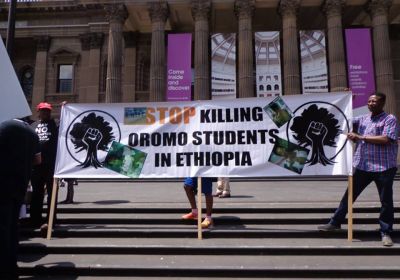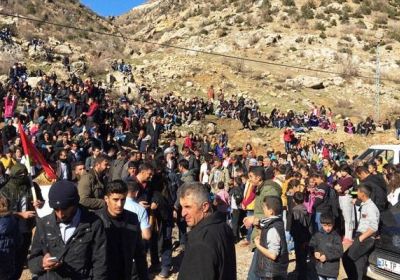
45 people gathered in Perth on July 24 to express solidarity with a group of young people who were victims of an Islamic State suicide bombing in the Kurdish town of Suruç on July 20.
-
45 people gathered in Perth on July 24 to express solidarity with a group of young people who were victims of an Islamic State suicide bombing in the Kurdish town of Suruç on July 20.
-
Loyalists rioted on July 13 in north Belfast, Irish Republican News said. The loyalists — largely anti-Catholic supporters of Britain's ongoing rule over the six counties in Ireland's north — drove a vehicle into residents in the predominantly Catholic and Irish nationalist Ardoyne area, seriously injuring a teenage girl. -
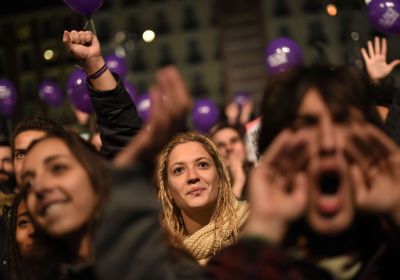
Thousands of people protested on July 15 across Europe – and in cities around the world – in solidarity with Greece's struggle against austerity. The next day, Marina Prentoulis, spokesperson for Syriza in Britain, told TeleSUR that what was needed was a “pan-European movement” capable of confronting the power of European capital and the neoliberal agenda of European leaders. -
More than 60 lawmakers from Germany’s Die Linke (The Left) party voted against the proposal for further austerity for Greece on July 17. They accused the German government of “destroying Europe” by forcing Greece to accept hard-hitting austerity measures required by the eurozone for a third bailout deal. -
New strikes have hit Greece as anger flares over the latest deal pushed onto Greece by the Troika of European Commission, European Central Bank and International Monetary Fund. Thousands of public sector workers from the ADEDY union took to the streets on July 15 as part of a general strike calling for the rejection of a raft of new austerity measures being put to the parliament by Prime Minister Alexis Tsipras. -
The Greek Parliament voted in the early hours of July 16 to back the deal agreed to by Prime Minister Alexis Tsipras on the tough economic measures demanded by Greece's creditors. The vote came despite street protests and strikes -- and in the face of a statement released the day before by the governing SYRIZA party's central committee against the deal. -
Leading British campaigners against global debt have slammed the creditors over a deal reached between the European Union countries and Greece, likening the deal to the imperial politics of the 19th century. The debt campaigners also drew parallels with the way debt was used to control Latin American nations in the 1980s. -
One month after Turkey’s June 7 parliamentary elections, the country still does not have a government. Ahmet Davutoglu of the Justice and Development Party (AKP) remains caretaker prime minister. President Recep Tayyip Erdogan remains the dominant figure in the AKP and is manoeuvring to retain his party’s leading position. The president is supposed to be an impartial figure above party politics but Erdogan pays scant regard to such constitutional niceties. The elections were marked by two significant and related developments. -
Regardless of the result of the latest round of negotiations between the SYRIZA-led government of Greece and the heads of the 28 members of the European Union, one thing is certain: in coming years, the Greek people are going to need all possible solidarity because their struggles and sufferings are bound to continue. The best imaginable deal with the EU will mean six years of Troika-imposed austerity grinding along to one degree or another. Forced Greek exit from the eurozone will drive the country deeper into recession, further contracting an economy that has shrunk by 25% since 2008. -
Gaza, July 2014.
Israel plans to shut down Palestinian TV station
Israel plans to shut down a new Arabic-language television station that services Palestinian citizens of Israel, Electronic Intifada said on June 25. -
Regional elections held in Spain on May 24 installed an historic pro-Basque state government in the Basque autonomous community of Navarre for the first time. It ended 16 years of rule by the pro-Spanish, centre-right Navarrese People's Union (UPN). The UPN won only 15 seats, down four from 2011. Its ally, the right-wing Spanish People’s Party (of Spanish Prime Minister Mariano Rajoy), won two, half of its quota in 2011. -
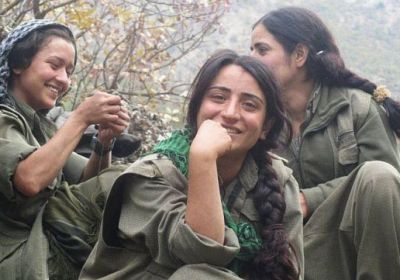
A delegation of six elections monitors sponsored by the Peace in Kurdistan Campaign to observe the June 7 Turkish election witnessed a stunning result took the left-wing Kurdish-based Peoples Democratic Party (HDP) into parliament for the first time.